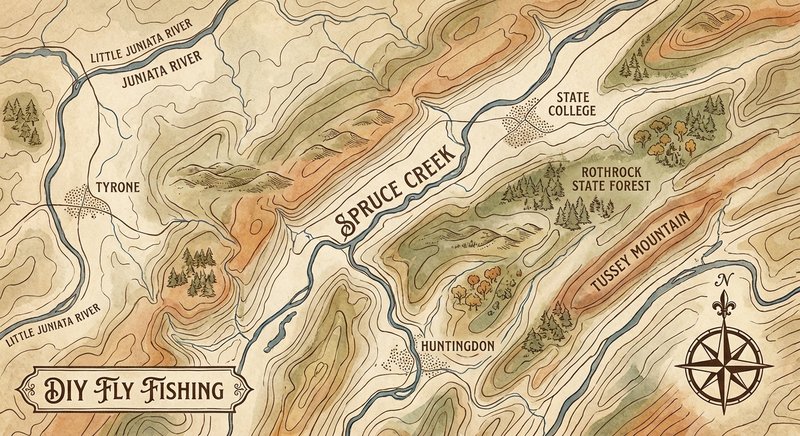
Spruce Creek
Fly fishing in Pennsylvania · Advanced · Best seasons: Spring, Summer, Fall
Target Species
Brown Trout
About This Water
Famous Huntingdon County limestone stream. Trophy brown trout in private and public sections.
Fishing Recommendations
Fly Fishing Guide: Spruce Creek, Pennsylvania
Spruce Creek is arguably the most storied and legendary limestone spring creek in the United States. Located in Huntingdon County, this "Stream of Presidents" has hosted everyone from Dwight D. Eisenhower to Jimmy Carter. It is a quintessential Pennsylvania spring creek: cold, fertile, and teeming with exceptionally large, educated trout.
🎣 Location Overview
Spruce Creek is a major tributary to the Little Juniata River. What makes it special is its karst limestone geology. Cold, mineral-rich groundwater bubbles up from the earth, maintaining a consistent temperature (around 50-55°F) year-round.
The water is remarkably fertile, supporting a massive biomass of crustaceans (scuds and sowbugs) and aquatic insects. The creek features classic spring creek characteristics: long, glassy pools, subtle riffles, and thick beds of elodea and watercress. Because most of the creek is privately managed or owned by fly fishing clubs, the fish are allowed to grow to trophy proportions, but they are also some of the most "technical" fish you will ever encounter.
🐟 Target Species & Behavior
The primary draw here is the Brown Trout. While there are some rainbows (mostly stocked), the wild and "wild-acting" browns are the stars.
- Size: Fish in the 18–24 inch range are common, with legitimate 10lb+ monsters lurking in the deep undercut banks.
- Behavior: These fish are highly wary. In the clear, slow-moving water, they have plenty of time to inspect your fly. They often hold tight to the "ledges" and deep undercut limestone banks during the day, moving into the shallower tail-outs of pools to feed during low light or during a heavy hatch.
- Feeding: They are opportunistic but selective. They thrive on a diet of scuds, sowbugs, and caddis larvae, but they become hyper-focused on specific life stages during major hatches (like the Sulphurs).
📅 Best Times to Fish
Spruce Creek is a year-round fishery due to the stable water temperatures, but three seasons stand out:
- Spring (Mid-April to June): The Prime Window. This is when the legendary hatches occur. The water levels are usually perfect, and the fish are most active.
- Summer (July to August): While other PA freestone streams get too warm, Spruce remains cold. This is Terrestrial Season. High-sun days are great for hopper-dropper rigs along the grassy banks.
- Fall (September to November): The brown trout become aggressive as they prepare for the spawn. This is the best time to throw streamers or small BWO (Blue Winged Olive) patterns.
- Best Time of Day: During the spring hatches, the "magic hour" is dusk. In the heat of summer, early mornings and late evenings are best. On overcast days, the fish feel more secure and may feed in the open all day.
🪰 Recommended Flies & Techniques
Top Fly Patterns
- Nymphs:
- The Spruce Creek Special: A local pheasant tail variant with a bit of flash.
- Scuds & Sowbugs (Sizes 14-18): Pink, gray, or olive. These are the "bread and butter."
- Walt’s Worm: Simple and deadly in the riffles.
- Dry Flies:
- Sulphurs (Sizes 14-18): The most famous hatch on the creek (May/June).
- Trico (Sizes 22-24): For the technical angler in late summer mornings.
- Ants and Beetles: Essential for summer fishing under overhanging branches.
- Streamers:
- Black or Olive Wooly Buggers: Fish these deep and slow near the undercut banks.
Techniques & Presentation
- The "Micro-Drift": Because the current is complex, you need a perfect dead drift. Use long, fine leaders (9–12 feet) tapering down to 6X or 7X fluorocarbon tippet.
- Sight Fishing: Don’t just blind cast. Spend time spotting fish. Because the water is clear, you can often target a specific trophy.
- Nymphing: European-style tight-line nymphing is incredibly effective in the riffles, but a small, unobtrusive yarn indicator is often better for the long, flat pools.
💡 Pro Tips & Local Knowledge
- Stay Low: The fish can see you long before you see them. Kneel when approaching the bank and wear earthy colors (drab greens and browns).
- The "Lunkers" are in the Roots: If you see a submerged root ball or a limestone ledge, there is a big brown trout under it. Your first cast needs to be your best cast.
- Shadow Management: Pay attention to where your shadow falls. If your shadow hits the water, the pool is "blown" for at least 30 minutes.
- The George Harvey Connection: This was the home water of George Harvey, the "Dean of Fly Fishing." Research the Harvey Slack-Leader Cast; it was designed specifically for the tricky currents of Spruce Creek to provide a drag-free drift.
⚠️ Important Information
Access Information (Crucial!)
Spruce Creek is famous for being highly private.
- Public Access: There is a small public section known as the "Franklin-Coleridge Section" (managed by Penn State). It is about a half-mile stretch and is Catch and Release Only.
- Private Access: Most of the creek is owned by private clubs (like the Spruce Creek Rod & Gun Club) or private estates. To fish these, you generally must be a guest of a member or book a guided trip through an outfitter that has access rights (e.g., Spruce Creek Fly Co.).
Regulations
- Catch and Release: Regardless of whether you are on the public or private water, Spruce Creek is treated as a premier catch-and-release fishery to preserve the trophy genetics.
- Barbless Hooks: Highly recommended (and often required on private beats) to protect the fish.
- License: You must have a valid Pennsylvania Fishing License and a Trout Permit.
Special Considerations
- Wading: The bottom can be very slick limestone and silt. Felt soles (where legal) or studs are highly recommended.
- Etiquette: Because the public water is limited, it can get crowded. Give other anglers plenty of space and never "low-hole" someone (stepping in downstream of them).
Bug Hatches & Matching Flies
| Hatch | Type | Peak months | Time of day | Hook sizes | Matching flies |
|---|---|---|---|---|---|
| Blue-Winged Olive Baetis spp. | mayfly | March, April, September, October, November | Mid-day/Afternoon | #18-24 | RS2 #20-22, BWO Sparkle Dun #18-22, Pheasant Tail #18-24 |
| Grannom Caddis Brachycentrus | caddis | April | Late Morning/Afternoon | #12-16 | LaFontaine's Deep Sparkle Pupa #14-16, Grannom Apple Body #14-16, Peacock Caddis #12-16 |
| Sulphur Ephemerella invaria/dorothea | mayfly | May, June | Evening | #14-18 | Sulphur Parachute #14-18, CDC Sulphur Emerger #14-18, Sulphur Spinner #14-18 |
| Trico Tricorythodes | mayfly | July, August, September | Morning | #22-26 | Trico Spinner #22-26, Griffith's Gnat #20-24, Trico Sunken Spinner #22-26 |
| Slate Drake Isonychia bicolor | mayfly | June, September, October | Afternoon/Evening | #10-14 | Iso Parachute #12-14, Zug Bug #10-14, Isonychia Nymph #10-12 |
| Ants and Beetles Formicidae/Coleoptera | terrestrial | June, July, August, September | All Day | #12-22 | Black Foam Beetle #14-18, Cinnamon Flying Ant #16-20, Crowe Beetle #12-16 |
| Tan Caddis Hydropsyche | caddis | May, June, July | Evening/Night | #14-18 | Elk Hair Caddis (Tan) #14-16, Holy Grail Caddis #14-18, Iris Caddis #14-16 |
| Midges Chironomidae | midge | January, February, December | Mid-day | #20-28 | Zebra Midge #18-24, Morgan's Midge #22-26, Mercury Midge #20-24 |
| Crane Fly Tipulidae | terrestrial | August, September | Afternoon/Evening | #8-12 | Crane Fly Adult #8-10, Killer Bug #10-12 |