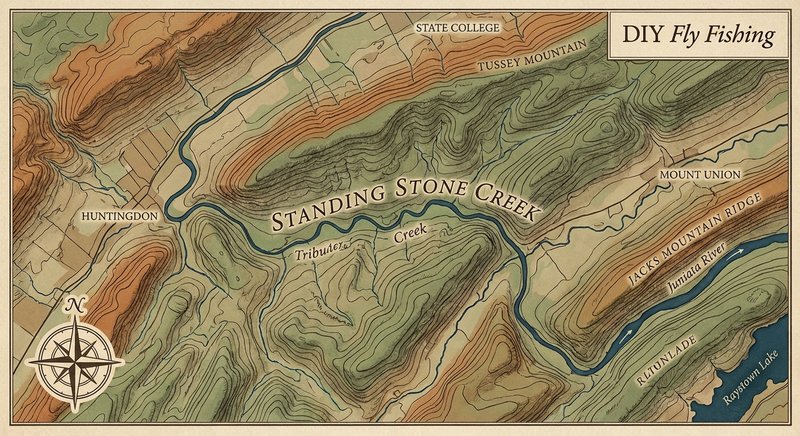
Standing Stone Creek
Fly fishing in Pennsylvania · Intermediate · Best seasons: Spring, Summer, Fall
Target Species
Brown Trout, Brook Trout
About This Water
Huntingdon County freestone with wild brown trout. Less crowded central PA alternative.
Fishing Recommendations
Standing Stone Creek is a quintessential Pennsylvania freestone stream located in Huntingdon County. Flowing from the heart of the Rothrock State Forest down to its confluence with the Juniata River, it offers a diverse angling experience that transitions from tight, technical mountain water to classic meadow runs.
🎣 Location Overview
Standing Stone Creek is cherished for its "split personality." The Upper Section, located within Rothrock State Forest and near Greenwood Furnace State Park, is a rugged, high-gradient environment characterized by plunge pools, rhododendron-lined banks, and wild fish.
The Middle and Lower Sections broaden out as they flow through the Stone Valley. These areas feature a mix of riffles, long glides, and deep undercut banks. While primarily a freestone stream, it does receive some limestone influence from localized springs, which helps maintain a healthy biomass of aquatic insects and crustacean life. It is a scenic, relatively quiet alternative to the more famous (and crowded) Spruce Creek or Penns Creek nearby.
🐟 Target Species & Behavior
- Brown Trout: These are the primary residents of the middle and lower reaches. You will find a mix of hardy wild browns and stocked fish. The wild browns are notoriously wary; they hold tight to structure, particularly fallen logs and undercut banks. They transition to "predator mode" during low light or high-water events.
- Brook Trout: The headwaters and the small feeder streams in the state forest are the stronghold of Pennsylvania’s state fish. These wild brookies are opportunistic but extremely spooky. They typically hold in the "bubble line" at the heads of pools where cold, oxygenated water enters.
- Feeding Behavior: In the upper reaches, fish are less picky about fly patterns but highly sensitive to vibration and shadows. In the lower sections, trout become more selective during major hatches (Sulphurs/Caddis) and rely heavily on subsurface nymphs and scuds during the off-hours.
📅 Best Times to Fish
- Spring (April – June): This is the "Golden Era" on Standing Stone. Water levels are usually optimal, and the major hatches occur. Late May to early June provides the best dry fly action.
- Summer (July – August): Focus exclusively on the upper sections or the very early morning hours. The lower reaches can get warm (above 70°F), which is stressful for trout. Terrestrial fishing (ants/beetles) is excellent in the shaded forest stretches during this time.
- Fall (September – October): A fantastic time for brown trout as they become aggressive before spawning. The cooling water temperatures "re-activate" the lower sections of the creek.
- Best Time of Day: During the spring, 10:00 AM to 4:00 PM is prime. In the heat of summer, seek the "trico" window at dawn or the "caddis" window at dusk.
🪰 Recommended Flies & Techniques
Dry Flies
- Hatches: Sulphurs (size 14-18), Blue Winged Olives (18-22), and Elk Hair Caddis (14-16).
- Attractors: Royal Wulff or Stimulators for the high-gradient upper sections.
- Terrestrials: Black Foam Ants and Cinnamon Ants (size 16-20) are lethal in late summer.
Nymphs
- The Go-Tos: Pheasant Tail Nymphs (14-18) and Hare’s Ears.
- The "Secret": Because of the limestone influence, Scuds and Cressbugs (grey or olive, size 16-18) work remarkably well in the slower, weedier sections of the mid-creek.
- Stoneflies: Golden Stonefly nymphs are effective in the faster riffles.
Streamers
- Patterns: Wooly Buggers (Black or Olive) and Sculpin patterns.
- Technique: "Pounding the banks." Cast tight to the overhanging grass or submerged wood and use erratic strips. This is the best way to find the trophy-sized wild browns.
💡 Pro Tips & Local Knowledge
- Stealth is Paramount: In the upper state forest sections, the water is crystal clear. If you can see the fish, they have already seen you. Wear earthy tones, stay low, and wade upstream to stay behind the fish's field of vision.
- The "Greenwood" Strategy: Use Greenwood Furnace State Park as your base. The water within and just below the park is well-stocked and has great access, but if you hike half a mile upstream or downstream from the main parking areas, the fishing pressure drops significantly.
- Watch the Gauge: Standing Stone is a freestone creek, meaning it rises and falls quickly with rain. If it’s "blown out" (chocolate milk color), the fishing is tough. If it’s "tea-colored" and dropping, it’s the best time to throw large streamers.
- Check the Feeders: Many small, unnamed tributaries flow into Standing Stone in the state forest. These often hold surprising numbers of wild brook trout and stay cool even in the dead of summer.
⚠️ Important Information
- Access: Much of the upper creek is on public land (Rothrock State Forest/Greenwood Furnace). The middle and lower sections pass through private farmland. Always look for "Posted" signs. Fortunately, many landowners allow fishing if you are respectful, stay in the stream bank, and don't litter.
- Regulations: Standing Stone Creek is generally governed by Pennsylvania Fish & Boat Commission (PFBC) "Statewide Regulations" for trout. However, sections may be subject to Stocked Trout Waters (STW) closures in early spring. Check the PFBC website for the most current map and season dates.
- Gear Recommendation: A 7.5' to 8.5' 4-weight rod is perfect for this creek. It's light enough for brookies but has enough backbone to turn a 15-inch brown trout. Use long leaders (9'–12') with 5x or 6x tippet for the slower pools.
Bug Hatches & Matching Flies
| Hatch | Type | Peak months | Time of day | Hook sizes | Matching flies |
|---|---|---|---|---|---|
| Blue-Winged Olive Baetis spp. | mayfly | April, May, September, October | Late Morning/Afternoon | #18-24 | RS2 #20-22, BWO Sparkle Dun #18-22, Pheasant Tail Nymph #18-20 |
| Blue Quill Paraleptophlebia adoptiva | mayfly | April, May | Mid-day | #16-18 | Blue Quill Dry #16-18, Dark Hendrickson #16-18 |
| Hendrickson Ephemerella subvaria | mayfly | April, May | Afternoon | #12-14 | Red Quill #12-14, Hendrickson Emerger #14, Hare's Ear Nymph #12-14 |
| Grannom Caddis Brachycentrus | caddis | April, May | All Day/Evening | #14-16 | Grannom Pupa #14-16, Elk Hair Caddis (Olive) #14-16, Peacock Caddis #16 |
| Sulfur Ephemerella invaria/rotunda | mayfly | May, June | Evening | #14-18 | Sulfur Parachute #14-18, Sulfur Emerger #16-18, Pheasant Tail #16-18 |
| Slate Drake Isonychia bicolor | mayfly | June, September | Afternoon/Evening | #10-14 | Iso Parachute #12-14, Prince Nymph #10-14, Zug Bug #12-14 |
| Light Cahill Stenacron canadense | mayfly | June, July | Evening | #12-16 | Light Cahill Dry #12-16, Gold Ribbed Hare's Ear #14-16 |
| Terrestrials (Ants & Beetles) Formicidae / Coleoptera | terrestrial | July, August, September | Late Morning/Afternoon | #12-20 | Black Foam Ant #16-20, Crowe Beetle #14-18, Cinnamon Ant #16-18 |