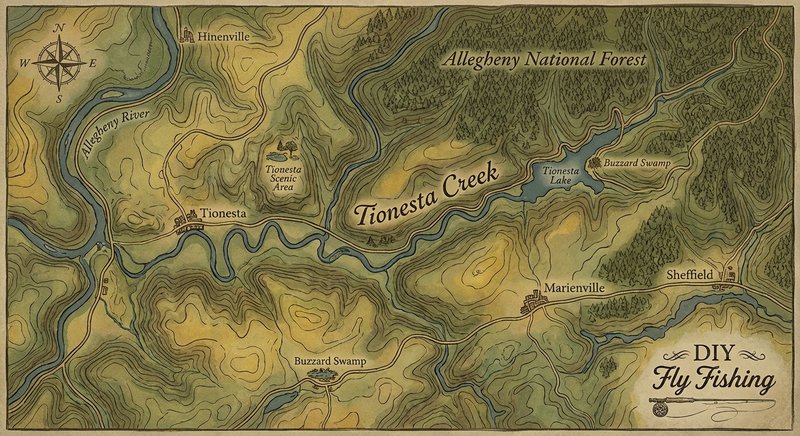
Tionesta Creek
Fly fishing in Pennsylvania · Intermediate · Best seasons: Spring, Summer, Fall
Target Species
Brook Trout, Brown Trout
About This Water
Forest County freestone with wild brook and brown trout. Remote Allegheny National Forest fishing.
Fishing Recommendations
As an expert guide who has spent years navigating the hemlock-shaded corridors of the Allegheny National Forest (ANF), I can tell you that Tionesta Creek is one of Pennsylvania’s most rewarding freestone systems. Unlike the limestone spring creeks of Central PA, the Tionesta is rugged, wild, and highly dependent on rainfall and forest cover.
Here is your comprehensive guide to fly fishing Tionesta Creek.
🎣 Location Overview
Tionesta Creek is a major tributary to the Allegheny River, flowing through the heart of the Allegheny National Forest in Forest and Warren Counties. What makes this water special is its duality: it offers "big water" fishing in its main stem and intimate, technical "blue lining" in its various branches and tributaries.
The creek is characterized by classic freestone features: long riffles, deep holes created by ancient glacial boulders, and a massive amount of woody debris (log jams) that provide world-class cover for trout. It feels remote, often lacking cell service, offering anglers a true wilderness experience under a canopy of white pine and hemlock.
🐟 Target Species & Behavior
- Brook Trout: The "natives" are found primarily in the upper reaches of the West Branch and the numerous small feeder streams (like Bluejay Creek or Farnsworth Run). They are opportunistic but extremely spooky. They hold in the "pillows" in front of rocks and in the deepest parts of tiny plunge pools.
- Brown Trout: The main stem and the lower West/South branches host significant numbers of stocked and holdover Brown Trout. These fish are more predatory. They are notorious for living deep under undercut banks and within the complex log jams that litter the creek. During a hatch, they will move to the tail-outs of pools, but otherwise, they are structure-oriented.
📅 Best Times to Fish
- Spring (April – June): This is the prime window. Water levels are usually high but manageable, and the primary hatches occur now.
- April: Look for Early Gray Stones and Blue Winged Olives.
- May: The "Super Bowl" of Tionesta fishing. Hendrickson, Sulphurs, and March Browns bring the larger fish to the surface.
- Summer (July – August): The main stem can get critically warm (above 70°F). During this time, ethical anglers move to the upper West Branch or the small, high-gradient tributaries where the water stays cool.
- Fall (September – October): A fantastic time for Brown Trout. As they prepare to spawn, they become aggressive. This is also the time for beautiful scenery and low, clear water that requires a stealthy approach.
- Time of Day: In Spring, midday is best as the sun warms the water. In Summer, fish strictly at dawn or dusk to find the lowest temperatures and most active fish.
🪰 Recommended Flies & Techniques
Dry Flies
- Adams (Size 12–18): The ultimate generalist for the Tionesta.
- Elk Hair Caddis (Size 14–16): Tan or Olive. The Tionesta has massive caddis populations.
- Sulphurs (Size 16): Vital for late May evenings.
- Stimulators (Size 10–14): Great for the "smash and grab" brookies in the tributaries.
Nymphs
- Pheasant Tail (Size 14–18): Imitates the numerous mayfly nymphs.
- Hare’s Ear (Size 12–16): Effective in the slower, deeper pools.
- Pat’s Rubber Legs (Size 8–12): Essential for the main stem to mimic large stoneflies.
Streamers
- Wooly Bugger (Black or Olive): The gold standard here.
- Sculpin Patterns: Use these near the heavy rock gardens in the main stem.
Techniques
- Nymphing: Use a "High Stick" or Euro-nymphing technique in the pocket water. Because of the logs, a traditional indicator often gets snagged.
- The "Log Flip": When fishing streamers, cast as close to a log jam as possible and strip aggressively away. Browns will dart out from the darkness to strike.
- Stealth: In the branches, stay out of the water. Wear earth tones and crawl if you have to—the wild fish will see you from 20 feet away.
💡 Pro Tips & Local Knowledge
- The West Branch Secret: The section of the West Branch above the town of Sheffield is some of the finest wild brook trout water in the state. Focus on the areas where the forest is densest.
- Temperature Check: Always carry a thermometer. If the main stem hits 68°F, stop fishing for trout. Head to the Tionesta Lake outflow or find a cold-water "mountain feeder."
- Respect the Wood: Most anglers avoid the tangles of fallen trees. That is where the 20-inch holdovers live. Use a heavier tippet (3X or 4X) and "bully" the fish away from the wood once hooked.
- Route 666: This road follows much of the creek. While it offers easy access, the best fishing is often found by parking at a pull-off and walking 15 minutes away from the road.
⚠️ Important Information
- Access: Much of the creek is within the Allegheny National Forest, meaning it is open to public fishing. However, there are pockets of private hunting camps; always respect "Posted" signs.
- Regulations: The majority of Tionesta Creek falls under Statewide General Regulations. However, check the PA Fish & Boat Commission (PFBC) handbook for any "Stocked Trout Water" closures in the early spring.
- Permits: A valid Pennsylvania Fishing License and a Trout Stamp are required.
- Safety:
- Wading: The rocks can be incredibly "greasy" with algae. Felt soles or studs are highly recommended.
- Wildlife: This is black bear and timber rattlesnake country. They generally avoid people, but stay alert, especially in the thick brush of the tributaries.
- Navigation: Don't rely on GPS; download offline maps or use a paper ANF map.
Guide’s Final Word: Tionesta Creek is not a place for those who want easy, "park-and-fish" sidewalk trout. It’s a place for the angler who likes to get some dirt on their waders and find fish that rarely see a fly. Match the hatch in May, or swing a streamer through the logs in October, and you’ll see why we call this the jewel of the Forest.
Bug Hatches & Matching Flies
| Hatch | Type | Peak months | Time of day | Hook sizes | Matching flies |
|---|---|---|---|---|---|
| Blue-Winged Olive Baetis | mayfly | April, May, September, October | Midday | #18-22 | BWO Sparkle Dun #18-22, Pheasant Tail #18-20 |
| Quill Gordon Epeorus pleuralis | mayfly | April | Midday | #12-14 | Quill Gordon Dry #12-14, Hare's Ear #12-14 |
| Hendrickson Ephemerella subvaria | mayfly | April, May | Afternoon | #12-14 | Hendrickson Parachute #14, Red Quill #12-14 |
| Grannom Caddis Brachycentrus | caddis | April, May | Morning/Afternoon | #14-16 | Elk Hair Caddis (Dark) #14-16, LaFontaine's Deep Pupa #14-16 |
| March Brown Maccaffertium vicarium | mayfly | May, June | Afternoon | #10-12 | March Brown Western #10-12, Gold Ribbed Hare's Ear #10-12 |
| Sulphur Ephemerella invaria/dorothea | mayfly | May, June | Evening | #14-18 | Sulphur Parachute #16-18, CDC Emerger #16-18 |
| Slate Drake Isonychia bicolor | mayfly | June, September | Evening | #10-14 | Iso Parachute #12-14, Zug Bug #10-12 |
| Light Cahill Stenonema/Stenacron | mayfly | June, July | Evening | #14-16 | Light Cahill Dry #14-16, Cream Variant #14-16 |
| Terrestrials (Ants/Beetles) Formicidae/Coleoptera | terrestrial | July, August, September | All Day | #12-18 | Black Foam Ant #16-18, Crowe Beetle #14-16 |