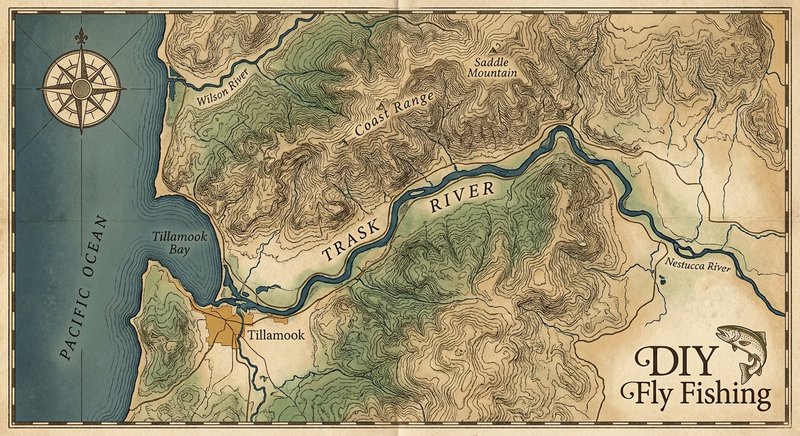
Trask River
Fly fishing in Oregon · Intermediate · Best seasons: Fall, Winter
Target Species
Steelhead, Chinook Salmon
About This Water
Tillamook area river with quality steelhead fishing. Less crowded than Wilson River.
Fishing Recommendations
As an expert guide with years of experience navigating the coastal waters of the Pacific Northwest, the Trask River holds a special place in my heart. It is one of the "big five" rivers that flow into Tillamook Bay and offers some of the most consistent opportunities for chrome-bright fish fresh off the tide.
Here is your comprehensive guide to fly fishing the Trask River.
🎣 Location Overview
The Trask River is a classic Oregon coastal gem. It is primarily a rain-fed system, winding through the rugged Coast Range before spilling into the tidewater of Tillamook Bay.
What makes the Trask special is its versatility. The upper river flows through high-gradient canyons with boulders and pocket water, while the lower river features long, deep walking-speed runs and classic tailouts. Unlike its neighbor, the Wilson River, the Trask tends to clear a bit faster after a heavy rain event, making it a "go-to" when other systems are still "blown out" (too muddy to fish). Anglers love it for its wild scenery and the sheer power of the fish that return here.
🐟 Target Species & Behavior
Fall Chinook (King Salmon)
- Behavior: These are massive, powerful fish (often 20–40+ lbs). In the Trask, they enter with the first heavy rains of autumn. They are aggressive when fresh but become territorial as they move toward spawning gravel.
- Holding: Look for "frogholes" (deep, slow pools) and the deep slots just below riffles. In low water, they congregate in tidewater; in high water, they move rapidly upstream.
Winter Steelhead
- Behavior: The Trask hosts both hatchery and wild winter steelhead. Hatchery fish arrive early (December/January), while the larger wild fish peak in February and March.
- Holding: Steelhead on the Trask love "walking speed" water—about 3 to 6 feet deep with a broken surface. Look for them on the inside seams of bends and in the tailouts of large pools.
📅 Best Times to Fish
- Fall Chinook: Late September through November. The "prime" window is usually mid-October after the first significant rain "freshet" raises the river level.
- Winter Steelhead: December through March.
- December/January: Best for hatchery-bound fish.
- February/March: Prime time for trophy wild steelhead.
- Best Conditions: The "Drop and Clear." You want to be on the water when the river gauge is receding and the water color transitions from "chocolate milk" to "steelhead green" (about 2–3 feet of visibility).
- Time of Day: Low light is your friend. Early morning and late evening are best, especially for Chinook, which can become "lock-jawed" once the sun hits the water.
🪰 Recommended Flies & Techniques
For Steelhead (The Swing)
The Trask is a fantastic river for Spey casting.
- Technique: Use a Skagit head with various T-series sink tips (T-11 to T-14) to get the fly down to the fish's level.
- Flies:
- Intruders: Pink/White, Blue/Black, or "Nightshade" (Black/Purple).
- Leech Patterns: Prom Dress or Hobo Spays in orange or pink.
For Steelhead (Nymphing/Indy)
- Technique: High-sticking or indicator fishing through bouldery pocket water.
- Flies: 10mm–12mm beads (Mottled Orange or Roe Gold), Prince Nymphs, or Nightmare Jigs.
For Chinook
- Technique: Heavy sink tips are mandatory. You must put the fly in their face. Use a "swing and strip" retrieve in the slower pools.
- Flies:
- Comets: Orange or Chartreuse with plenty of flash.
- Bunny Leeches: Large, lead-eyed patterns in Chartreuse/Blue or Pink/Purple.
💡 Pro Tips & Local Knowledge
- The "Hospital Hole" Area: This is a famous spot near the deadline. It’s highly productive but can be crowded. If you want solitude, head further upstream into the Trask River Road canyon sections.
- The "Green Water" Rule: If you can see your boots in knee-deep water but not in waist-deep water, the river is in perfect "green" condition. This is when the fish are most confident and aggressive.
- Low Water Stealth: In the Fall, if the rains haven't come, the Trask can be very low and clear. Switch to longer, thinner leaders (10–12lb fluorocarbon) and smaller, darker flies to avoid spooking "stale" fish.
- Short Casts First: Many anglers wade right over the fish. On the Trask, steelhead often sit surprisingly close to the bank in the softest water. Fish the "inside" before bombing a long cast.
⚠️ Important Information
- Access: Much of the lower river is private, but there are excellent public access points at Lorens Drift, Dam Hole, and numerous pull-outs along Trask River Road as you head East.
- Drift Boats: The Trask is a popular drift boat river. If you are wading, be respectful of drift boaters' lines, and they will generally do the same for you.
- Regulations:
- Always check the ODFW (Oregon Department of Fish and Wildlife) Sport Fishing Regulations before heading out.
- A Combined Angling Tag (Harvest Card) is required for Salmon and Steelhead.
- Pay close attention to "Deadlines" (areas where fishing is prohibited, usually near the hatchery or dam).
- Safety: The Trask can rise several feet in a matter of hours during a coastal storm. Always check the NOAA River Forecast (Trask River near Tillamook) before your trip. Felt-soled boots and a wading staff are highly recommended for the slippery basalt rocks.
Tight lines, and enjoy the beauty of the Oregon Coast!
Bug Hatches & Matching Flies
| Hatch | Type | Peak months | Time of day | Hook sizes | Matching flies |
|---|---|---|---|---|---|
| Blue-Winged Olive (BWO) Baetis | mayfly | March, April, October, November | Afternoon | #16-20 | Parachute Adams #16-20, RS2 #18-20, Pheasant Tail #16-20 |
| March Brown Rhithrogena morrisoni | mayfly | March, April, May | Mid-day | #12-14 | March Brown Dry #12-14, Gold Ribbed Hare's Ear #12-14, March Brown Wet #12-14 |
| Golden Stonefly Calineuria californica | stonefly | June, July | Morning/Evening | #6-10 | Chubby Chernobyl #8-10, Pat's Rubber Leg #6-10, Kaufmann's Stone #8-10 |
| Grannom Caddis Brachycentrus | caddis | April, May | Afternoon/Evening | #14-16 | Elk Hair Caddis #14-16, Peacock Caddis #16, Deep Sparkle Pupa #14-16 |
| October Caddis Dicosmoecus | caddis | September, October | Evening | #8-10 | Orange Stimulator #8-10, Morrish October Caddis #8-10, Peeping Caddis #8-10 |
| Pale Morning Dun (PMD) Ephemerella | mayfly | June, July, August | Morning/Afternoon | #14-18 | Sparkle Dun #16-18, PMD Parachute #14-18, Split Case PMD #16-18 |
| Little Black Stonefly Capniidae | stonefly | February, March | Mid-day | #16-20 | Black Zebra Midge #18-20, Little Black Sloan #18, Copper John (Black) #16-18 |
| Spotted Sedge Hydropsyche | caddis | July, August, September | Evening | #14-16 | Caddis Variant #14-16, Soft Hackle Hare's Ear #14-16, Hydropsyche Larva #14-16 |