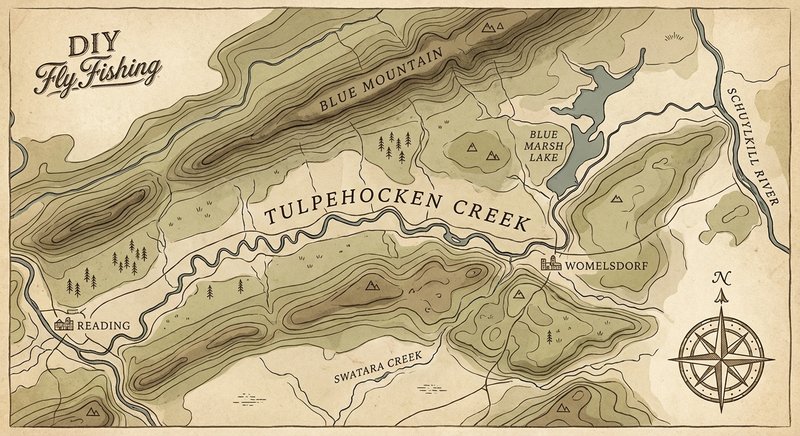
Tulpehocken Creek
Fly fishing in Pennsylvania · Intermediate · Best seasons: Spring, Summer, Fall, Winter
Target Species
Brown Trout, Rainbow Trout
About This Water
Berks County tailwater with excellent brown trout. Year-round fishing opportunity.
Fishing Recommendations
Welcome to the "Tully." As a guide who has spent years deciphering the technical waters of Pennsylvania, I can tell you that Tulpehocken Creek is one of the premier tailwater fisheries in the Mid-Atlantic. Located just outside of Reading, PA, it offers a unique blend of limestone-influenced fertility and the consistent temperatures of a bottom-release dam.
Here is your comprehensive guide to fly fishing the Tulpehocken.
🎣 Location Overview
The "Tully" is a classic tailwater flowing from the Blue Marsh Lake dam. Because the water is drawn from the bottom of the reservoir, it remains cool in the summer and stays ice-free in the winter.
What makes it special is its limestone character. The creek flows through a valley rich in calcium carbonate, leading to incredible biomass and prolific insect hatches. The water is generally low-gradient, characterized by long, glassy pools, subtle riffles, and undercut banks. It is a "technical" stream—the fish are well-educated, the water is often clear, and the currents are complex. If you can catch fish consistently on the Tully, you can catch them anywhere.
🐟 Target Species & Behavior
- Brown Trout: The kings of the creek. Many are stocked as fingerlings and "hold over," becoming wild in their behavior. They are notoriously wary and tend to hold near structure—undercut banks, fallen logs, and the deep slots at the head of pools.
- Rainbow Trout: These are frequently stocked and tend to congregate in the faster oxygenated riffles and "bubble lines." They are often more opportunistic than the browns but will still snub a poor drift.
Behavior Note: Because of the high angler pressure, these fish are "PhD trout." They recognize poor presentations and oversized tippets. They feed heavily on micro-midges and small crustaceans (scuds/cressbugs) year-round.
📅 Best Times to Fish
- Spring (April – June): This is prime time. The water levels stabilize, and the major hatches (Hendricksons, Sulphurs, and Caddis) bring fish to the surface.
- Summer (July – August): The Tully is famous for its Trico hatch. You must be on the water at daybreak. As the sun rises and the air warms, thousands of tiny black mayflies swarm. By 10:00 AM, the "spinner fall" begins, and the water can look like it's boiling with rising trout.
- Fall (September – November): My personal favorite. The crowds thin out, and the Brown Trout become aggressive as they prepare for the spawn. Blue Winged Olives (BWOs) are the primary hatch.
- Winter (December – March): One of the few reliable winter spots in PA. Focus on the warmest part of the day (12 PM – 3 PM). Look for midge activity and fish deep with nymphs.
🪰 Recommended Flies & Techniques
Top Fly Patterns
- Dry Flies: Trico Spinners (#22-26), CDC Sulphurs (#16-18), Elk Hair Caddis (#14-18), Blue Winged Olives (#18-22), and Griffith’s Gnat (#20-24).
- Nymphs: Zebra Midges (#20-22), Walts Worms (#14-18), Pheasant Tails (#16-20), and especially Scuds/Cressbugs (#14-18) in olive or grey.
- Streamers: Black or Olive Wooly Buggers, and small sculpin patterns fished tight to the banks.
Effective Techniques
- Technical Nymphing: European Nymphing (tight-line) is incredibly effective in the riffles. However, in the long pools, a tiny nymph suspended under a very small, sensitive indicator is often necessary.
- The "Trico Drift": During the Trico spinner fall, use a 12-foot leader tapering down to 7X tippet. You must time your cast to the rhythm of the rising fish.
- Streamer Stripping: On overcast days or when the water is slightly off-color, strip streamers through the deep holes to trigger an aggression strike from a trophy Brown.
💡 Pro Tips & Local Knowledge
- The "Tully Twitch": When fishing the Trico spinner fall, if a dead drift isn't working, give the fly a microscopic twitch. Sometimes that slight movement differentiates your fly from the thousands of real insects on the water.
- Focus on the "DHALO": The most popular section is the Delayed Harvest Artificial Lures Only area, stretching from Blue Marsh Dam downstream to the mouth of Cacoosing Creek.
- Key Spots:
- Reber’s Bridge: Classic water with a good mix of riffles and pools.
- The Red Bridge: High-pressure area but holds a massive amount of fish.
- Gring’s Mill: Beautiful park setting with excellent technical water.
- Stealth is Mandatory: The Tully is a silt-bottomed creek in many places. Heavy wading sends vibrations through the water. Move slowly, and when possible, fish from the bank rather than wading into the middle of a pool.
⚠️ Important Information
- Regulations: The Tully is managed under Delayed Harvest Artificial Lures Only (DHALO) regulations. This means:
- Fishing can be done year-round.
- No bait allowed; only artificial flies or lures.
- Catch and release only from Labor Day until June 15th. Check the PA Fish & Boat Commission (PFBC) website for current creel limits outside those dates.
- Wading Safety: The rocks can be incredibly "greasy" with algae. Felt soles or studs are highly recommended.
- Water Flows: Always check the USGS gauge for Tulpehocken Creek near Reading, PA. Ideal fishing flows are between 150 cfs and 300 cfs. Anything over 450 cfs becomes difficult and dangerous to wade.
- Permits: You must have a valid Pennsylvania Fishing License and a Trout Stamp.
Enjoy the Tully—it’s a challenging mistress, but when you crack the code, it’s some of the most rewarding fly fishing in the country!
Bug Hatches & Matching Flies
| Hatch | Type | Peak months | Time of day | Hook sizes | Matching flies |
|---|---|---|---|---|---|
| Trico Tricorythodes spp. | mayfly | July, August, September | Morning | #20-24 | Trico Spinner #20-24, Trico Drowned Spinner #20-24, Sunville Trico #22 |
| Sulphur Ephemerella invaria/dorothea | mayfly | May, June | Evening | #14-18 | Sulphur Parachute #14-18, Sulphur Emerger #14-18, Pheasant Tail #14-18 |
| White Fly Ephoron leukon | mayfly | August | Evening/Night | #12-14 | White Wulff #12-14, Ephoron Spinner #12-14, White Glo-Bug #12 |
| Blue-Winged Olive Baetis spp. | mayfly | April, May, September, October | Afternoon | #18-22 | BWO Parachute #18-22, RS2 #18-22, WD-40 #18-22 |
| Tan Caddis Hydropsyche spp. | caddis | May, June | Afternoon/Evening | #14-18 | Elk Hair Caddis (Tan) #14-16, LaFontaine's Deep Sparkle Pupa #14-18, Holy Grail #14-16 |
| Midges Chironomidae | midge | January, February, March, December | Morning/Afternoon | #20-26 | Zebra Midge #20-24, Griffith's Gnat #20-24, Top Secret Midge #22-26 |
| Grannom Caddis Brachycentrus spp. | caddis | April | Morning/Afternoon | #14-16 | Peacock Caddis #14-16, Green Weenie #12-14, Dark Blue Sedge #14 |
| Terrestrials Formicidae / Coleoptera | terrestrial | July, August, September | All Day | #12-18 | Cinnamon Ant #14-18, Crowe Beetle #12-16, Chernobyl Ant #10-14 |