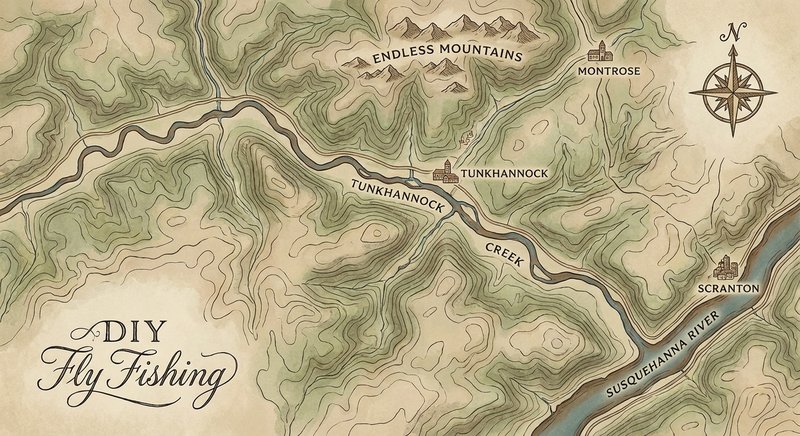
Tunkhannock Creek
Fly fishing in Pennsylvania · Beginner · Best seasons: Spring, Summer, Fall
Target Species
Brown Trout, Brook Trout
About This Water
Wyoming County stream with wild brown trout. Good fishing in rural NE Pennsylvania.
Fishing Recommendations
Tunkhannock Creek, located in the rolling hills of Northeastern Pennsylvania, is a classic Appalachian freestone stream. While many anglers flock to the famous limestone spring creeks of Central PA, the "Tunk" offers a rugged, scenic, and rewarding alternative for those who enjoy technical dry fly fishing and pocket-water nymphing.
🎣 Location Overview
Tunkhannock Creek is divided primarily into the Main Stem, the North Branch, and the South Branch. For the fly angler, the South Branch is the "crown jewel," specifically the Delayed Harvest Artificial Lures Only (DHALO) section.
The creek is characterized by large glacial boulders, deep emerald pools, and swift, oxygenated riffles. What makes it special is its classic "freestone" personality—the water level and temperature fluctuate with the weather, meaning the fish are highly attuned to the seasons. The backdrop is spectacular, featuring the massive Nicholson Bridge (Tunkhannock Viaduct), which looms over the valley, providing one of the most iconic views in American fly fishing.
🐟 Target Species & Behavior
- Brown Trout: The dominant species. You’ll find a mix of heavy-bodied stocked fish and a fair population of stream-bred "wild" browns. They are wary and tend to hold in the "heavy" water—look for them at the heads of pools where the riffle breaks, or tucked tightly against the large boulders.
- Brook Trout: While the main stems are primarily a Brown Trout fishery, the upper reaches and smaller tributaries of the Tunkhannock hold beautiful, vibrant native Brookies. They are opportunistic but require cold, clean water. In the main branches, look for Brookies near the mouths of cold-water feeder streams during the warmer months.
📅 Best Times to Fish
- Spring (April – June): This is the prime window. The "Grand Slam" of PA hatches occurs here—Hendricksons in late April, followed by Sulfurs and Light Cahills in May and June. The water levels are usually perfect, and the fish are most active.
- Summer (July – August): Fishing becomes technical. Focus on early mornings (dawn to 10:00 AM) and late evenings. Warning: As a freestone stream, the Tunk can get warm. If water temps exceed 68°F, please stop fishing to protect the trout.
- Fall (September – October): A fantastic time for Brown Trout as they become aggressive before the spawn. Low water requires a stealthy approach, but the cooling temperatures bring a second wind to the insect activity (Blue Winged Olives).
🪰 Recommended Flies & Techniques
Dry Flies
- Sulfurs (Size 14-18): The most consistent hatch in May/June.
- Elk Hair Caddis (Size 12-16): Great for skating across the riffles.
- Blue Winged Olives (Size 18-22): Essential for overcast or drizzly days in Spring and Fall.
- Terrestrials (Summer): Dave’s Hopper or black foam ants (Size 14-18) dropped along the banks.
Nymphs
- Pheasant Tail & Hare’s Ear (Size 14-18): The gold standard.
- Frenchie / Perdigons: Effective for "Euro-nymphing" the fast pocket water.
- Zebra Midge: Vital for the low, clear water of late summer.
Streamers
- Woolly Bugger (Black or Olive): Especially effective after a rain when the water has a "tea" stain.
- Sculpin Patterns: Swing these through the deep holes for the larger, predatory Browns.
Techniques
- Tight-Line Nymphing: Because the Tunk is full of boulders, there are dozens of micro-currents. A traditional indicator will often get pulled around. Using a tight-line (Euro) setup allows you to get deep in the pockets where the big fish hide.
- The "Reach Cast": In the long, flat pools, trout have plenty of time to inspect your fly. A reach cast is essential to prevent drag and ensure a natural drift.
💡 Pro Tips & Local Knowledge
- The Nicholson Section: Start your trip at the South Branch near the Nicholson Viaduct. There is a well-known DHALO (Delayed Harvest Artificial Lures Only) section here that holds fish year-round and offers plenty of public access.
- Watch the Rocks: The rocks in Tunkhannock Creek are notoriously slippery. Studded wading boots and a wading staff are not just recommendations—they are necessities here.
- Find the "Seams": On the Tunk, trout love to sit right on the line between fast and slow water. Look for the "bubbles" and keep your fly in that line.
- Local Secret: During the heat of summer, seek out the "Cold Holes" where groundwater seeps in. You’ll often find fish stacked in these small thermal refuges.
⚠️ Important Information
- Regulations: Be sure to distinguish between the "Open to Harvest" sections and the DHALO sections. In DHALO areas, you must use artificial lures/flies only, and no harvest is permitted between Labor Day and the following June.
- Permits: A valid Pennsylvania Fishing License and a Trout/Salmon Stamp are required for all anglers 16 and older.
- Access: Much of the Tunkhannock flows through private land. While PA laws regarding "navigable" waters are complex, the best practice is to stick to the designated public access points or look for "Fishing Permitted" signs. Always respect landowners to ensure future access for all.
- Check the Gauge: Check the USGS stream gauge for "Tunkhannock Creek near Tunkhannock, PA." Ideal fishing flows are generally between 200cfs and 500cfs. Anything over 800cfs can be dangerous to wade.
Guide’s Final Word: “Tunkhannock Creek isn't going to give up its fish easily. It requires a stealthy approach and a good read of the water. But when you land a buttery-yellow Brown trout under the shadow of the great Nicholson Bridge, you’ll realize it’s one of the most soulful fishing experiences in the Northeast.”
Bug Hatches & Matching Flies
| Hatch | Type | Peak months | Time of day | Hook sizes | Matching flies |
|---|---|---|---|---|---|
| Blue-Winged Olive Baetis / Pseudocloeon | mayfly | April, May, September, October | Afternoon | #18-22 | BWO Sparkle Dun #18-22, Pheasant Tail #18-20, RS2 #20-22 |
| Hendrickson Ephemerella subvaria | mayfly | April, May | Afternoon | #12-14 | Red Quill #12-14, Hendrickson Emerger #14, Hendrickson Nymph #12-14 |
| Grannom Caddis Brachycentrus | caddis | April, May | Morning/Afternoon | #14-16 | Grannom Pupa #14-16, Elk Hair Caddis (Olive) #14-16, LaFontaine's Deep Sparkle Pupa #14-16 |
| March Brown Maccaffertium vicarium | mayfly | May, June | Afternoon | #10-12 | March Brown Dry #10-12, Gold Ribbed Hare's Ear #10-12, March Brown Wet #12 |
| Sulphur Ephemerella invaria / dorothea | mayfly | May, June | Evening | #14-18 | Sulphur Parachute #14-18, Sulphur Emerger #16-18, Pheasant Tail (Flashback) #16-18 |
| Green Drake Ephemera guttulata | mayfly | May, June | Evening/Dusk | #8-10 | Green Drake Paradun #8-10, Coffin Fly #8-10, Green Drake Nymph #8-10 |
| Light Cahill Stenonema / Stenacron | mayfly | June, July | Evening | #12-14 | Light Cahill Dry #12-14, Cream Usual #14, Gold Ribbed Hare's Ear (Light) #14 |
| Slate Drake Isonychia bicolor | mayfly | June, September | Afternoon/Evening | #10-12 | Isonychia Nymph #10-12, Iso Parachute #10-12, Zug Bug #10-12 |
| Trico Tricorythodes | mayfly | July, August, September | Early Morning | #22-26 | Trico Spinner #22-24, Trico Parachute #22-26, Trico Nymph #22-24 |
| Tan Caddis Hydropsyche | caddis | May, June, July, August | Evening | #14-16 | Elk Hair Caddis (Tan) #14-16, Pupa (Tan) #14-16, Soft Hackle Hare's Ear #14-16 |