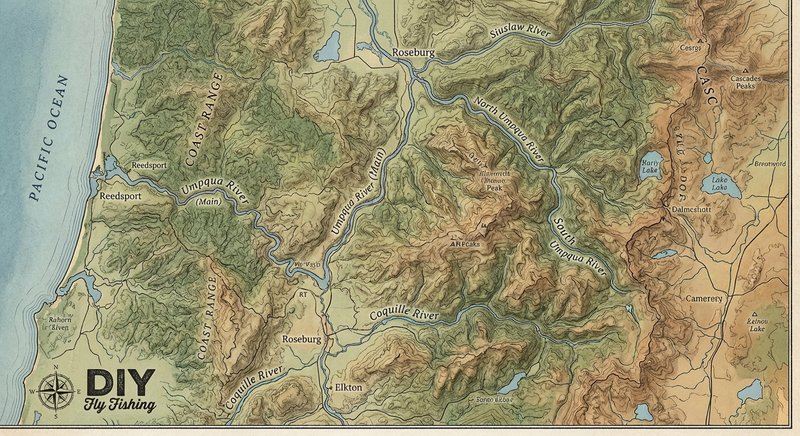
Umpqua River (Main)
Fly fishing in Oregon · Beginner · Best seasons: Spring, Summer, Fall
Target Species
Smallmouth Bass, Striped Bass, Shad
About This Water
Large southwest Oregon river with striped bass, smallmouth, and shad. Diverse fishery.
Fishing Recommendations
The Main Umpqua River is a legendary waterway that begins at the confluence of the North and South Umpqua rivers near Roseburg and flows roughly 111 miles to the Pacific Ocean at Reedsport. While the North Umpqua is world-famous for steelhead, the Main Umpqua is a warm-water paradise, often cited as one of the premier Smallmouth Bass destinations in the United States.
🎣 Location Overview
The Main Umpqua is a massive, powerful river characterized by deep emerald pools, long gravel bars, and dramatic basalt rock formations. What makes it special is its incredible biological productivity; the sheer volume of fish per mile is staggering.
Unlike the high-gradient North Umpqua, the Main river meanders through the Coast Range, offering a mix of "big water" feel with intimate structure. Anglers love it because it is an "everybody wins" river—it is approachable for beginners due to the high fish count, yet offers technical challenges for experts hunting "Trophy Class" Smallmouth or elusive, hard-pulling Striped Bass.
🐟 Target Species & Behavior
Smallmouth Bass
The "Bronzeback" is the undisputed king of the Main Umpqua.
- Behavior: They are aggressive and highly competitive.
- Holding Water: Look for "structure with current." Large basalt boulders, submerged ledges, and the edges of fast-moving riffles are prime. In the heat of summer, they move into faster, oxygenated water.
- Feeding: They gorge on crayfish (the primary food source), sculpins, and various minnows.
American Shad
Known as the "Poor Man's Tarpon," these chrome-bright silver fish enter the river by the hundreds of thousands.
- Behavior: They travel in massive schools in the lower and middle river. They don't feed once they enter freshwater, but they strike out of aggression or instinct.
- Holding Water: Deep, slow-moving "slots" or runs. They tend to follow the same paths upstream year after year.
Striped Bass
The ghosts of the lower river.
- Behavior: These are big, powerful migratory fish. They are ambush predators that follow the tide and the baitfish.
- Holding Water: Found primarily from Scottsburg down to the estuary. They hide in deep holes or under overhanging brush during the day and move into the shallows to hunt at night or during low-light hours.
📅 Best Times to Fish
- Spring (May – June): This is Shad Season. The river comes alive as the run peaks. It is also the time when the largest Smallmouth begin to move toward spawning beds (pre-spawn), though water levels can be high and turbid from snowmelt.
- Summer (July – August): The Peak Smallmouth Season. Water temperatures rise, and the bass become hyper-active. This is the best time for topwater action. Morning and late evening are best for the biggest fish, but you can catch "numbers" all day long.
- Fall (September – October): The Trophy Window. As the water cools, the smaller bass slow down, but the "Wall Hangers" feed heavily to bulk up for winter. This is also a secondary window for Striped Bass in the lower river.
🪰 Recommended Flies & Techniques
For Smallmouth Bass
- Techniques: Poppers on the surface (morning/evening) and crayfish patterns on the bottom.
- Top Flies:
- Umpqua Special: Near-Nuff Crayfish (Size 2-6) in Olive or Orange.
- Surface: BoogleBugs or Clouser 8-Hats in Yellow or Chartreuse.
- Streamers: Clouser Minnows (Blue/White or Chartreuse/White).
- Presentation: For crayfish, use a sink-tip line and "bounce" the fly along the bottom with short, erratic strips. For topwater, cast toward the bank and let the rings dissipate before giving it a "pop."
For Shad
- Techniques: Swinging flies on a sinking line.
- Top Flies:
- Shad Darts: Small, weighted flies with tinsel and bright colors (Chartreuse, Pink, or Gold).
- The "Dickey Fly": A local favorite—bead head, flashabou tail, and a colorful thread body.
- Presentation: Cast slightly upstream, let the sink-tip get the fly deep, and allow it to swing through the school in a classic "down and across" steelhead presentation.
For Striped Bass
- Techniques: Large streamers on heavy sink-tip lines (250–400 grain).
- Top Flies: 6–10 inch Deceivers, Game Changers, or bulky EP Fibers patterns in white/grey or "Mullet" colors.
💡 Pro Tips & Local Knowledge
- The "Elkton to Big Bend" Stretch: This is widely considered the "Golden Mile" for Smallmouth. The rock structure here is unparalleled.
- Crayfish Color Matters: If the water is clear, use olive/brown patterns. If the river has a little "color" (turbidity), switch to bright orange or red. The Umpqua crayfish often turn bright orange when they molt.
- The "Shad Slot": If you catch one shad, stay put. They travel in tight lines. If you are 5 feet too far left or right, you might not see a bite. Adjust your cast distance until you find the "conveyor belt" of fish.
- The "Slide" Technique: When fishing from a drift boat, cast your popper literally onto the dry rocks of the bank and "slide" it into the water. Big bass often sit inches from the shore waiting for terrestrial insects or frogs to fall in.
⚠️ Important Information
- Access: The Main Umpqua is best fished via drift boat or raft. While there are bank access points (James Wood Park, Sawyer Rapids, Elkton Bridge), much of the best water is bordered by private land.
- Regulations: The Main Umpqua has specific regulations regarding bait and harvest. As of recent seasons, there is often no limit on Smallmouth Bass to protect the native salmonid smolts—but check the ODFW Recreation Report before you go.
- Safety: The Umpqua has several dangerous rapids (e.g., Sawyer Rapids). If you are rowing, ensure you have a river map and the skill set to navigate Class II-III water.
- Invasive Species: Always clean, drain, and dry your gear. The Umpqua is a sensitive ecosystem; preventing the spread of New Zealand Mud Snails is critical.
Guide’s Final Word: Bring a 6-weight rod for the bass, an 8-weight for the stripers, and plenty of sunscreen. The Umpqua canyon gets hot in the summer, but the fishing is even hotter.