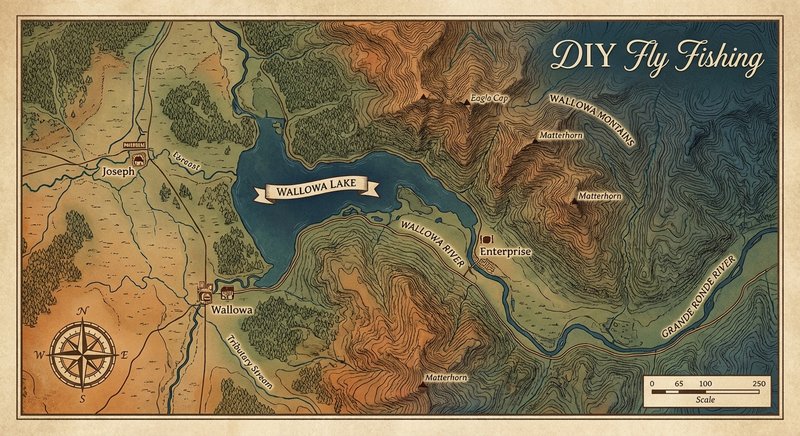
Wallowa Lake
Fly fishing in Oregon · Beginner · Best seasons: Spring, Summer, Fall
Target Species
Kokanee Salmon, Lake Trout, Rainbow Trout
About This Water
Northeast Oregon glacier lake with kokanee and lake trout. Stunning mountain scenery.
Fishing Recommendations
Wallowa Lake is one of the "Crown Jewels" of Oregon. Nestled at the base of the 9,000-foot peaks of the Wallowa Mountains—often called the "Little Switzerland of America"—this glacial ribbon lake offers a spectacular backdrop for an angler. At 3.7 miles long and nearly 300 feet deep, it is a high-altitude, cold-water fishery that presents unique challenges and massive rewards for the fly fisher.
🎣 Location Overview
Wallowa Lake is a classic alpine "terminal moraine" lake. Formed by ancient glaciers, it is characterized by crystal-clear water and dramatic drop-offs. Unlike many shallow Oregon lakes, Wallowa drops to extreme depths very quickly from the shoreline.
What makes it special for fly anglers is the South End. While the north end is more developed, the south end (near Wallowa Lake State Park) is where the Wallowa River flows into the lake. This inlet creates a nutrient-rich delta that attracts every species in the lake. It is a "two-story" fishery: you have Rainbow Trout active in the upper water column, while massive Lake Trout and schools of Kokanee inhabit the dark depths.
🐟 Target Species & Behavior
Kokanee Salmon
Wallowa Lake is famous for producing world-record-class Kokanee (landlocked Sockeye).
- Behavior: They are pelagic, meaning they roam the open, deep water in schools. They feed primarily on zooplankton.
- Fly Target: They are difficult to target on a fly during mid-summer when they are 60+ feet deep. However, in late spring and early fall, they move into the upper 15–20 feet of the water column and congregate near the south end before their spawning run.
Lake Trout (Mackinaw)
These are the apex predators of the lake. They grow to monstrous sizes (20–30+ lbs) by feeding on the Kokanee.
- Behavior: Usually found at 50–100 feet. However, in the Spring and late Fall, when water temperatures are consistent from top to bottom, they move into the "shallows" (10–30 feet) to hunt.
- Fly Target: Look for them near the steep rocky drop-offs on the east and west banks.
Rainbow Trout
The lake is heavily stocked with "legals" and "trophy" rainbows, but there is also a population of wild, bright-colored fish.
- Behavior: They cruise the shoreline and weed beds. They are much more opportunistic than the Kokanee and will rise for hatches.
📅 Best Times to Fish
- Spring (May - June): This is arguably the best time for fly anglers. As the ice thaws and the water remains cold, Lake Trout move shallow. Rainbows are very active near the surface.
- Summer (July - August): The "Dog Days." You must fish first light (4:30 AM – 8:00 AM) or last light. During the day, fish retreat to the deep "thermocline" to stay cool.
- Fall (September - October): The most exciting time. The Kokanee begin to school near the South End inlet. The Lake Trout follow them in to feast. The fall colors in the Wallowas are a bonus.
🪰 Recommended Flies & Techniques
For Rainbows (Shoreline/Surface)
- Technique: Dry-dropper along the logs and docks at the State Park, or stripping small streamers.
- Flies:
- Dries: Elk Hair Caddis (#14-16), Parachute Adams (#16), Royal Wulff.
- Nymphs: Gold-ribbed Hare’s Ear, Pheasant Tail, and Chironomids (under an indicator).
For Kokanee (The "Mini-Salmon" Setup)
- Technique: You need a Full Sinking Line (Type 3 or 5). Search for schools with a fish finder or look for "dimples" at dawn. Use a "strip-strip-pause" retrieve.
- Flies: Bright colors are key.
- Red or Pink San Juan Worms, Red Copper Johns (#16), or small "Comet" style flies with plenty of flash.
For Lake Trout (The Big Game)
- Technique: Use an 8-weight rod with a heavy 250-350 grain sinking tip. You are "dredging." Cast toward the drop-off, let it sink for 20–30 seconds, and use long, aggressive strips.
- Flies: Anything that mimics a 5-8 inch Kokanee.
- White/Silver Game Changers, Double Bunnies, or large Clouser Minnows.
💡 Pro Tips & Local Knowledge
- Focus on the "Drop-Off": If you are fishing from a boat or float tube, find where the turquoise water turns to dark navy. This ledge is where the big Rainbows and Lake Trout patrol to ambush baitfish.
- The South End Delta: The area where the Wallowa River enters the lake is the most productive fly fishing water. There is a distinct "shelf" there. Position yourself on the edge of that shelf.
- The "Wallowa Wind": Be careful. Because the lake is in a deep glacial valley, winds can kick up instantly, creating "whitecaps" that are dangerous for float tubes and small pontoons. Always check the forecast.
- Chironomid Fishing: In the early morning during summer, there is often a massive midge hatch. If the lake looks like glass and you see tiny rings, fish a long leader (15ft) with a tiny Chironomid 12 feet under a strike indicator.
⚠️ Important Information
- Regulations: Wallowa Lake is open year-round, but the Wallowa River inlet has specific seasonal closures to protect spawning Kokanee. Always check the current ODFW Central/Southeast Zone Regulations before heading out.
- Boating: There is a great boat ramp at the State Park (South End) and a Marina at the North End.
- Aquatic Invasive Species: If you bring your own boat or float tube, you must have an Oregon AIS (Aquatic Invasive Species) permit.
- Respect the Kokanee: If you fish the fall run, ensure you are not "snagging" or "flossing" fish in the river sections. Use ethical sight-fishing practices.
Guide’s Final Thought: Wallowa Lake is a "quality over quantity" fishery for the fly angler. You might work hard for five fish, but one of them could be the Rainbow or Mackinaw of a lifetime. Pack your sinking lines and your camera—you'll need both.
Bug Hatches & Matching Flies
| Hatch | Type | Peak months | Time of day | Hook sizes | Matching flies |
|---|---|---|---|---|---|
| Chironomids Chironomidae | midge | April, May, June | All Day | #12-22 | Zebra Midge #16-20, Chromie #12-18, Griffith's Gnat #18-22 |
| Callibaetis Callibaetis ferrugineus | mayfly | June, July, August | Late Morning/Afternoon | #12-16 | Callibaetis Spinner #14-16, Hare's Ear Nymph #12-16, Parachute Adams #14-18 |
| Traveling Sedge Hesperophylax | caddis | July, August | Evening | #8-12 | Mikulak Sedge #8-10, Goddard Caddis #10-12, LaFontaine's Deep Sparkle Pupa #10-14 |
| Damselfly Enallagma | terrestrial | June, July | Mid-day | #10-14 | Marabou Damsel #10-12, Adult Damsel #12-14, Braided Butt Damsel #12 |
| Pale Morning Dun (PMD) Ephemerella | mayfly | June, July | Late Morning | #14-18 | PMD Sparkle Dun #16-18, Pheasant Tail #14-18, PMD Parachute #14-16 |
| Scuds Gammarus | terrestrial | Year-round | All Day | #12-18 | Ray Charles #14-18, Scud (Olive/Pink) #12-16 |
| Terrestrials (Ants/Beetles) Formicidae / Coleoptera | terrestrial | July, August, September | Afternoon | #12-18 | Black Foam Ant #14-18, Chernobyl Ant #8-12, Juicy Beetle #12-16 |
| Dragonfly Anisoptera | terrestrial | July, August | Morning/Afternoon | #4-10 | Gomphus Nymph #6-10, Dragonfly Nymph (Olive) #4-8 |