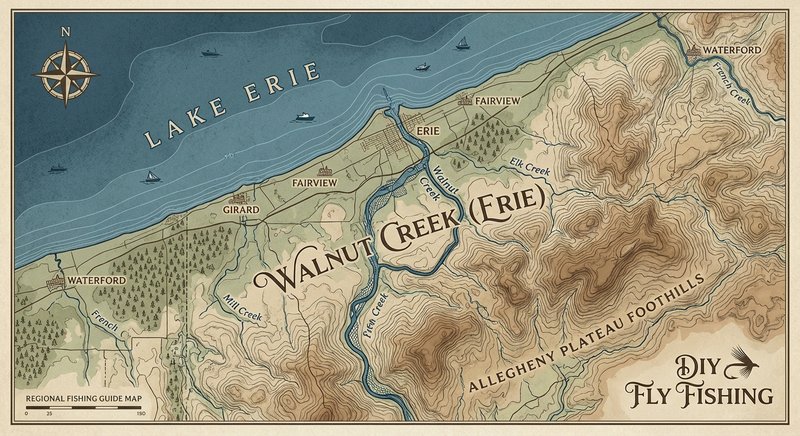
Walnut Creek (Erie)
Fly fishing in Pennsylvania · Beginner · Best seasons: Fall, Winter, Spring
Target Species
Steelhead
About This Water
Popular steelhead stream near Erie. Good access and consistent runs of Great Lakes steelhead.
Fishing Recommendations
Tight lines! You’re looking at one of the most prolific—and arguably the most famous—steelhead destinations in the Great Lakes region. As a guide who has spent plenty of cold mornings on the shale banks of Lake Erie’s tributaries, I can tell you that Walnut Creek is both a blessing and a challenge.
Here is your comprehensive guide to fly fishing Walnut Creek, Pennsylvania.
🎣 Location Overview
Walnut Creek is a medium-sized tributary located in Erie County, PA. It is the crown jewel of "Steelhead Alley." What makes Walnut special is its accessibility and the sheer density of fish. Because the Pennsylvania Fish and Boat Commission (PFBC) operates a large marina and hatchery facility at the mouth, Walnut receives an enormous annual stocking of steelhead smolts.
The creek is characterized by its shale bedrock bottom. It features beautiful "cliff" sections, deep plunge pools, and long, flat glides. While the lower section near the marina is essentially a basin, the water quickly transforms into a classic creek environment as you move upstream. It is a "spit-and-growl" stream—very sensitive to rain. It clears faster than the larger Elk Creek, making it the "go-to" when other rivers are blown out.
🐟 Target Species & Behavior
The primary target is the Lake Erie Steelhead (an adfluvial Rainbow Trout). These fish spend their summers in the deep, cool waters of the lake and migrate into Walnut Creek to spawn.
- Behavior: These fish are not actively "feeding" for survival as they would in the lake; they strike out of instinct, aggression, or opportunistic snacking on eggs.
- Holding Patterns: In high water, they move fast. In normal or low flows, look for them in the "slots"—the darker, deeper depressions in the shale. They love to sit at the head of a pool (the "riffle") when oxygen is high, or in the tail-outs during the evening.
- The "Spook" Factor: Because Walnut is often crystal clear, these fish are notorious for being "leader shy." If they see you or your thick line, they will lock their jaws.
📅 Best Times to Fish
- Fall (Late September – November): This is the "Grand Push." The first cold rains of October trigger the massive run. Fish are silver, aggressive, and incredibly strong.
- Winter (December – February): Fishing slows down but remains consistent. You’ll be fishing "ice water." The fish move to the deepest, slowest pools to conserve energy.
- Spring (March – April): The "dropback" season. Fish are spawning on the gravel reaches, and then hungry "dropbacks" head back to the lake. These fish are often very aggressive and will smash streamers.
- Prime Conditions: Look for a falling barometer and water that has a "green" tint (not chocolate milk, but not gin-clear).
🪰 Recommended Flies & Techniques
Walnut Creek is primarily an indicator nymphing game, though swinging flies can work in specific runs.
Top Fly Patterns
- Egg Patterns: Sucker Spawn (Peach, Cream, Pink), Blood Dots, and Glow Bugs. This is the "bread and butter."
- Nymphs: Size 14-18 Pheasant Tails, Hare’s Ears, and Zebra Midges. In low water, small nymphs outperform eggs.
- The "Crystal Meth": A localized diamond-braid shrimp/egg hybrid that is legendary in Erie.
- Streamers: Wooly Buggers (Black or White) and Egg-Sucking Leeches.
Techniques
- Indicator Nymphing: Use a small, sensitive indicator. Because the shale bottom is flat, you need to adjust your weight (split shot) constantly so your fly "ticks" the bottom without dragging.
- The "Erie Short-Line": In crowded spots, many anglers use a high-sticking method with very little fly line out to maintain perfect vertical orientation.
- Low-Water Stealth: If the water is clear, drop to 5X or 6X Fluorocarbon tippet and use flies without flash.
💡 Pro Tips & Local Knowledge
- The "Stop 3" and "Manchester" Holes: These are the most famous spots. They hold thousands of fish but also hundreds of anglers. If you want peace, hike further upstream past the RT 5 bridge.
- Watch the Shale: The bedrock is extremely slippery. Studded felt soles or cleats are mandatory. Without them, you will end up in the drink.
- The "Mud Tint": If the creek is rising and starting to turn brown, switch to larger, darker profiles like a black Wooly Bugger or a fluorescent orange egg.
- First Light: On Walnut, the best fishing is often the first 60 minutes of legal light. The fish haven't been "pounded" by a hundred casts yet and are much more willing to take.
⚠️ Important Information
- Access: The Walnut Creek Access Area (managed by the PFBC) provides ample parking, restrooms, and a cleaning station.
- Regulations: You must have a Pennsylvania Fishing License AND a Lake Erie Permit (or a Combo Trout/Lake Erie permit).
- Etiquette: Walnut Creek is famous for "combat fishing." If someone is hooked up, give them room. If you arrive at a hole and it's crowded, ask if you can join the rotation.
- Boundary Lines: Be aware of the "No Fishing" markers near the marina basin and the weir. These are strictly enforced by Waterways Conservation Officers.
- Property: Respect private property signs as you move upstream. Much of the creek is open due to the generosity of landowners and PFBC easements.
Guide’s Final Word: Walnut Creek can be frustrating when the crowds are thick, but when you hook into a fresh, chrome 8-pounder in a narrow shale canyon, you’ll understand why people travel from all over the country to fish it. Dress warm, bring your cleats, and keep your fly on the bottom!
Bug Hatches & Matching Flies
| Hatch | Type | Peak months | Time of day | Hook sizes | Matching flies |
|---|---|---|---|---|---|
| Blue Winged Olive Baetis tricaudatus | mayfly | April, October, November | Afternoon | #18-22 | RS2 #18-22, Pheasant Tail Nymph #18-20, BWO Sparkle Dun #18-22 |
| Little Black Stonefly Capniidae | stonefly | February, March | Midday | #14-18 | Early Brown/Black Stone Nymph #14-16, Griffith's Gnat #18-20, Zebra Midge #18-20 |
| Caddis (Grannom) Brachycentrus | caddis | April, May | All day/Evening | #12-16 | LaFontaine's Deep Sparkle Pupa #14-16, Elk Hair Caddis #12-16, Peahead Caddis #14-16 |
| Sulphur Ephemerella invaria | mayfly | May, June | Evening | #14-16 | Sulphur Parachute #14-16, Sulphur Emerger #14-16, Frenchie #14-16 |
| Midges Chironomidae | midge | January, February, March, December | Midday | #18-24 | Zebra Midge (Red or Black) #18-22, Palomino Midge #20-22, Blood Worm #18-20 |
| White Fly Ephoron leukon | mayfly | August | Evening/Dusk | #12-14 | White Wulff #12-14, Ephoron Spinner #12-14 |
| Terrestrials (Ants/Beetles) Formicidae/Coleoptera | terrestrial | July, August, September | Afternoon | #12-18 | Black Foam Ant #14-18, Fat Albert #10-12, Chocolate Beetle #14-16 |
| Golden Stonefly Acronuria | stonefly | June, July | Evening | #8-12 | Pat's Rubber Leg #8-12, Golden Stone Nymph #10-12 |