Wapwallopen Creek
Fly fishing in Pennsylvania · Beginner · Best seasons: Spring, Summer, Fall
Target Species
Brown Trout, Brook Trout
About This Water
Luzerne County freestone with wild brown and brook trout. Underrated fishery.
Fishing Recommendations
Wapwallopen Creek—or "The Wappy" as locals call it—is one of Luzerne County’s hidden gems. While often overshadowed by the larger Lehigh or Lackawanna Rivers nearby, this freestone stream offers a quintessential Pennsylvania fly fishing experience, ranging from tumbling mountain water to technical pool-and-drop sections.
As your guide, here is the deep dive into fishing Wapwallopen Creek.
🎣 Location Overview
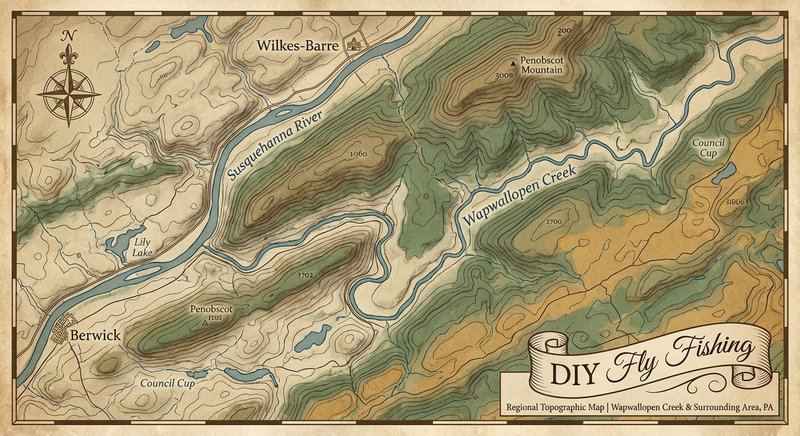
Wapwallopen Creek is a classic Appalachian freestone stream located in Northeastern Pennsylvania. It originates in the highlands near Nuangola and winds its way through lush forests and agricultural valleys before dropping steeply through a dramatic gorge and entering the Susquehanna River.
What makes it special is its diversity of character. The upper reaches feel like a secluded mountain brook, while the middle and lower sections widen into a more traditional trout stream with deep plunge pools, long runs, and classic riffles. It is heavily influenced by rainfall; it can run high and turbid after a storm but clears relatively quickly. Anglers love it because it offers a sense of solitude that is hard to find on more famous PA limestone springs.
🐟 Target Species & Behavior
The Wappy is a two-story fishery, but for the fly angler, the focus is on trout.
- Brown Trout: These are the primary residents. The creek is stocked annually by the Pennsylvania Fish and Boat Commission (PFBC), but there is a significant population of wild, stream-born Brown Trout. These wild fish are wary, often holding tight to undercut banks, submerged logs, and the "bubbles" at the head of deep pools.
- Brook Trout: Found primarily in the cooler, steeper headwaters and the small mountain tributaries. These are native gems—small, aggressive, and stunningly colored.
- Behavior: In the spring, fish are opportunistic and will move for larger meals. As the water warms in the summer, they retreat to the oxygenated "white water" (the heads of pools) and deep shady undercut banks. They are notorious for being "shadow feeders"—if your shadow falls on the water, the fishing is over for that hole.
📅 Best Times to Fish
Spring (April – Early June)
This is the prime window. The water temperatures are ideal (50°–60°F), and the major hatches occur. Early spring is great for nymphing, while May brings the best dry fly action.
Summer (Late June – August)
Fishing becomes more technical. You must focus on the early morning (dawn till 10:00 AM) or the "magic hour" at dusk. Seek out high-gradient sections where the water is well-oxygenated. Note: Keep an eye on water temps; if it hits 68°F, give the trout a break to prevent mortality.
Fall (September – November)
The Wappy comes alive again. Wild Browns become aggressive as they prepare for the spawn. This is "streamer season." The colors of the foliage matching the colors of the trout make this the most aesthetic time to be on the water.
🪰 Recommended Flies & Techniques
Dry Flies
- Hatches: Look for Early Brown Stoneflies (March), Blue Winged Olives (April/May), and the legendary Sulphurs (Late May/June).
- The "Wappy Special": A Royal Wulff or Humpy (Size 14-16) is highly effective here. Because the water is often broken and turbulent, high-visibility attractors work well.
- Trics & Gnats: In late summer, tiny Tricos (Size 22-24) hatch in the slower flats near the mouth.
Nymphs (The Bread and Butter)
- Pheasant Tail (14-18): Imitates almost everything.
- Frenchie or Perdigon: In the fast pocket water, you need flies that sink instantly.
- Walts Worm: Simple and deadly in the deeper runs.
Streamers
- Wooly Bugger (Black or Olive): The gold standard for the Wappy.
- Small Sculpin Patterns: Fish these deep through the plunge pools where the big wild browns hide.
Presentation Tip
Short-line Nymphing: Because of the creek's "pocket water" nature, European-style nymphing (high-sticking) is incredibly effective. Minimizing fly line on the water prevents the complex currents from dragging your fly unnaturally.
💡 Pro Tips & Local Knowledge
- The "Gorge" Section: The lower section near the Susquehanna features a dramatic drop with waterfalls. While scenic, the best trout fishing is often upstream of the falls. The water above the gorge stays cooler longer.
- Tributary Hopping: If the main stem is running high or too warm, explore the tiny unnamed "blue lines" that feed into the Wappy. These are almost guaranteed to hold native Brookies.
- Stealth is Mandatory: This isn't the Delaware River where you can long-cast. This is "ninja fishing." Wear earthy colors, stay low, and wade upstream to stay behind the fish's field of vision.
- The "Ant" Factor: From July through September, a Cinnamon Ant or Black Foam Beetle dropped right against a grassy bank will often out-fish any hatch.
⚠️ Important Information
Access
- Public access is available via various bridge crossings and pull-offs along Wapwallopen Road and Hoby-Wapwallopen Road.
- Private Property: Much of the land surrounding the creek is privately owned. Pennsylvanians are generally friendly, but always respect "Posted" signs. If it's not posted, you are generally okay to wade, but keep your footprint small.
Regulations
- License: A valid Pennsylvania Fishing License and a Trout/Salmon Permit are required for anyone 16 and older.
- Classification: Check the current PFBC summary, as certain sections may fall under different management (Stocked Trout Waters vs. Wild Trout designations).
- Catch and Release: While some sections allow harvest, I strongly recommend Catch and Release for all wild fish to preserve the genetics of this fragile ecosystem.
Safety
- The rocks in the Wappy are notoriously "greasy." Felt soles or studs are highly recommended.
- Cell service is spotty in the steeper sections of the valley—let someone know where you are parking.
Guide’s Final Word: Wapwallopen Creek rewards the patient angler who appreciates the "small ball" game. Don't look for 20-inch fish; look for the perfect 10-inch wild brown that fought like a heavyweight in a crystal-clear mountain pool. Tight lines!
Bug Hatches & Matching Flies
| Hatch | Type | Peak months | Time of day | Hook sizes | Matching flies |
|---|---|---|---|---|---|
| Blue-Winged Olive Baetis tricaudatus | mayfly | March, April, October, November | Mid-day | #18-22 | RS2 #18-22, Parachute Adams #18-22, Pheasant Tail Nymph #18-20 |
| Quill Gordon Epeorus pleuralis | mayfly | April | Afternoon | #12-14 | Quill Gordon Dry #12-14, Gold Ribbed Hare's Ear #12-14 |
| Hendrickson Ephemerella subvaria | mayfly | April, May | Afternoon | #12-14 | Red Quill #12-14, Hendrickson Nymph #12-14, Hendrickson Emerger #12-14 |
| Grannom Caddis Brachycentrus | caddis | April, May | Morning/Evening | #14-16 | Elk Hair Caddis #14-16, LaFontaine's Deep Pupa #14-16, Grannom Larva #14-16 |
| Sulphur Ephemerella invaria/dorothea | mayfly | May, June | Evening | #14-18 | Sulphur Parachute #14-18, CDC Sulphur Emerger #16-18, Sulphur Spinner #14-18 |
| Slate Drake Isonychia bicolor | mayfly | June, September, October | Afternoon/Evening | #10-14 | Isonychia Parachute #10-12, Zug Bug #10-14, Prince Nymph #10-14 |
| Tan Caddis Hydropsyche | caddis | June, July, August | Evening | #14-16 | Tan Elk Hair Caddis #14-16, Soft Hackle Hare's Ear #14-16 |
| Light Cahill Stenacron interpunctatum | mayfly | June, July | Evening | #12-14 | Light Cahill Dry #12-14, Cream Usual #12-16 |
| Terrestrials Formicidae / Coleoptera | terrestrial | July, August, September | All Day | #12-20 | Black Foam Beetle #14-18, Cinnamon Ant #16-20, Dave's Hopper #10-12 |