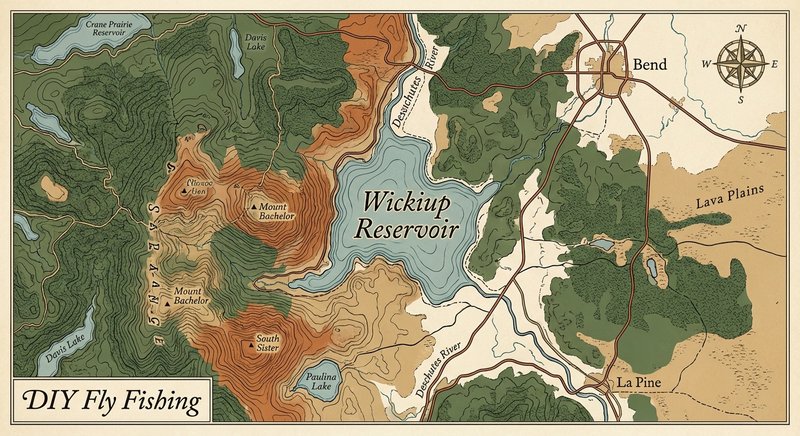
Wickiup Reservoir
Fly fishing in Oregon · Beginner · Best seasons: Spring, Summer, Fall
Target Species
Brown Trout, Kokanee Salmon, Rainbow Trout
About This Water
Large Cascade reservoir with brown trout, kokanee, and whitefish.
Fishing Recommendations
Wickiup Reservoir is often referred to as the "biological factory" of Central Oregon. Located in the Deschutes National Forest, it is legendary among fly anglers for producing some of the largest German Brown Trout in the United States. While it is a man-made impoundment of the Upper Deschutes River, its shallow, nutrient-rich waters create a massive food base that allows fish to grow to trophy proportions with shocking speed.
Here is your comprehensive guide to fly fishing Wickiup Reservoir.
🎣 Location Overview
Wickiup is the second-largest reservoir in Oregon, but it is remarkably shallow. It is characterized by vast flats, submerged lava flows, and—most importantly—the winding submerged channels of the Deschutes River, Davis Creek, and Wickiup Creek.
What makes it special is its productivity. The volcanic soil and shallow depth allow for massive hatches of midges, callibaetis, and damselflies. However, anglers must be prepared for "stump hopping." When the water is drawn down for irrigation, thousands of ancient tree stumps are revealed. This structure provides the perfect ambush cover for predatory trout but makes navigation by boat a tactical challenge.
🐟 Target Species & Behavior
Brown Trout
The undisputed kings of Wickiup. These are not your average stream browns; they are piscivorous (fish-eating) monsters that can exceed 10–15 pounds.
- Behavior: They hold in the deep river channels during the day and move onto the shallow flats to hunt at dawn, dusk, and during low-light conditions.
- Feeding: While they eat insects as juveniles, the big adults target Tui Chub, Kokanee fry, and crawfish.
Kokanee Salmon
Wickiup produces some of the "fattest" Kokanee in the state.
- Behavior: They are school-oriented and light-sensitive. They follow the cool, oxygenated water of the submerged Deschutes channel.
- Feeding: Primarily zooplankton, but they are notoriously aggressive toward bright, flashy attractor patterns.
Rainbow Trout
Often overlooked due to the Browns, the Rainbows here are hard-fighting and grow quickly.
- Behavior: They tend to stay closer to the inlet of the Deschutes and around the dam. They are more likely to be found rising to mayfly hatches than the trophy Browns.
📅 Best Times to Fish
- Spring (April – June): This is the prime window. As the ice melts and the reservoir fills, fish move into the shallows. The "opener" in late April/May is famous for targeting big Browns near the banks.
- Summer (July – August): As water levels drop due to irrigation needs, the fish are pushed out of the flats and into the concentrated river channels. This makes them easier to find, but the warmer water can make them lethargic during mid-day.
- Fall (September – October): A "trophy hunter’s" dream. Brown trout become aggressive as they prepare to move up the Deschutes River to spawn. The colors on the fish are spectacular, and they are looking for large meals.
- Prime Windows: Low light is your best friend. Be on the water before the sun hits the surface. Overcast, drizzly days are often the most productive for trophy Browns.
🪰 Recommended Flies & Techniques
For Trophy Brown Trout (Streamers)
- Technique: Use a fast-sink tip line. Cast toward submerged stumps or the edges of the river channel and use an erratic, "injured" retrieve.
- Patterns:
- Sculpzilla (White or Olive) #4-8
- Gamechanger (White/Silver to mimic Kokanee fry)
- JJ Special (Yellow/Brown)
- Dolly Varden (Large articulated streamers)
For The "Hatch" (Nymphing & Dry Fly)
- Technique: Indicator nymphing along the channel edges or "slow-rolling" a midge on a hover line.
- Patterns:
- Callibaetis Spinners #14-16 (for the morning rise)
- Balanced Leeches (Bruised or Peacock) - Highly effective under an indicator
- Chironomids (Black/Silver or Red/Black) #12-18
For Kokanee (Fly Trolling)
- Technique: Many fly anglers "troll" using an intermediate or Type 3 sinking line at a very slow walking pace.
- Patterns:
- Red Wedding Ring style flies
- Pink or Orange Comets
- Bead-head Wooly Buggers in hot pink.
💡 Pro Tips & Local Knowledge
- Follow the Channel: Download a bathymetric map or use a high-quality GPS (like OnX or Navionics). The fish live in the "old river bed." If you are over the flats and not seeing fish, move until you find the drop-off into the channel.
- The "Wickiup Wind": The wind usually kicks up by 11:00 AM. It can be dangerous for small boats. Plan to be off the water or in a sheltered cove by noon.
- Low Water Strategy: In recent years, Wickiup has been drawn down very low by late summer. When this happens, the reservoir becomes more like a slow-moving river. Focus on the "inflow" areas where the Deschutes enters the reservoir; the moving water is highly oxygenated and attracts every fish in the system.
- The "Stump Hook": Don't use 5x tippet for Browns here. Use 0x or 1x fluorocarbon (12-15lb test). You need to be able to "horse" a big fish away from the submerged timber, or they will wrap you and break you off instantly.
⚠️ Important Information
- Access: The primary boat ramps are at Gull Point and Wickiup Butte. During low water years, the Wickiup Butte ramp is often the only one deep enough to launch.
- Regulations: Wickiup falls under the "Central Zone" regulations. Generally, the season runs from late April through October 31st. Always check the current ODFW (Oregon Department of Fish and Wildlife) regulations, as emergency closures due to low water levels or temperature have occurred in recent years.
- Safety: The submerged stumps are notorious for destroying lower units on outboard motors. If you are not in the main channel, travel at a crawl.
- Environment: Be mindful of the Oregon Spotted Frog habitat—certain areas may have seasonal restrictions.
Guide’s Final Word: Wickiup is a game of patience. You might go hours without a strike, but when the rod finally bows, it could be the largest Brown Trout of your life. Stay focused on the channel edges and keep your streamers deep!
Bug Hatches & Matching Flies
| Hatch | Type | Peak months | Time of day | Hook sizes | Matching flies |
|---|---|---|---|---|---|
| Chironomids Chironomidae | midge | April, May, June | All Day | #10-18 | Ice Cream Cone #12-16, Chironobomber #10-14, Griffith's Gnat #16-20 |
| Callibaetis Callibaetis ferrugineus | mayfly | June, July, August | Late Morning/Afternoon | #12-16 | Callibaetis Spinner #14-16, Mercer's Poxyback Callibaetis #14-16, Quigley's Cripple #14-16 |
| Damselfly Enallagma | terrestrial | June, July | Mid-day | #10-14 | Marabou Damsel #10-12, Braided Butt Damsel #12-14, Sheep Creek Special #12-14 |
| Traveling Sedge Hesperophylax | caddis | June, July | Evening | #8-12 | Mikulak Sedge #8-10, Goddard Caddis #10-12, Godzilla Caddis #8-10 |
| Dragonfly Anisoptera | terrestrial | July, August | Afternoon | #4-8 | Gomphus Nymph #6-10, Moorish Dirty Dragon #4-8, Carey Special #6-10 |
| Water Boatmen Corixidae | terrestrial | September, October | Afternoon | #14-16 | Prince Nymph #14-16, Water Boatman #14-16 |
| Little Black Caddis Brachycentrus | caddis | April, May | Afternoon | #16-18 | Zebra Midge (Black) #18, Elk Hair Caddis (Black) #16-18 |
| Carpenter Ants Camponotus | terrestrial | May, June | Afternoon | #10-14 | Black Foam Ant #12-14, Chernobyl Ant #10-12 |