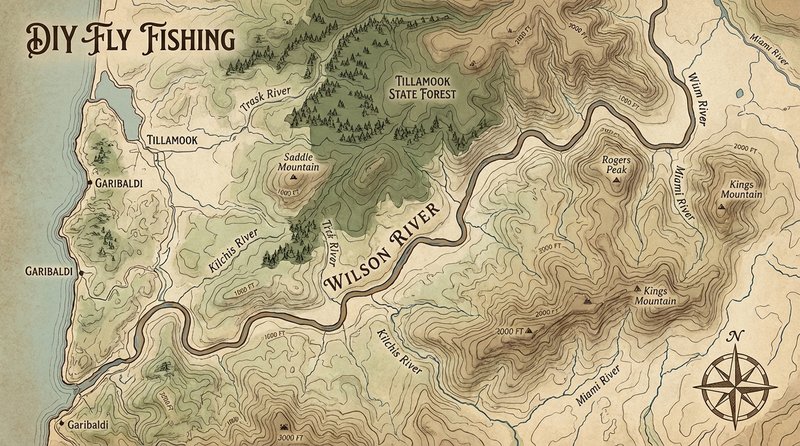
Wilson River
Fly fishing in Oregon · Beginner · Best seasons: Fall, Winter, Spring
Target Species
Steelhead, Chinook Salmon, Coho Salmon
About This Water
Popular Tillamook County river for steelhead and salmon. Good access and consistent runs.
Fishing Recommendations
The Wilson River is one of Oregon’s "Big Three" coastal rivers (alongside the Trask and Nestucca) and is arguably the premier destination for winter steelhead in the Pacific Northwest. Flowing from the high Coast Range down through the Tillamook State Forest and into Tillamook Bay, the Wilson is a classic freestone river known for its breathtaking emerald-green water and its accessibility.
🎣 Location Overview
The Wilson is a "flashy" river, meaning its levels rise and fall quickly with the rain. This is its greatest strength; while other rivers remain blown out for days after a storm, the Wilson often clears and becomes fishable within 24–48 hours.
The river is divided into three distinct characters:
- The Upper River: Tight, technical water with boulder gardens and deep canyon pools. Best for those who like to hike and pick apart pocket water.
- The Middle River: Classic "swing" water with long, walking-speed riffles and tailouts.
- The Lower River/Tidewater: Slower, deeper water where fresh fish first enter from the salt.
Anglers love the Wilson because it offers a legitimate chance at a 20-pound steelhead and 50-pound Chinook, all within a 90-minute drive of Portland.
🐟 Target Species & Behavior
Winter Steelhead
These are the Wilson's crown jewels. They enter the river from December through April.
- Behavior: They are aggressive when fresh. They hold in "seams" where fast and slow water meet, and in the "tailouts" (the smooth water just above a rapid).
- Feeding: They don't technically feed in freshwater, but they strike out of predatory instinct or territorial aggression.
Fall Chinook (King Salmon)
Massive, powerful fish that arrive in October and November.
- Behavior: They prefer deep, slow holes and "holding water" behind large boulders. They move on the rise of the river and settle as it drops.
- Feeding: They are notorious for being "moody." They react best to large, bright profiles that irritate them into striking.
Coho Salmon (Silver Salmon)
Typically running alongside the Chinook in late fall.
- Behavior: Coho love "slack water" or the slow edges of main currents. They are much more willing to chase a fly than Chinook.
📅 Best Times to Fish
- Winter Steelhead (December – April): The peak is usually February and March. Look for a "dropping and clearing" hydrograph. The magic water color is "steelhead green"—about 3 to 4 feet of visibility.
- Fall Chinook (October – November): The first big rains of October push the bulk of the run into the river.
- Coho (September – November): Early fall is best, specifically in the lower river reaches.
- Optimal Conditions: Low-light periods (dawn and dusk) are always best, but on the Wilson, water level is everything. The river is prime when the gauge at Tillamook is between 4.5 and 6.0 feet.
🪰 Recommended Flies & Techniques
Winter Steelhead: The "Swing" vs. The "Nymph"
- Spey Casting (Swinging): This is the soul of the Wilson. Use a 7 or 8-weight Spey rod with a Skagit head and a T-11 or T-14 sink tip.
- Top Flies: Intruders (Pink/Orange, Black/Blue), Hobo Spey, and Prom Dress.
- Indicator Nymphing: Highly effective in the upper river's pocket water.
- Top Flies: Lifter’s Beads (10mm or 12mm in "Mottled Roe"), Nightmares, and Rubber-Legged Stoneflies.
Fall Chinook & Coho
- Technique: Usually swung deeply or "stripped" in tidewater.
- Top Flies: Comets (Chartreuse or Orange), Bunny Leaches, and the Flash Trap. For Coho, think small and bright (pink/purple).
💡 Pro Tips & Local Knowledge
- The "Color" Rule: If the water is dirty (1–2 feet visibility), go big and bright (Cerise, Chartreuse). If the water is low and clear, go small and dark (Black, Blue, or even Olive).
- Focus on the Tailouts: Most fly anglers over-fish the deep "buckets." Winter steelhead are often resting in the shallow, walking-speed water at the very end of a run before it breaks into the next riffle.
- The Highway 6 Factor: The Wilson runs parallel to Highway 6. This means easy access, but also "combat fishing" in popular holes. To find success, look for pull-outs without cars and be prepared to bushwhack down to the water.
- The "Guide Shop" Hole: A famous spot. It’s crowded for a reason—it holds fish. If you’re new, start here to see how locals transition through a run.
⚠️ Important Information
Access
- Foot Access: Plentiful along Highway 6. Key spots include Jones Creek, Footbridge, and the Siskeyville area.
- Boat Access: The Wilson is a premier drift boat river. Popular drifts are Sollie Smith Bridge to Tidewater (lower) and Mills Bridge to Sollie Smith.
Regulations & Permits
- Steelhead: Wild steelhead must be released unharmed. Only hatchery fish (identified by a clipped adipose fin) may be retained.
- Licensing: You need a valid Oregon Angling License AND a Combined Angling Tag (Steelhead/Salmon).
- Barbless Hooks: While not always mandatory depending on the specific zone/season, it is highly recommended for the safety of wild fish. Always check the ODFW Recreation Report before heading out.
Special Considerations
- Safety: The Wilson can rise several feet in a few hours. Always keep an eye on the weather and river gauges.
- Wading: The rocks are incredibly slippery (basalt). Studded wading boots and a wading staff are non-negotiable.
Bug Hatches & Matching Flies
| Hatch | Type | Peak months | Time of day | Hook sizes | Matching flies |
|---|---|---|---|---|---|
| Blue Winged Olive (BWO) Baetis | mayfly | March, April, October, November | Midday | #16-22 | Parachute Adams #18-20, RS2 #18-22, Pheasant Tail Nymph #16-20 |
| March Brown Rhithrogena morrisoni | mayfly | March, April, May | Afternoon | #12-14 | March Brown Dry #12-14, Hare's Ear Nymph #12-14, March Brown Spun Emerger #12-14 |
| Grannom Caddis Brachycentrus | caddis | April, May | Morning/Afternoon | #14-16 | Elk Hair Caddis #14-16, Peacock Caddis Larva #14-16, Deep Sparkle Pupa #14-16 |
| Golden Stonefly Hesperoperla pacifica | stonefly | June, July | All Day | #8-12 | Chubby Chernobyl #8-12, Kaufmann's Stone #8-12, Pats Rubber Legs #8-12 |
| Yellow Sally Isoperla | stonefly | June, July, August | Late Afternoon/Evening | #14-16 | Yellow Sally Dry #14-16, Little Yellow Sloan #14-16 |
| October Caddis Dicosmoecus | caddis | September, October | Afternoon/Evening | #8-10 | Orange Stimulator #8-10, October Caddis Pupa #8-10, Morrish's Deep October Nymph #10 |
| Pale Morning Dun (PMD) Ephemerella excrucians | mayfly | June, July, August | Morning/Midday | #16-18 | PMD Sparkle Dun #16-18, Split Case PMD #16-18, Trigger Finger PMD #16 |
| Midges Chironomidae | midge | January, February, December | All Day | #18-24 | Zebra Midge #18-22, Griffith's Gnat #18-22, Top Secret Midge #20-22 |