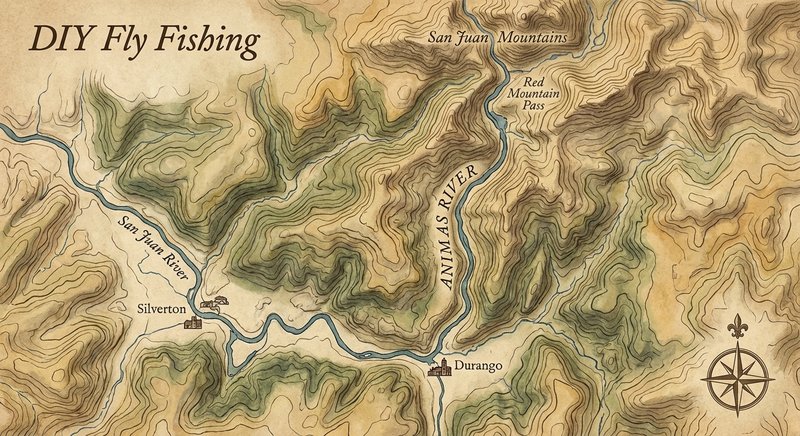
Animas River
Fly fishing in Colorado · Beginner · Best seasons: Summer, Fall
Target Species
Rainbow Trout, Brown Trout
About This Water
Through Durango with good populations of wild trout. Urban and canyon sections with diverse fishing opportunities.
Fishing Recommendations
Tight lines! You’ve picked one of the most underrated and rewarding freestone rivers in the Rocky Mountains. As a guide who has spent years rowing and wading these waters, the Animas River is a gem that demands respect but offers incredible rewards for the technical angler.
Here is your comprehensive guide to fishing the Animas in Durango, Colorado.
🎣 Location Overview
The Animas River—the "River of Lost Souls"—is one of the last major free-flowing (un-dammed) rivers in Colorado. Flowing through the heart of Durango, it offers a unique blend of urban accessibility and rugged wilderness.
What makes it special is its Gold Medal status. To earn this designation from Colorado Parks and Wildlife, a river must consistently produce a high number of "quality" trout (14+ inches). The Animas is a "big water" river; it’s wide, powerful, and filled with massive boulders, deep plunges, and long, slick glides. It isn't a high-alpine creek where you catch dozens of 8-inch fish; it’s a river where you hunt for a few 20-inch buttery browns.
🐟 Target Species & Behavior
The Animas is a high-productivity fishery, though it can be "moody" due to its freestone nature.
- Brown Trout: The kings of the Animas. These fish are wild, wary, and highly territorial. They hold tight to the banks, behind large "bus-sized" boulders, and in deep undercut banks. They are aggressive predators, often preferring a large streamer over a tiny nymph.
- Rainbow Trout: Generally found in the faster, oxygenated "riffle-run" water. While many are wild, there is also a healthy population of stocked fish that grow quickly in the rich aquatic environment.
- Behavior: During the day, fish hold in the "seams" (where fast and slow water meet). As evening approaches, larger browns often move into shallower tailouts to hunt baitfish and crawfish.
📅 Best Times to Fish
While you can fish the Animas year-round, the Summer and Fall are the pinnacle.
- Summer (July – August): Once the spring runoff subsides (usually by late June), the river becomes a dry-fly paradise. This is the time for big terrestrial patterns and evening caddis hatches.
- Fall (September – November): This is arguably the best time for trophy hunters. The Brown Trout begin their pre-spawn move, becoming extremely aggressive. The water drops and clears, making the fish easier to locate. The fall colors in the Animas Canyon are world-class.
- Best Time of Day:
- Summer: Early morning and the "magic hour" before sunset to avoid the heat and the inner-tube rafters.
- Fall: Mid-morning through late afternoon as the water warms slightly.
🪰 Recommended Flies & Techniques
Top Fly Patterns
- Dry Flies: Chubby Chernobyl (Size 8-12, Orange or Tan), Elk Hair Caddis (Size 14-16), Puterbaugh’s Foam Caddis, and Parachute Adams.
- Nymphs: Pat’s Rubber Legs (the "workhorse" here), Pheasant Tail (Size 14-18), Prince Nymph, and the RS2 (Size 20-22) for the picky fish in the tailouts.
- Streamers: This is streamer country. Use Sparkle Minnows, Sex Dungeon (Olive or Black), and Sculpzilla.
Effective Techniques
- The "Durango Rig": A heavy two-nymph rig under a large indicator. You need to get deep, fast. Use plenty of split shot to bounce off the bottom of those deep runs.
- Hopper-Dropper: In late summer, a Chubby Chernobyl with a bead-head nymph 24 inches below it is lethal along the banks.
- The Streamer Swing: In the fall, cast your streamer at a 45-degree angle toward the bank and strip aggressively or "swing" it through the deep pools.
💡 Pro Tips & Local Knowledge
- The "Big Water" Mindset: The Animas is wide. Don't try to fish the whole river. Focus on the first 15 feet from the bank. The biggest fish often hold much closer to the shore than you think, especially in the pocket water.
- Wading Safety: This river is slick and powerful. The rocks are covered in "snot" (didymo/algae). Use felt-soled boots with studs and a wading staff. Don't underestimate the current.
- Follow the Train: The Durango & Silverton Narrow Gauge Railroad runs right along the river. In the "High Animas" (above Durango), the only way to access certain spots is by taking the train and getting dropped off at the "Needleton" stop.
- Watch the Gauge: If the river flow (USGS gauge at Durango) is above 2,000 CFS, wading is dangerous. The "sweet spot" for wade fishing is 400–800 CFS.
⚠️ Important Information
- Access: There are roughly 7 miles of public access within the city limits of Durango via the Animas River Trail. The "Gold Medal" water starts at the Lightner Creek confluence and runs south to the Rivera Bridge.
- Regulations:
- From the Lightner Creek confluence to the Dalton Ranch bridge: Artificial flies and lures only.
- The bag and possession limit for trout is two fish, 16 inches or longer. (Most locals practice 100% Catch and Release to preserve the trophy quality).
- Permits: A valid Colorado Fishing License is required. You can buy these at local shops like Durango Angler or San Juan Angler.
- Private Property: Be careful south of town; the river flows through Southern Ute Tribal Lands. You must have a specific Tribal Fishing Permit to fish those stretches—a standard CO license won't cut it.
Guide’s Final Word: "The Animas doesn't give up its secrets easily. If you get skunked, don't be discouraged. Keep your flies deep, watch your shadows on the water, and when that 20-inch Brown finally hits your streamer, you'll know why we call this place home."
Bug Hatches & Matching Flies
| Hatch | Type | Peak months | Time of day | Hook sizes | Matching flies |
|---|---|---|---|---|---|
| Midges Chironomidae | midge | January, February, March, December | All Day | #18-24 | Zebra Midge #18-22, Griffith's Gnat #18-22, Top Secret Midge #20-24 |
| Blue-Winged Olive (BWO) Baetis | mayfly | March, April, September, October | Late Morning/Afternoon | #18-22 | RS2 #18-22, Parachute Adams #18-22, JujuBaetis #18-22 |
| Salmonfly Pteronarcys californica | stonefly | June | Afternoon/Evening | #4-8 | Pats Rubber Legs #6-8, Chubby Chernobyl #6-10, Sofa Pillow #6-8 |
| Mother's Day Caddis Brachycentrus | caddis | April, May | Afternoon/Evening | #14-16 | Elk Hair Caddis #14-16, Peacock Caddis #14-16, Graphic Caddis #14-16 |
| Pale Morning Dun (PMD) Ephemerella excrucians | mayfly | June, July, August | Morning/Early Afternoon | #14-18 | Pheasant Tail Nymph #14-18, PMD Sparkle Dun #16-18, Mercury PMD #16-18 |
| Golden Stonefly Hesperoperla pacifica | stonefly | June, July | Morning/Evening | #8-12 | 20 Incher Stone #8-12, Golden Chubby #10-12, Iron Lotus #12-14 |
| Yellow Sally Isoperla | stonefly | June, July | Afternoon/Evening | #14-16 | Yellow Sally Dry #14-16, Little Yellow Sloan #14-16, Hot Bead Micro Stone #14-16 |
| Tricos Tricorythodes | mayfly | August, September | Early Morning | #20-24 | Trico Spinner #20-22, Sunray Trico #20-24, Trico Nymph #20-22 |
| Grasshoppers Acrididae | terrestrial | July, August, September | Late Morning/Afternoon | #8-12 | Amy's Ant #10-12, Morrish Hopper #8-12, Tan Thunder Thighs #10-12 |