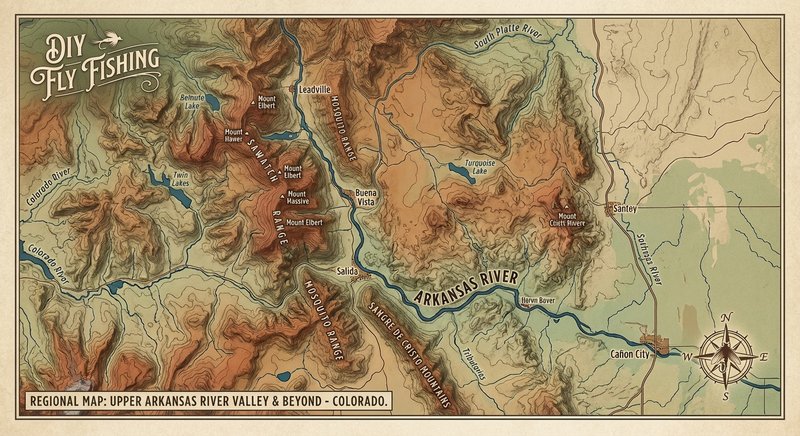
Arkansas River
Fly fishing in Colorado · Beginner · Best seasons: Spring, Summer, Fall
Target Species
Brown Trout, Rainbow Trout
About This Water
From Leadville to Canon City, this river offers excellent brown trout fishing with easy access and beautiful mountain scenery.
Fishing Recommendations
Welcome to the "Ark." As a guide, the Arkansas River is one of my favorite systems because of its sheer diversity and resilience. Stretching over 100 miles of Gold Medal Water, it is the longest continuous stretch of managed blue-ribbon water in Colorado. Whether you are fishing the high-alpine meadows near Leadville or the deep, bouldery pockets of Bighorn Sheep Canyon, the Ark offers a quintessential western freestone experience.
🎣 Location Overview
The Arkansas River is a freestone river that begins its journey near Leadville, dropping through a massive glacial valley before carving through deep granite canyons.
What makes it special is the high gradient and high oxygen levels. This isn't a slow, meandering meadow stream for the most part; it’s a "pocket water" factory. The river is characterized by millions of granite boulders that create endless eddies, soft seams, and holding lies. Because it’s a freestone (un-dammed for most of its prime fishing length), the insect life is incredibly prolific. It is famous for being one of the most productive wild brown trout fisheries in the United States.
🐟 Target Species & Behavior
- Brown Trout: These make up about 80–90% of the river's population. They are wild, hardy, and aggressive. They love structure. You’ll find them tucked tightly against "cushions" in front of rocks, in the soft eddies behind boulders, and undercut banks.
- Rainbow Trout: While less numerous than the browns, the rainbows here are hard-fighting and often found in the faster, more oxygenated "heavy" water at the heads of riffles.
- Behavior: Arkansas River trout are "opportunistic feeders." Because the water moves fast, they don't have long to decide. If a fly looks like food and is presented well, they will usually eat it. They aren't as "tippet shy" as South Platte fish, but they demand a drag-free drift.
📅 Best Times to Fish
Spring (Mid-March – May)
This is the season of the Mother’s Day Caddis Hatch. Starting in late April near Cañon City and moving upstream toward Salida, this hatch is a "blizzard" event. If you catch it right, the dry fly fishing is world-class.
- Window: Pre-runoff (late March to early May) is prime.
Summer (July – August)
Once the spring runoff recedes (usually by late June or early July), the river comes alive. This is the time for Stoneflies and Grasshoppers.
- Window: High summer is perfect for "smash and grab" dry fly fishing from a raft or wading the edges.
Fall (September – November)
My personal favorite. The water drops and clears, the crowds disappear, and the Brown Trout become aggressive as they prepare for the spawn.
- Window: Late September through October. Blue Winged Olives (BWO) hatch on cloudy days.
🪰 Recommended Flies & Techniques
Top Fly Patterns
- Dries: Puterbaugh’s Foam Caddis (#14-18), Elk Hair Caddis (Tan/Orange), Amy’s Ant (#10-12), Chubby Chernobyl (Gold/Olive), Parachute Adams (#16-22).
- Nymphs: Pat’s Rubber Legs (Coffee/Black), Prince Nymph (#12-16), Frenchie (#14-18), Graphic Burk’s Caddis (#14-16), Juju Baetis (#18-22).
- Streamers: Black or Olive Wooly Buggers, Sparkle Minnows, or the Autumn Splendor (especially in Fall).
Effective Techniques
- Dry-Dropper: This is the "standard" Ark rig. Use a buoyant dry fly (like a Chubby or a Foam Caddis) and hang a weighted nymph 2-3 feet below it. This allows you to pick apart pocket water efficiently.
- Tight-Line/Euro Nymphing: Because the river is so full of pockets and varying currents, tight-line nymphing is incredibly effective here to avoid drag.
- Bank Slapping: During summer, cast your hoppers within inches of the grass line. The fish often sit right against the bank to avoid the heavy main current.
💡 Pro Tips & Local Knowledge
- The "Inside Out" Approach: Most anglers wade too deep. On the Ark, the fish are often at your feet. Stand on the bank and fish the "soft" water right against the shore before you ever step into the river.
- Focus on Bighorn Sheep Canyon: The stretch between Coaldale and Parkdale has endless public access and some of the best pocket water on the river.
- Follow the Hatch: In the spring, the Brachycentrus (caddis) hatch moves upstream about 4–5 miles a day. Check local fly shop reports (in Salida or Buena Vista) to find the "active" zone.
- Watch the Flows: The Ark is part of the Voluntary Flow Management Program (VFMP). Flows are kept higher for rafters until mid-August, then dropped for fishing. Fishing usually improves significantly once flows drop below 700 CFS at the Wellsville gauge.
⚠️ Important Information
- Access: Much of the river is managed by the Arkansas Headwaters Recreation Area (AHRA). There are numerous well-marked public access points. However, there are also private "islands" of land; always look for "Public Fishing" vs. "Private Property" signs.
- Regulations: Most of the river is Gold Medal, meaning specific tackle restrictions apply (usually artificial flies and lures only, with a bag limit of 2 trout 14 inches or longer—though most guides advocate for 100% Catch & Release).
- Safety: The Arkansas is a powerful river. The rocks are notoriously "greasy" and slick. A wading staff is not optional here—it is a necessity.
- Permits: A valid Colorado Fishing License is required. Many parking areas require a Colorado State Parks pass or a daily fee.
Guide’s Final Word: Don't get discouraged if you miss fish at first. The strikes on the Ark are fast because the water is fast. Keep your rod tip up, keep your drifts short, and cover as much water as possible!
Bug Hatches & Matching Flies
| Hatch | Type | Peak months | Time of day | Hook sizes | Matching flies |
|---|---|---|---|---|---|
| Midges Chironomidae | midge | January, February, March, April | All day | #18-24 | Zebra Midge #18-22, Griffith's Gnat #20-22, Top Secret Midge #20-24 |
| Blue Winged Olive Baetis | mayfly | March, April, September, October | Late Morning/Afternoon | #18-22 | RS2 #18-22, Parachute Adams #18-22, Pheasant Tail #18-20 |
| Mother's Day Caddis Brachycentrus occidentalis | caddis | April, May | All day | #14-16 | Peeping Caddis #14-16, Elk Hair Caddis (Dark) #14-16, LaFontaine's Deep Sparkle Pupa #14-16 |
| Golden Stonefly Hesperoperla pacifica | stonefly | June, July | Morning/Afternoon | #8-12 | Pat's Rubber Legs #8-12, Chubby Chernobyl #8-12, Golden 20-Incher #10-12 |
| Pale Morning Dun Ephemerella excrucians | mayfly | July, August | Late Morning/Afternoon | #16-18 | Juju PMD #16-18, PMD Sparkle Dun #16-18, Frenchie #16 |
| Yellow Sally Isoperla | stonefly | June, July | Afternoon/Evening | #14-16 | Stimulator (Yellow) #14-16, Iron Sally #14-16, Sally Hog #14-16 |
| Trico Tricorythodes | mayfly | August, September | Early Morning | #20-24 | Trico Spinner #20-24, Drowned Trico #22, Sunken Trico Spinner #20-22 |
| Grasshoppers Acrididae | terrestrial | August, September | Late Morning/Afternoon | #8-12 | Amy's Ant #10-12, Morrish Hopper #8-12, Parachute Hopper #10-14 |