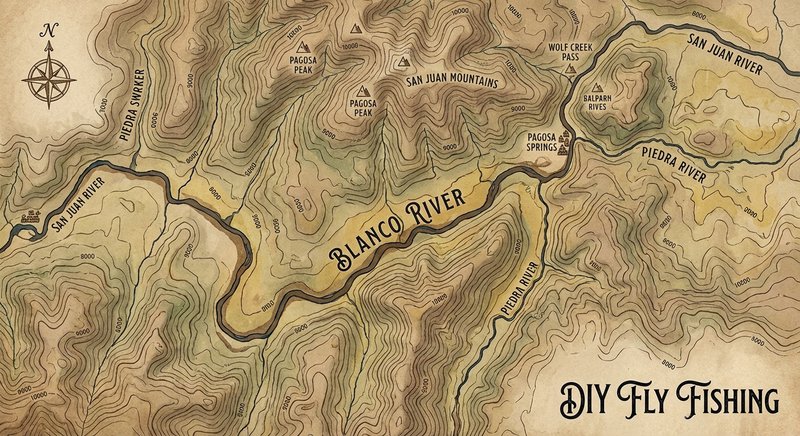
Blanco River
Fly fishing in Colorado · Beginner · Best seasons: Summer, Fall
Target Species
Brown Trout, Rainbow Trout
About This Water
Near Pagosa Springs with wild brown and rainbow trout. Less crowded San Juan fishing.
Fishing Recommendations
The Blanco River in Southwest Colorado is one of the state’s best-kept secrets. Tucked away near Pagosa Springs in the San Juan National Forest, it is often overshadowed by its larger neighbors, the San Juan and the Piedra. However, for the angler seeking solitude, rugged scenery, and eager wild trout, the Blanco is a hidden gem.
As your guide, here is the comprehensive breakdown of how to fish this high-country drainage.
🎣 Location Overview
The Blanco River is a classic freestone stream that drains the western slopes of the South San Juan Wilderness. It is characterized by its crystal-clear water, steep gradients in the upper reaches, and a mix of pocket water, deep pools, and long runs in its middle sections.
What makes the Blanco special is its remoteness and "small water" feel. Unlike the tailwaters of Colorado, the Blanco is entirely dependent on snowpack and rainfall. It is a high-gradient environment where the fish are opportunistic and the scenery—dominated by towering ponderosa pines and jagged peaks—is breathtaking. Anglers love it because you can often hike for miles without seeing another soul, providing a true wilderness fishing experience.
🐟 Target Species & Behavior
The Blanco is primarily a Brown and Rainbow Trout fishery, with the occasional cutthroat appearing in the higher headwaters.
- Brown Trout: These are the "kings" of the Blanco. They tend to be more elusive and are often found in the undercut banks, under large boulders, or in the deep, shaded tail-outs of pools. During the fall, they become much more aggressive as they prepare to spawn.
- Rainbow Trout: Found in the faster oxygenated water, riffles, and the heads of pools. They are generally more willing to rise to a dry fly than the browns.
- Behavior: Because the Blanco is a nutrient-poor freestone stream compared to a tailwater, the fish are opportunistic. They don't have the luxury of being overly picky; if a meal looks natural and is presented well, they will usually take it.
📅 Best Times to Fish
While you can fish the Blanco starting in late spring, the river is highly susceptible to heavy runoff.
- Summer (July – August): This is the prime window. Once the snowmelt subsides (usually by late June), the water clears and the dry fly action begins. This is the time for terrestrial patterns and high-country attractor dries.
- Fall (September – October): My personal favorite. The water levels drop, the cottonwoods turn gold, and the Brown Trout become aggressive. This is when you’ll find the largest fish moving out of their deep summer haunts.
- Best Time of Day:
- Summer: Early morning and late evening (the "magic hour") are best to avoid the midday sun.
- Fall: Wait for the water to warm up slightly; 10:00 AM to 4:00 PM is usually the sweet spot.
🪰 Recommended Flies & Techniques
Top Fly Patterns
- Dries:
- Attractors: Royal Wulff, Humpy (Yellow or Royal), and Stimulators (Size 12-16).
- Terrestrials: Foam Ants, Beetles, and Joe’s Hoppers (Size 10-14) during August.
- Mayflies: Parachute Adams and BWO (Size 16-20).
- Nymphs:
- Classics: Bead-head Prince Nymph, Pheasant Tail, and Hare’s Ear (Size 14-18).
- Stoneflies: Pat’s Rubber Legs (Black or Coffee) for deeper runs.
- Streamers:
- Wooly Buggers (Olive or Black) and Near Nuff Crawfish.
Effective Techniques
- Dry-Dropper Rig: This is the "bread and butter" of the Blanco. Use a high-visibility Stimulator or Hopper as your "indicator" and hang a Pheasant Tail or Copper John 18–24 inches below it.
- High-Sticking/Tight-Line Nymphing: In the pocket water sections, keep as much fly line off the water as possible to avoid drag caused by conflicting currents.
- Pocket Water Picking: Don’t just fish the big pools. Some of the best fish hide in "buckets"—small pockets of soft water behind large boulders.
💡 Pro Tips & Local Knowledge
- The "Lower Blanco" vs. "Upper Blanco": The upper reaches (accessible via Blanco Basin Road) offer more public access within the National Forest. The lower sections near the confluence with the San Juan have more private property—always check your maps.
- Stealth is Key: Because the water is exceptionally clear, the fish are "spooky." Wear earthy tones (no bright white shirts), keep a low profile, and try to cast from a distance rather than standing right on top of the hole.
- Follow the Shadows: In the summer, the fish will move into the shade of the canyon walls or overhanging brush as soon as the sun hits the water. Target the "dark water."
- The Hopper-Copper-Dropper: Local guides swear by a three-fly rig here in late August: A large foam hopper, a heavy nymph to get deep, and a tiny unweighted midge or emerger at the end.
⚠️ Important Information
Access
- Access is primarily via Blanco Basin Road (CR 326) south of Pagosa Springs.
- Follow the road until it enters the San Juan National Forest. There are several well-marked trailheads and pull-offs.
- Warning: Be mindful of private property boundaries. Much of the lower river is surrounded by private ranches; Colorado law states that the riverbed is private, so you cannot "float through" or wade on private land without permission.
Regulations & Permits
- A valid Colorado Fishing License is required.
- Standard Colorado Parks and Wildlife (CPW) regulations apply, but always check the current brochure for specific bag limits or tackle restrictions (though most of the upper river is open to bait, most serious anglers stick to artificials to preserve the wild population).
Special Considerations
- Wildlife: This is bear and mountain lion country. Carry bear spray and be "bear aware" with your food.
- Monsoons: In July and August, afternoon thunderstorms are common. Get off the water if you see lightning, and be aware that heavy rain upstream can cause the river to "blow out" (turn muddy) very quickly.
Bug Hatches & Matching Flies
| Hatch | Type | Peak months | Time of day | Hook sizes | Matching flies |
|---|---|---|---|---|---|
| Blue Winged Olive (BWO) Baetis spp. | mayfly | April, May, September, October | Late Morning/Afternoon | #18-22 | Parachute Adams #18-22, RS2 #20-22, Pheasant Tail #18-20 |
| Pale Morning Dun (PMD) Ephemerella excrucians | mayfly | June, July, August | Mid-morning/Afternoon | #14-18 | PMD Sparkle Dun #16-18, Split Case PMD #16-18, Barr's PMD Emerger #16-18 |
| Golden Stonefly Hesperoperla pacifica | stonefly | June, July | Morning/Afternoon | #8-12 | Pat's Rubber Legs #8-12, Chubby Chernobyl (Gold) #8-12, 20-Incher Stone #10-12 |
| Yellow Sally Isoperla spp. | stonefly | June, July, August | Late Afternoon/Evening | #14-16 | Yellow Sally Foam Dry #14-16, Iron Sally #14-16 |
| Brachycentrus (Mother's Day Caddis) Brachycentrus occidentalis | caddis | May | Afternoon | #14-16 | Elk Hair Caddis (Olive/Tan) #14-16, Peacock Caddis Larva #14-16 |
| Western Green Drake Drunella doddsi | mayfly | July | Afternoon/Evening | #10-12 | Green Drake Hairwing #10-12, Quigley Cripple Drake #10-12 |
| Midges Chironomidae | midge | March, April, October, November | Morning | #20-24 | Zebra Midge #20-22, Griffith's Gnat #20-22 |
| Grasshoppers Acrididae | terrestrial | August, September | All Day | #8-12 | Morrish Hopper #8-12, Joe's Hopper #10-12 |
| Spotted Sedge Hydropsyche spp. | caddis | July, August, September | Evening | #14-18 | LaFontaine's Deep Sparkle Pupa #14-16, Godzilla Caddis #14-16 |