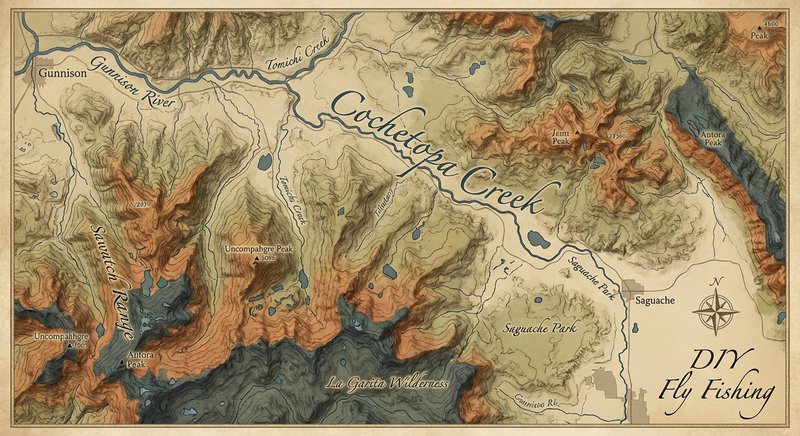
Cochetopa Creek
Fly fishing in Colorado · Intermediate · Best seasons: Summer, Fall
Target Species
Brown Trout
About This Water
Remote stream in Cochetopa Wildlife Area. Wild brown trout in scenic high mountain meadows.
Fishing Recommendations
Cochetopa Creek is one of Colorado's "hidden in plain sight" gems. Located south of Gunnison and Parlin, this high-altitude meadow stream offers some of the most classic, technical, and rewarding dry-fly fishing for wild Brown trout in the state.
Here is your comprehensive guide to fishing Cochetopa Creek.
🎣 Location Overview
Cochetopa Creek is the quintessential meandering meadow stream. Flowing through the high-country sagebrush flats of the Gunnison Basin, it is characterized by deep "S-curves," dramatic undercut banks, and thick willow lining.
What makes it special is its intimacy. This isn't a river where you need a long cast; it’s a creek where you need a smart cast. The water is generally slow-moving and crystal clear, demanding stealth and precision. Because it flows through the Cochetopa Grasslands, the wind can be a factor, but the deep cut-banks provide a sanctuary for some surprisingly large Brown trout that punch well above the creek's weight class.
🐟 Target Species & Behavior
While you will find the occasional Rainbow or Brook trout (especially higher up near the Dome Lakes), Brown Trout are the primary residents of the lower meadow stretches.
- Bank-Hugging: Cochetopa Browns are notorious for living "under the grass." They tuck deep into the undercut banks to avoid ospreys and the high-altitude sun.
- Terrestrial Focused: Because of the surrounding grasslands, these fish are highly keyed into land-based insects like grasshoppers, ants, and beetles.
- Spook Factor: These fish are incredibly wary. They can feel the vibration of an angler walking heavily on the bank long before they see a fly.
📅 Best Times to Fish
Optimal Seasons
- Summer (July – August): This is the "Golden Age" on the Cochetopa. As the meadows dry out, the grasshoppers become active. This is peak dry-fly season.
- Fall (September – October): A favorite for seasoned guides. The Brown trout become aggressive ahead of the spawn, and the Blue Winged Olive (BWO) hatches on overcast days can be spectacular.
Best Times of Day
- 10:00 AM – 4:00 PM: In the summer, you don't need to be there at the crack of dawn. You want the sun to warm the grass so the hoppers start jumping.
- Late Afternoon: The "witching hour" just before sunset often sees a prolific caddis hatch.
🪰 Recommended Flies & Techniques
Top Fly Patterns
- Terrestrials: Amy’s Ant (#10-12), Chubby Chernobyl (Tan or Orange, #12-14), Dave’s Hopper (#10-12), and Black Foam Ants (#16).
- Dry Flies: Parachute Adams (#14-18), Elk Hair Caddis (Tan, #14-16), and CDC BWO (#18-20) for the fall.
- Nymphs: Pheasant Tail (#16-18), Hare’s Ear (#16), and Bead-head Copper Johns (Red or Blue, #16-18).
- Streamers: Small Woolly Buggers (Olive or Black, #8-10) or Gold Ribbed Hare’s Ear streamers.
Effective Techniques
- The Hopper-Dropper: This is the most effective rig on the Cochetopa. Use a high-visibility hopper as your "indicator" and hang a small nymph (like a Pheasant Tail) about 18–24 inches below it.
- "Dapping" the Banks: Sometimes the willows are too thick for a traditional cast. Stealthily poke your rod tip through the brush and drop your fly right against the bank.
- The Twitch: When fishing a hopper, give it a tiny "twitch" to mimic a struggling insect. This often triggers a violent strike from a Brown hiding under the bank.
💡 Pro Tips & Local Knowledge
- Walk Softly: If you can feel the ground "thump" under your boots, the fish have already left the bank. Walk 10 feet back from the edge until you are ready to cast.
- Target the Outside Bends: The deepest water and the best undercuts are always on the outside of the "S" curves.
- Watch the Wind: The Cochetopa valley is notoriously windy. If the wind picks up, don't head for the truck—this often blows more hoppers into the water, triggering a feeding frenzy. Switch to a heavier leader and a larger foam fly.
- The "Dome Lakes" Strategy: If the creek is running low or the fishing is slow, head upstream to the Dome Lakes State Wildlife Area. It offers great flat-water fishing and serves as the headwaters for the creek.
⚠️ Important Information
Access
- Public vs. Private: Much of Cochetopa Creek runs through private ranch land. However, there are significant public stretches within the Cochetopa State Wildlife Area (SWA) and the Grand Mesa, Uncompahgre, and Gunnison (GMUG) National Forests. Always check a map (like OnX) to ensure you are on public water.
- The "Snyder Creek" Confluence: The area near the confluence with Snyder Creek is a productive public starting point.
Regulations & Permits
- A valid Colorado Fishing License is required.
- If fishing within a State Wildlife Area (SWA), you must have a valid hunting or fishing license to even set foot on the property (even for non-anglers).
- Most of the creek is under standard mountain stream regulations, but always check the current Colorado Parks and Wildlife (CPW) brochure for any emergency closures or specific tackle restrictions.
Special Considerations
- Cattle: This is open range country. You will likely encounter cows. They are generally harmless but can muddy the water if a large herd crosses upstream of you.
- Sun & Hydration: You are at over 9,000 feet. The sun is intense and the air is dry. Bring more water than you think you need.
Bug Hatches & Matching Flies
| Hatch | Type | Peak months | Time of day | Hook sizes | Matching flies |
|---|---|---|---|---|---|
| Blue-Winged Olive (BWO) Baetis spp. | mayfly | April, May, September, October | Midday | #18-22 | Parachute Adams #18-22, RS2 #20-22, Pheasant Tail #18-20 |
| Pale Morning Dun (PMD) Ephemerella excrucians | mayfly | July, August | Late Morning/Afternoon | #14-18 | PMD Sparkle Dun #16-18, Hare's Ear Nymph #14-16, Military Mayfly #16-18 |
| Western Green Drake Drunella grandis | mayfly | July, August | Afternoon | #10-12 | Green Drake Hairwing #10-12, Drake Cripple #12, 20 Incher Stone #10-12 |
| Brachycentrus (Grannom Caddis) Brachycentrus occidentalis | caddis | May, June | Morning/Evening | #14-16 | Elk Hair Caddis #14-16, LaFontaine's Deep Pupa #14-16, Peacock Caddis #16 |
| Yellow Sally Isoperla spp. | stonefly | June, July | Afternoon/Evening | #14-16 | Yellow Sally Stimulator #14-16, Iron Lotus #16, Little Yellow Sloan #14-16 |
| Trico Tricorythodes spp. | mayfly | August, September | Early Morning | #20-24 | Trico Spinner #20-24, Sunken Trico #22, Griffith's Gnat #20-22 |
| Grasshoppers Orthoptera | terrestrial | August, September | All Day | #8-12 | Parachute Hopper #10-12, Amy's Ant #12, Morrish Hopper #8-10 |
| Midges Chironomidae | midge | January, February, March, December | Late Morning | #18-24 | Zebra Midge #18-22, Top Secret Midge #20-22, Morgan's Midge #20-22 |