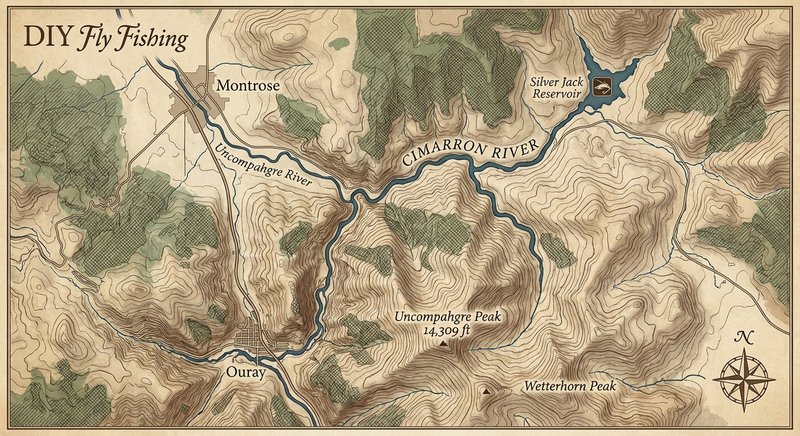
Cimarron River
Fly fishing in Colorado · Intermediate · Best seasons: Summer, Fall
Target Species
Brown Trout, Rainbow Trout
About This Water
Small stream in the San Juan Mountains. Wild brown trout in remote canyon setting south of Montrose.
Fishing Recommendations
Welcome to the Cimarron River, one of Colorado’s best-kept secrets. Located in the shadow of the dramatic Cimarron Ridge and the Uncompahgre Wilderness, this river offers some of the most scenic and rewarding small-to-medium water fishing in the San Juan Mountains.
As your guide, I’m going to walk you through how to tackle the three forks and the main stem below Silver Jack Reservoir.
🎣 Location Overview
The Cimarron River is a rugged, high-alpine system characterized by its three distinct forks (North, Middle, and South) that converge into Silver Jack Reservoir, and the tailwater section that flows below the dam into a dramatic, boulder-strewn canyon.
What makes the Cimarron special is its wild character. Unlike the manicured banks of the nearby Taylor or Fryingpan, the Cimarron is raw. You’ll find classic pocket water, deep plunge pools, and undercut banks shaded by dense willows and evergreens. It feels like "old school" Colorado—remote, quiet, and filled with eager, wild fish.
🐟 Target Species & Behavior
The Cimarron is primarily a Brown Trout and Rainbow Trout fishery, though you will find Colorado River Cutthroats in the higher reaches of the three forks.
- Brown Trout: These are the kings of the Cimarron. In the tailwater section below Silver Jack, they utilize the deep holes and "boulder gardens" to hide. They are ambush predators here, often tucked tightly against the banks or under large rocks.
- Rainbow Trout: Found throughout the system, often in the swifter, more oxygenated riffles and the heads of pools.
- Behavior: Because the growing season is short at this elevation (approx. 7,000–9,000 ft), these fish are generally opportunistic. However, in the tailwater section, they can become more selective during specific hatches (Caddis and Blue Winged Olives).
📅 Best Times to Fish
While you can find fish in the late spring, the Cimarron is a classic Summer and Fall destination.
- Summer (July - August): This is the prime window. Once the runoff subsides (usually by early July), the dry fly fishing is world-class. The water is clear, and the fish are looking up.
- Fall (September - October): This is my favorite time. The Aspen trees turn gold, the water levels drop, and the Brown Trout become aggressive as they prepare for the spawn. The crowds (which are already small) disappear completely.
- Time of Day: In mid-summer, the "magic hour" is 10:00 AM to 3:00 PM when the sun hits the water and activates insect life. In the fall, focus on the warmest part of the afternoon.
🪰 Recommended Flies & Techniques
Top Fly Patterns
- Dry Flies:
- Chubby Chernobyl (Size 10-14): The ultimate attractor and hopper pattern.
- Elk Hair Caddis (Size 14-18): A staple for the evening rise.
- Parachute Adams (Size 16-20): For when they get picky in the slower glides.
- Stimulators (Orange or Yellow, Size 12-16): Mimics the large stoneflies found in the canyon.
- Nymphs:
- Pat’s Rubber Legs (Size 10-12): Essential for the deeper holes below the dam.
- Pheasant Tail (Size 16-20): Works year-round.
- Perdigons (Size 16-18): Great for getting deep quickly in fast pocket water.
- Streamers:
- Wooly Bugger (Black or Olive): A classic that never fails here.
- Gold Bead Sparkle Minnow: Excellent for aggressive Fall Browns.
Techniques
- Dry-Dropper: This is the "bread and butter" technique on the Cimarron. Run a buoyant foam dry fly (like a Chubby) with a 2-foot dropper to a weighted nymph. This allows you to cover two zones in the pocket water without a bobber spooking fish.
- Tight-Line Nymphing: In the boulder-heavy sections below the dam, a traditional indicator often gets caught in conflicting currents. Using a Euro-style or tight-line approach helps you pick apart the pockets effectively.
- The "Splat" Cast: When fishing hoppers in August, don't be afraid to let the fly hit the water with a bit of a thud. This often triggers a reactionary strike from a big Brown hiding under a willow.
💡 Pro Tips & Local Knowledge
- The Tailwater Secret: The section directly below Silver Jack Dam is a "tailwater," but it doesn't fish like one. It's steep and rugged. Wear wading boots with studs; the rocks here are notoriously slippery and "bowling ball" shaped.
- Look for the "Ledges": The Cimarron has many underwater shelf rock formations. Fish often sit right on the edge where the shallow water drops into a dark blue hole.
- The Three Forks: If the main river is running high, head above the reservoir to the Middle or South Forks. These are smaller, "blue line" style creeks where a 3-weight rod and a single dry fly will provide a day of endless action with smaller but beautiful fish.
- Stealth is Key: Because the water is often crystal clear, your shadow is your worst enemy. Fish upstream and stay low to the bank.
⚠️ Important Information
Access
- Lower Cimarron: Most access is via Cimarron Road (P68) off Highway 50 between Montrose and Gunnison.
- Silver Jack Area: Take Forest Service Road 858 (Owl Creek Pass Road). This road is stunning but can be rough; a high-clearance vehicle is recommended but not always required in mid-summer.
Regulations
- Check CPW Regulations: Most of the Cimarron falls under standard Colorado mountain stream regulations, but always check the current Colorado Fishing Brochure for specific bag limits or tackle restrictions, as some stretches may be "Catch and Release" or "Artificial Fly and Lure Only."
- Private Property: While much of the upper river is in the Uncompahgre National Forest, there are pockets of private land on the lower river. Look for "Posted" signs and respect property lines.
Special Considerations
- Wildlife: This is prime Black Bear and Mountain Lion country. Carry bear spray and be aware of your surroundings, especially if you are deep in the canyon.
- Weather: Afternoon thunderstorms are a daily occurrence in July and August. Get off the water if you hear thunder; lightning at 9,000 feet is no joke.
Guide’s Final Word: The Cimarron is for the angler who values solitude and scenery as much as the fish. Bring a camera—the view of Dunsinane Mountain from the river valley is one of the most iconic sights in the American West. Tight lines!
Bug Hatches & Matching Flies
| Hatch | Type | Peak months | Time of day | Hook sizes | Matching flies |
|---|---|---|---|---|---|
| Midges Chironomidae | midge | January, February, March, April | All Day | #18-24 | Zebra Midge #18-22, Griffith's Gnat #20-24, Top Secret Midge #20-22 |
| Blue Winged Olive Baetis spp. | mayfly | April, May, September, October | Late Morning/Afternoon | #18-22 | RS2 #20-22, Parachute Adams #18-22, JujuBaetis #18-22 |
| Pale Morning Dun Ephemerella spp. | mayfly | July, August | Morning/Early Afternoon | #16-18 | PMD Sparkle Dun #16-18, Pheasant Tail #16-18, Barr's PMD Emerger #16-18 |
| Green Drake Drunella doddsii | mayfly | July, August | Afternoon/Evening | #10-12 | Colorado Green Drake #10-12, Drake Hairwing Dun #10-12, 20 Incher Stone #10-12 |
| Golden Stonefly Hesperoperla pacifica | stonefly | June, July | All Day | #8-12 | Pat's Rubber Leg #8-12, Chubby Chernobyl #8-12, Golden Rogue Stone #10-12 |
| Spotted Sedge Hydropsyche spp. | caddis | July, August | Late Afternoon/Evening | #14-16 | Elk Hair Caddis #14-16, LaFontaine's Deep Sparkle Pupa #14-16, Puterbaugh Caddis #14-16 |
| Yellow Sally Isoperla spp. | stonefly | July, August | Afternoon | #14-16 | Yellow Sally Dropper #14-16, Iron Sally #14-16, Stimulator #14-16 |
| Grasshoppers Orthoptera | terrestrial | August, September | Afternoon | #8-12 | Parachute Hopper #10-12, Morrish Hopper #8-12, Amy's Ant #10-14 |