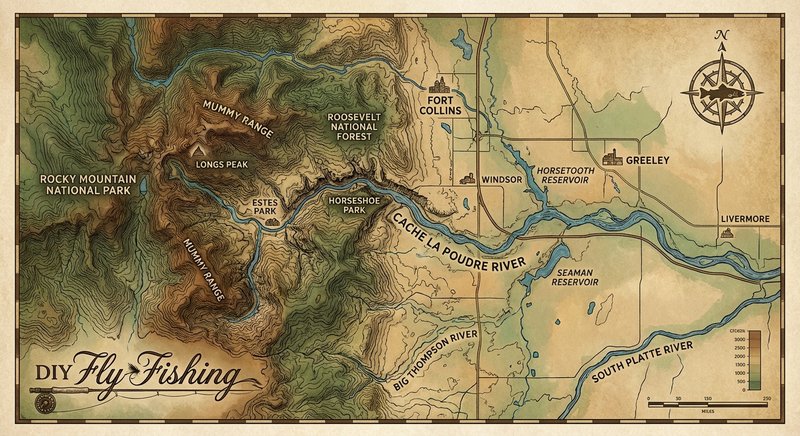
Cache la Poudre River
Fly fishing in Colorado · Intermediate · Best seasons: Summer, Fall
Target Species
Rainbow Trout, Brown Trout, Brook Trout
About This Water
Colorado's only designated Wild and Scenic River. Excellent freestone fishing in scenic Poudre Canyon northwest of Fort Collins.
Fishing Recommendations
As an expert guide who has spent countless days navigating the granite-choked pockets of the Northern Front Range, it is a pleasure to break down one of Colorado’s true gems. The Cache la Poudre River (known locally as "The Poudre") is Colorado’s only federally designated "Wild and Scenic" river. It is a classic western freestone—un-dammed for most of its length—meaning it lives and breathes with the seasons.
🎣 Location Overview
The Poudre flows through a dramatic, steep-walled canyon along Highway 14, west of Fort Collins. What makes this river special is its diversity of character. In the upper reaches, it is a high-alpine stream meandering through meadows; in the main canyon, it transforms into a high-gradient, boulder-filled playground of "pocket water."
Unlike the tailwaters of the South Platte or the Blue River, the Poudre is a "working man’s" trout stream. The fish aren't usually as massive as those found in private trophy water, but they are wild, opportunistic, and incredibly hard-fighting. Anglers love the Poudre for its accessibility—with miles of public National Forest land—and the fact that you can fish a different type of water every half-mile.
🐟 Target Species & Behavior
- Brown Trout: The dominant species in the lower and middle canyon. They are wary and love structure. Look for them in the "cushion" in front of large boulders, under overhanging branches, or tucked tightly against the granite banks.
- Rainbow Trout: More prevalent in the swifter, highly oxygenated riffles and the heads of deep pools. Many are wild, though some sections near campgrounds are supplemented by stocking.
- Brook Trout: Found primarily in the headwaters (above Poudre Falls) and in the small tributary creeks. They are smaller but vibrantly colored and extremely aggressive toward dry flies.
Behavior Note: Because this is a freestone river with limited nutrients compared to a tailwater, these fish are "opportunistic." They don't have the luxury of being overly picky; if a meal passes by in the fast current, they have a split second to decide to eat.
📅 Best Times to Fish
Summer (Late June – August)
Once the spring runoff subsides (usually by late June), the river comes alive.
- Conditions: High oxygen, active hatches.
- Prime Window: 8:00 AM to 11:00 AM and "the evening rise" from 6:00 PM until dark.
Fall (September – October)
This is arguably the "Golden Era" on the Poudre.
- Conditions: Low, crystal-clear water and brilliant yellow aspens.
- Prime Window: 10:00 AM to 4:00 PM. As temperatures drop, the fish wait for the sun to hit the water to trigger insect activity.
- Special Event: The Brown Trout become aggressive and territorial as they prepare for the fall spawn.
🪰 Recommended Flies & Techniques
Top Fly Patterns
- Dries: Elk Hair Caddis (size 14-18), Parachute Adams (16-20), Hippie Stomper (12-14), and Amy’s Ant (10-12) for summer terrestrials.
- Nymphs: Pat’s Rubber Legs (size 8-12) to mimic the Golden Stoneflies, Prince Nymphs, Pheasant Tails, and the Frenchie (a guide favorite here).
- Streamers: Black or Olive Wooly Buggers, and the Sparkle Minnow for aggressive fall Browns.
Techniques
- Dry-Dropper: This is the "bread and butter" of the Poudre. Use a buoyant dry fly (like a Chubby Chernobyl) and hang a weighted nymph 18-24 inches below it. It allows you to fish the pockets effectively without a heavy bobber.
- Tight-Line (Euro) Nymphing: Because the Poudre is so rocky with complex currents, traditional indicator nymphing often leads to "drag." A tight-line approach allows you to get nymphs deep into the small pockets behind rocks where the big fish sit.
- The "Skate": During caddis hatches in July, don't be afraid to twitch or "skate" your dry fly across the surface. Poudre trout love a moving target.
💡 Pro Tips & Local Knowledge
- The "Pocket Water" Secret: Most anglers walk past the small pockets (the size of a bathtub) to get to the big pools. On the Poudre, the biggest fish often sit in those tiny pockets of soft water right in the middle of heavy rapids. One accurate cast is all you need.
- Watch the Temperature: In mid-summer, the lower canyon (near the mouth) can get too warm for trout health (above 68°F). If it’s a hot July day, head higher up the canyon toward Big South or Poudre Falls where the water stays chilled.
- Stealth in the Fall: When the water drops in September, the fish become extremely "spooky." Ditch the bright fly line and long-distance casting. Wear earthy colors, crouch low, and use a 9-foot to 12-foot 5X leader to avoid lining the fish.
⚠️ Important Information
- Access: Most of the canyon is within the Roosevelt National Forest, meaning it is public. However, there are pockets of private land (notably around the Mountain Park area and certain resorts). Always look for "Public Fishing" signs.
- Regulations:
- Some sections are Catch and Release only with artificial flies and lures only (specifically from the Casper Bridge down to the state fish hatchery).
- Always check the current Colorado Parks and Wildlife (CPW) brochure for specific boundary markers.
- Safety: The Poudre Canyon is narrow and Highway 14 has very small shoulders. Be extremely careful when parking and walking along the road. The rocks are notoriously slippery—felt soles or metal studs on your wading boots are highly recommended.
- Permit: A standard Colorado Fishing License is required for everyone 16 and older.
Bug Hatches & Matching Flies
| Hatch | Type | Peak months | Time of day | Hook sizes | Matching flies |
|---|---|---|---|---|---|
| Midges Chironomidae | midge | January, February, March, December | Late Morning/Afternoon | #18-24 | Zebra Midge #18-22, Griffith's Gnat #20-22, Morgan's Midge #20-24 |
| Blue Winged Olive Baetis spp. | mayfly | April, May, September, October | Late Morning/Afternoon | #18-22 | RS2 #18-22, Parachute Adams #18-22, Juju Baetis #18-22 |
| Mother's Day Caddis Brachycentrus occidentalis | caddis | May | Afternoon/Evening | #14-16 | Elk Hair Caddis #14-16, Peeping Caddis #14-16, LaFontaine's Deep Sparkle Pupa #14-16 |
| Pale Morning Dun Ephemerella excrucians | mayfly | July, August | Late Morning/Afternoon | #16-18 | PMD Sparkle Dun #16-18, Pheasant Tail #16-18, Split Case PMD #16-18 |
| Western Green Drake Drunella coloradensis | mayfly | July | Afternoon/Evening | #10-12 | Colorado Green Drake #10-12, Quigley Cripple Green Drake #10-12, Poudre Canyon Drake #12 |
| Golden Stonefly Hesperoperla pacifica | stonefly | June, July | Morning/Evening | #8-12 | Pat's Rubber Legs #8-12, Chubby Chernobyl #8-12, 20 Incher #10-12 |
| Yellow Sally Isoperla spp. | stonefly | July, August | Afternoon/Evening | #14-16 | Yellow Stimulator #14-16, Iron Sally #14-16, Little Yellow Stone #16 |
| Spotted Sedge Hydropsyche spp. | caddis | July, August, September | Evening | #14-18 | Godzilla Caddis #14-16, Graphic Caddis #16-18, X-Caddis #16-18 |
| Red Quill Rhithrogena morrisoni | mayfly | June, July | Afternoon | #12-14 | Red Quill #12-14, Hare's Ear #12-14 |
| Terrestrials Orthoptera / Formicidae | terrestrial | August, September | Late Morning/Afternoon | #10-16 | Amy's Ant #12-14, Morrish Hopper #10-12, Black Foam Beetle #14-16 |