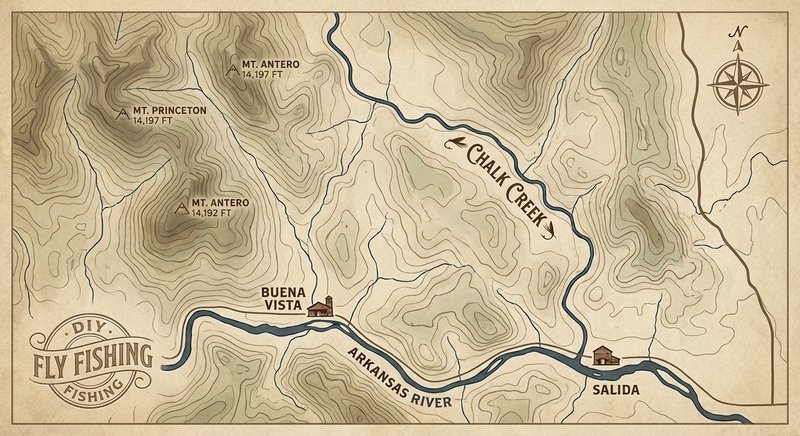
Chalk Creek
Fly fishing in Colorado · Intermediate · Best seasons: Summer, Fall
Target Species
Brown Trout, Rainbow Trout
About This Water
Near Mt. Princeton hot springs. Wild brown and rainbow trout in beautiful canyon setting.
Fishing Recommendations
Chalk Creek is a classic Colorado mountain freestone stream that flows from the high peaks of the Sawatch Range down to its confluence with the Arkansas River at Nathrop. Nestled between Mount Princeton and Mount Antero, this creek offers some of the most scenic and accessible pocket-water fishing in the state.
As an expert guide, here is my comprehensive breakdown for fishing Chalk Creek, Colorado.
🎣 Location Overview
Chalk Creek is defined by its high-gradient, "stair-step" character. Because it drops significantly in elevation over a short distance, the water is characterized by fast runs, plunge pools, and abundant "pocket water" created by massive granite boulders.
What makes it special is the Chalk Cliffs—the white, towering kaolinite formations that give the creek its name. These minerals sometimes give the water a slight milky tint, but it remains remarkably productive. Anglers love it because it is far less crowded than the neighboring Arkansas River and offers a "small stream" intimacy where trout are opportunistic and eager to rise to a dry fly.
🐟 Target Species & Behavior
The creek is predominantly home to Brown Trout and Rainbow Trout, with the occasional Brook Trout appearing as you move higher toward St. Elmo.
- Brown Trout: These are the dominant species in the middle and lower sections. They are masters of the undercut banks and the "soft" water behind large boulders. They tend to be more aggressive in the fall during their spawn.
- Rainbow Trout: Often found in the bubblier, highly oxygenated water at the heads of pools. The CPW (Colorado Parks and Wildlife) frequently stocks certain accessible areas near campgrounds, but wild rainbows are also present.
- Behavior: Because the water is fast and the growing season is short, these fish are not "Ph.D. trout" like those on the South Platte. They have a split second to decide to eat before the current sweeps the food away. Fast reflexes and aggressive takes are the norm here.
📅 Best Times to Fish
Optimal Seasons
- Summer (July – August): This is the prime window. Once the spring runoff subsides (usually by late June), the creek becomes a dry-fly paradise.
- Fall (September – October): My personal favorite time. The cottonwoods and aspens turn gold, the water levels drop and clear significantly, and the Brown Trout become very aggressive.
Best Times of Day
- Summer: 9:00 AM to 11:00 AM (nymphing) and 1:00 PM to dusk (dry fly/dropper).
- Fall: 11:00 AM to 4:00 PM. The water needs to warm up slightly to get the bugs moving.
Prime Conditions
Look for "emerald green" water clarity. If the creek looks like chocolate milk after a heavy summer monsoon rain, head to the nearby Arkansas or wait 24 hours for it to clear.
🪰 Recommended Flies & Techniques
Top Fly Patterns
- Dry Flies:
- Stimulators (Size 12-16) in Orange or Yellow (imitates small stones and hoppers).
- Chubby Chernobyl (Size 12-14) in Tan or Purple.
- Elk Hair Caddis (Size 14-18) in Tan or Olive.
- Parachute Adams (Size 16-20) for slower tailouts.
- Nymphs:
- Pheasant Tail (Size 16-18) – a staple for the PMD hatches.
- Pat’s Rubber Legs (Size 10-12) in Coffee/Black.
- Prince Nymph (Size 14-16) – the flash attracts fish in the bubbly water.
- Streamers:
- Woolly Buggers (Size 10-12) in Black or Olive. Use these in the deeper plunge pools.
Effective Techniques
- Dry-Dropper Rig: This is the "gold standard" on Chalk Creek. Use a buoyant dry fly (like a Chubby) and hang a small nymph (like a Beadhead Pheasant Tail) 18–24 inches below it. This allows you to cover two zones without a heavy indicator that might spook fish in shallow pockets.
- High-Sticking: Due to the complex currents, you’ll have a lot of "micro-drag." Keep as much fly line off the water as possible, using a short line and a long leader to "guide" your flies through the pockets.
- The "Splat" Cast: In the summer, don't be afraid to let your terrestrial flies (hoppers/ants) land with a bit of a "splat." It mimics a bug falling off the bank and triggers a reactionary strike.
💡 Pro Tips & Local Knowledge
- Focus on the "Seams": In high-gradient water, trout live on the edges. Look for the line where fast water meets slow water. That "seam" is the conveyor belt for food.
- The Mount Princeton Hot Springs Factor: Be aware that the hot springs discharge warm water into the creek. During the dead of winter, this can create a unique "tailwater" effect for a short stretch, but in the heat of summer, the water immediately downstream can get too warm for trout health. Fish above the hot springs during heatwaves.
- Move Fast: Don't spend 30 minutes on one hole. If you don't get a hit in 5–10 good drifts, move to the next pocket. Chalk Creek rewards the mobile angler.
- Stealth Matters: Even though the water is noisy, the fish are looking up. Avoid wearing bright colors and try to stay low when approaching the flatter tailouts.
⚠️ Important Information
Access Information
- Public Access: Much of the creek runs through the San Isabel National Forest along County Road 162. There is ample parking at pull-offs and campgrounds (Cascade, Mount Princeton, and Chalk Creek campgrounds).
- Private Property: There are several private tracts, particularly around the Mount Princeton Hot Springs Resort and certain residential areas. Always look for "Posted" signs. If a cabin is right on the water, assume it’s private.
Regulations & Permits
- A valid Colorado Fishing License is required.
- Standard Colorado mountain stream regulations usually apply (8 fish limit, though we strongly encourage Catch and Release to preserve this small-water fishery).
- Check the current CPW brochure for any seasonal emergency closures due to water temperature.
Special Considerations
- Wading Safety: The boulders in Chalk Creek are notorious for being slick and unstable. I highly recommend wading boots with felt soles or metal studs and a wading staff, especially during higher flows.
- Wildlife: This is high-country bear and mountain lion territory. Keep your "streamside snacks" sealed and be aware of your surroundings.
Bug Hatches & Matching Flies
| Hatch | Type | Peak months | Time of day | Hook sizes | Matching flies |
|---|---|---|---|---|---|
| Blue Winged Olive Baetis spp. | mayfly | April, May, September, October | Midday | #18-22 | RS2 #20-22, Parachute Adams #18-22, Pheasant Tail #18-20 |
| Golden Stonefly Hesperoperla pacifica | stonefly | June, July | Morning/Afternoon | #8-12 | Pat's Rubber Leg #8-12, Chubby Chernobyl #10-12, 20 Incher #10-14 |
| Pale Morning Dun Ephemerella dorothea | mayfly | July, August | Late Morning/Early Afternoon | #14-18 | PMD Sparkle Dun #16-18, Frenchie #14-16, Military Mayfly #16-18 |
| Brachycentrus Caddis Brachycentrus occidentalis | caddis | May | Afternoon | #14-16 | Elk Hair Caddis #14-16, Peacock Caddis Larva #14-16, LaFontaine's Deep Sparkle Pupa #14-16 |
| Spotted Sedge Hydropsyche spp. | caddis | July, August, September | Evening | #14-18 | Puterbaugh's Foam Caddis #16-18, Zebra Midge #16-18, Graphic Caddis #16-18 |
| Yellow Sally Isoperla spp. | stonefly | July, August | Afternoon/Evening | #14-16 | Yellow Stimulator #14-16, Iron Sally #14-16, Little Yellow Sloan #16 |
| Midges Chironomidae | midge | January, February, March, December | Midday | #18-24 | Griffith's Gnat #18-22, Top Secret Midge #20-24, Black Beauty #20-22 |
| Grasshoppers Acrididae | terrestrial | August, September | Late Morning/Afternoon | #8-12 | Hopper Juan #10-12, Amy's Ant #10-14, Parachute Hopper #10-12 |