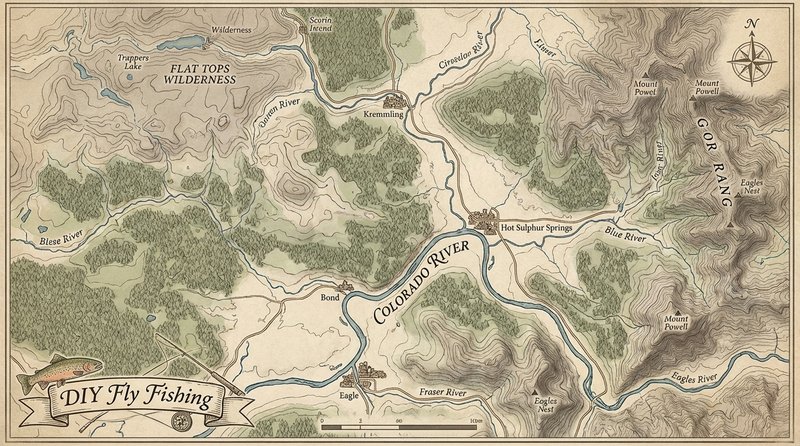
Colorado River
Fly fishing in Colorado · Intermediate · Best seasons: Summer, Fall
Target Species
Rainbow Trout, Brown Trout
About This Water
From its headwaters to the canyons, offering diverse fishing experiences. The upper sections near Granby provide excellent trout fishing.
Fishing Recommendations
As an expert guide who has spent countless hours rowing the "Upper C" and wading the canyons, I can tell you that the Colorado River is the lifeblood of Western fly fishing. While it starts as a tiny trickle in Rocky Mountain National Park, by the time it reaches the popular fishing stretches, it becomes a powerful, diverse fishery capable of producing trophy-sized wild trout.
Here is your comprehensive guide to fly fishing the Colorado River.
🎣 Location Overview
The Colorado River in its namesake state offers two distinct personalities: the high-alpine headwaters and the powerful "Upper Colorado" (from Granby down to Dotsero). What makes this river special is its diversity of water. You’ll find everything from technical pocket water and classic riffles to deep, swirling eddies and massive "slick" pools.
Anglers love it because it is a "bug factory." The biomass here is staggering, supporting a high density of wild Brown and Rainbow trout. Unlike smaller mountain streams, the Colorado is a "big water" experience—it demands respect, rewarded with hard-fighting fish in a stunning red-rock canyon backdrop.
🐟 Target Species & Behavior
- Brown Trout: The kings of the Colorado. They are aggressive, predatory, and love structure. Look for them tucked against undercut banks, behind large mid-stream boulders, or in the deep "buckets" at the tail-outs of runs. In the fall, they become exceptionally territorial.
- Rainbow Trout: Often found in the faster, oxygenated water. They frequent the "heads" of riffles and the heavy foam lines. Colorado River rainbows are known for their aerial acrobatics and incredible strength due to living in heavy current.
Behavior Note: These fish are opportunistic but wary. In the summer, they look up for big terrestrials and stones; in the fall, they focus on smaller midge and mayfly life cycles to bulk up for winter.
📅 Best Times to Fish
Optimal Seasons
- Summer (Late June – August): This is the time for "Big Bug" fishing. Once the spring runoff subsides (usually by late June), the river explodes with Salmonflies and Golden Stones.
- Fall (September – November): My personal favorite. The crowds thin out, the Browns turn a vibrant gold as they prepare to spawn, and the Blue Winged Olive (BWO) hatches are legendary.
Best Times of Day
- Summer: Early morning (6 AM – 10 AM) for dry fly action; late evening for the spinner fall. Mid-day is best for deep nymphing or "hopper-dropper" rigs.
- Fall: The "Banker’s Hours." You don't need to be on the water at dawn. The best BWO hatches usually happen between 11 AM and 3 PM on overcast days.
Prime Windows
- The "Salmonfly Hatch": Usually late June/early July. It’s chaotic, but landing a 20-inch Brown on a 2-inch dry fly is the pinnacle of Colorado fishing.
- Late September: When the water temps drop, the fish become hyper-active feeders.
🪰 Recommended Flies & Techniques
Top Fly Patterns
- Dries: Chubby Chernobyl (Orange/Gold, sizes 8-12), Amy’s Ant, Puterbaugh’s Foam Caddis, Parachute Adams (sizes 16-20).
- Nymphs: Pat’s Rubber Legs (the "workhorse"), Prince Nymph, Zebra Midge (Red or Black, sizes 18-22), Frenchie, and RS2s.
- Streamers: Black or Olive Sculptzilla, Gold Sparkle Minnow, and the Sex Dungeon (for trophy Browns).
Effective Techniques
- Hopper-Dropper: In the summer, use a buoyant foam dry fly (like a Chubby) with 2-3 feet of 4X fluorocarbon tied to a bead-head nymph. It covers two zones at once.
- The "Tight-Line" Nymph: In the rocky stretches near Radium, Euro-nymphing or short-leash nymphing is deadly for picking apart pockets.
- Streamer Stripping: In the fall, "pound the banks" from a boat or wade-swing streamers through deep runs.
Presentation Tips
Mend, then mend again. The Colorado has complex currents. If your fly has even a hint of "drag," the wild trout will ignore it. Use a "reach cast" to get a clean drift the moment your fly hits the water.
💡 Pro Tips & Local Knowledge
- The "Radium to State Bridge" Stretch: This is the classic float. If you are wading, focus on the Pumphouse Recreation Area. It has excellent bank access and diverse water.
- Watch the "Flows": The Colorado is tailwater-influenced (from Lake Granby/Windy Gap), but also has many tributaries. Check the USGS gauges. Ideally, you want "dropping and clearing" water.
- The "Cloud Cover" Advantage: If it’s a gray, drizzly day in October, drop everything and go. The BWO hatch will be thick, and the big Browns will lose their inhibitions.
- Fish the "Inside Turns": Most anglers fish the deep outside bends. Experienced guides know that big fish often move into the shallower "inside" gravel bars to feed, especially in the morning.
⚠️ Important Information
Access
- Pumphouse, Radium, and State Bridge are the primary public access points.
- Much of the river between State Bridge and Dotsero flows through private land. Respect "No Trespassing" signs. If you are in a boat, you must stay in the boat while passing through private property (you cannot anchor or wade).
Regulations & Permits
- A valid Colorado Fishing License is required.
- Special Regulations: Be aware that certain stretches (like from Canyon Creek to Rock Creek) have "Gold Medal" status, meaning specific lure/fly restrictions and catch-and-release rules apply. Always check the current CPW Fishing Brochure.
Special Considerations
- Safety: The Colorado is a powerful river. If wading, use a wading staff and a belt. The rocks are notoriously "greasy."
- Temperature: During drought years, "Hoot Owl" restrictions (no fishing after 2 PM) may be implemented to protect fish from heat stress. Check local fly shop reports (like in Kremmling or Silverthorne) before heading out.
Bug Hatches & Matching Flies
| Hatch | Type | Peak months | Time of day | Hook sizes | Matching flies |
|---|---|---|---|---|---|
| Midges Chironomidae | midge | January, February, March, December | All Day | #18-24 | Zebra Midge #18-22, Griffith's Gnat #20-22, Top Secret Midge #20-24 |
| Blue Winged Olive Baetis | mayfly | April, May, September, October | Mid-day | #18-22 | RS2 #18-22, Parachute Adams #18-20, JujuBaetis #18-22 |
| Salmonfly Pteronarcys californica | stonefly | June | All Day | #4-8 | Rogue Foam Stone #4-8, Pat's Rubber Legs #6-10, Clark's Stone #6-8 |
| Mother's Day Caddis Brachycentrus | caddis | May | Afternoon | #14-16 | Elk Hair Caddis #14-16, Peeping Caddis #14-16, LaFontaine Sparkle Pupa #14-16 |
| Pale Morning Dun Ephemerella excrucians | mayfly | June, July, August | Morning/Afternoon | #14-18 | CDC Pheasant Tail #16-18, PMD Sparkle Dun #16-18, Split Case PMD #16-18 |
| Golden Stonefly Hesperoperla pacifica | stonefly | June, July | Morning/Evening | #8-12 | Chubby Chernobyl #8-12, 20-Incher Stone #10-12, Golden Stimulator #10-14 |
| Trico Tricorythodes | mayfly | August, September | Morning | #20-24 | Trico Spinner #20-24, Sunken Trico #22-24, Drowned Trico Spinner #20-22 |
| Grasshoppers Orthoptera | terrestrial | August, September | Afternoon | #8-12 | Amy's Ant #10-12, Morrish Hopper #8-12, Parachute Hopper #10-14 |
| Yellow Sally Isoperla | stonefly | June, July, August | Late Afternoon/Evening | #14-16 | Yellow Stimulator #14-16, Iron Lotus #16, Little Yellow Sloan #14-16 |