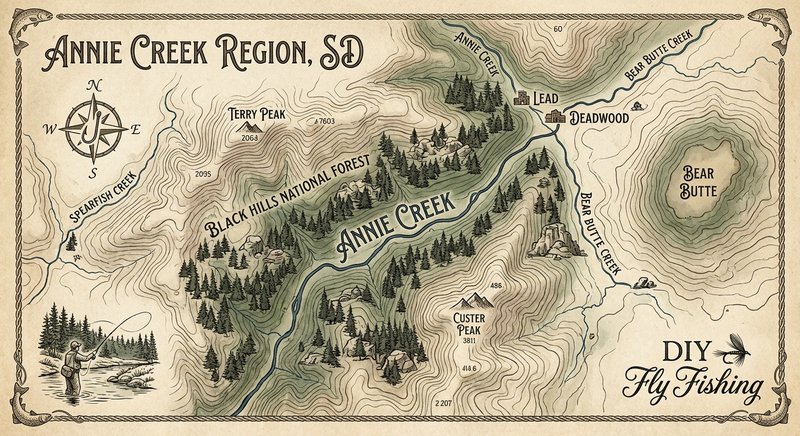
Annie Creek
Fly fishing in South Dakota · intermediate · Best seasons: spring, summer, fall
Target Species
Brown Trout, Brook Trout
About This Water
Black Hills tributary with wild trout. Small stream through forest.
Fishing Recommendations
Annie Creek is one of the Black Hills' best-kept secrets. While most anglers flock to the famous waters of Spearfish Creek, Annie Creek offers a rugged, intimate "blue-lining" experience for those who don’t mind a little bushwhacking and technical casting.
Here is your comprehensive guide to fly fishing Annie Creek, South Dakota.
🎣 Location Overview
Annie Creek is a high-gradient tributary of Spearfish Creek, located in the northern Black Hills near Lead and Savoy. What makes this water special is its "pocket water" nature—think miniature waterfalls, deep plunge pools, and crystal-clear runs shaded by a dense canopy of birch, pine, and willow.
The water is cold, limestone-filtered, and highly oxygenated. It is much smaller than Spearfish Creek, often no more than 6 to 10 feet wide. Anglers love it because it feels prehistoric; it’s a place where you can find solitude and wild, vibrant fish that rarely see a fly. It is the definition of "small stream soul fishing."
🐟 Target Species & Behavior
The creek is a stronghold for Wild Brook Trout and Brown Trout.
- Brook Trout: These dominate the upper reaches. They are opportunistic but incredibly spooky. In this clear water, they see you long before you see them. They hold in the "white water" bubbles at the head of pools and in tiny depressions behind rocks.
- Brown Trout: Found more frequently in the middle and lower stretches near the confluence with Spearfish Creek. They are the "kings" of the deeper undercut banks.
- Feeding Behavior: Because Annie Creek is a high-energy environment, these fish are "strike-oriented." They don't have the luxury of inspecting a fly for long before the current sweeps it away. If they aren't spooked, they will usually smash a well-presented dry fly.
📅 Best Times to Fish
Optimal Seasons
- Late Spring (May - June): As the high-country snow melts and the Black Hills wake up, the aquatic insect life explodes. This is prime time for nymphing and early season dry fly action.
- Summer (July - August): The "Golden Era" for Annie Creek. When larger rivers get too warm, the spring-fed influence of Annie Creek keeps it cool. This is terrestrial season—ants, beetles, and hoppers are the ticket.
- Fall (September - October): The most beautiful time to be in the canyon. The Brook Trout turn brilliant shades of orange and red for the spawn. The fish are aggressive, protecting territory.
Best Times of Day
- Mid-Day (10 AM - 4 PM): Unlike larger rivers where you avoid the midday sun, the deep canyon walls and heavy tree cover on Annie Creek keep the water shaded. The hatch is often most productive when the sun hits the water directly, activating the bugs.
🪰 Recommended Flies & Techniques
Top Fly Patterns
- Dry Flies:
- Parachute Adams (Size 16–20) - The gold standard.
- Elk Hair Caddis (Size 14–16) - Great for skating across riffles.
- Hippie Stomper (Size 14) - High visibility and floats forever.
- Black Ants & Foam Beetles (Size 16–18) - Essential for summer.
- Nymphs:
- Bead-head Pheasant Tail (Size 16–18).
- Zebra Midge (Red or Black, Size 18–22).
- Prince Nymph (Size 14–16) - For the deeper plunge pools.
- Streamers:
- Thin Mint or Black Woolly Bugger (Size 10–12) - Only for the largest holes to entice a territorial Brown.
Techniques & Presentation
- The Bow-and-Arrow Cast: This is the most important skill here. The brush is so thick that a traditional backcast is often impossible.
- Dry-Dropper Rig: Use a buoyant dry fly (like a Stimulator) with a small, unweighted nymph tied 12–18 inches below it. This allows you to cover two water columns in tiny pockets.
- Stealth Approach: Walk upstream (always fish up). Stay low, wear drab colors, and try to keep your shadow off the water.
💡 Pro Tips & Local Knowledge
- The "One-Cast" Rule: In these small pools, you usually get one, maybe two, good presentations. If you botch the drift or splash the line, move to the next pocket. The fish will go under a rock and stay there for an hour.
- Light Gear: Leave the 5-weight at home. A 2-weight or 3-weight rod (7’6” or shorter) is the perfect tool for Annie Creek. It makes a 10-inch Brookie feel like a monster and allows for better accuracy in tight quarters.
- Focus on the Confluence: The area where Annie Creek meets Spearfish Creek often holds larger-than-average Brown Trout that move up into the tributary to escape the pressure of the main river.
- Short Leaders: Use a shorter leader (7.5 feet) tapered to 5x or 6x. A long 9-foot leader is a nightmare to manage in the overhanging willows.
⚠️ Important Information
- Access: Much of Annie Creek is within the Black Hills National Forest, making it accessible to the public. However, there are pockets of private mining claims and cabins. Always check a map (like OnX) or look for "No Trespassing" signs.
- Regulations: A South Dakota fishing license is required. Most of Annie Creek falls under standard Black Hills trout regulations, but always check the current SD Game, Fish & Parks (GFP) handbook for any seasonal closures or tackle restrictions.
- Safety: The terrain is steep and the rocks are notoriously slick. Felt-soled boots or studs are highly recommended. Also, be aware that this is mountain lion and northern timber rattlesnake country—though snakes are rare right on the cold water, they sun themselves on the canyon rims.
- Leave No Trace: This is a fragile ecosystem. Barbless hooks are recommended to ensure a healthy release for these wild gems.
Guide’s Final Word: Annie Creek isn't about the size of the fish; it’s about the beauty of the surroundings and the technical challenge of the catch. If you value wild fish in a wild place, this is your water.
Bug Hatches & Matching Flies
| Hatch | Type | Peak months | Time of day | Hook sizes | Matching flies |
|---|---|---|---|---|---|
| Blue Winged Olive Baetis spp. | mayfly | April, May, September, October | Mid-day/Afternoon | #18-22 | BWO Sparkle Dun #18-20, RS2 #20-22, Pheasant Tail #18-22 |
| Pale Morning Dun Ephemerella invaria | mayfly | June, July | Late Morning/Afternoon | #14-18 | PMD Parachute #16-18, Split Case PMD #16-18, Quigley Cripple #14-16 |
| Mother's Day Caddis Brachycentrus occidentalis | caddis | May | Morning/Afternoon | #14-16 | Peacock Caddis #14-16, Deep Sparkle Pupa #14-16, Elk Hair Caddis #14-16 |
| Little Black Stonefly Capniidae family | stonefly | February, March, April | Mid-day | #16-18 | Zebra Midge #18-20, Black Copper John #16-18, Griffith's Gnat #18-20 |
| Trico Tricorythodes spp. | mayfly | July, August, September | Early Morning | #20-24 | Trico Spinner #20-22, Sunken Trico #22-24 |
| Little Yellow Stonefly Isoperla spp. | stonefly | June, July | Evening | #14-16 | Yellow Sally Parachute #14-16, Little Yellow Sloan #14-16 |
| Grasshopper Acrididae family | terrestrial | August, September | Afternoon | #10-14 | Parachute Hopper #12-14, Joe's Hopper #10-12, Morrish Hopper #12-14 |
| Midge Chironomidae | midge | January, February, March, December | All Day | #18-24 | Zebra Midge #20-22, Morgan's Midge #20-22, Smoke Jumper #20-22 |
| Spotted Sedge Hydropsyche spp. | caddis | June, July, August | Evening | #14-18 | X-Caddis #16-18, Soft Hackle Hare's Ear #14-16, Hydropsyche Larva #14-16 |