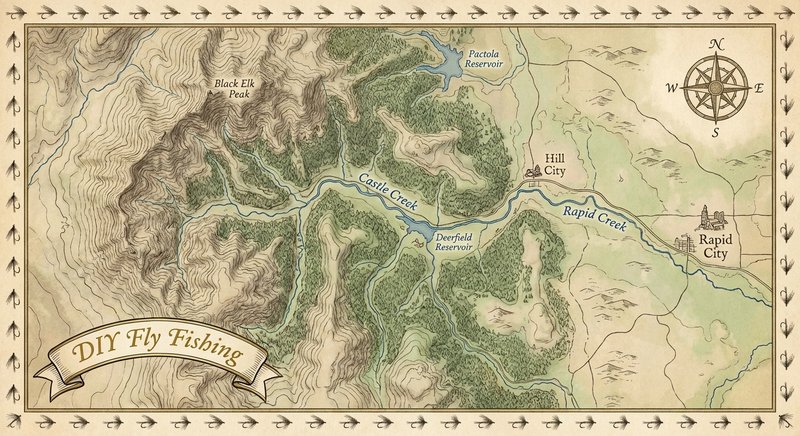
Castle Creek
Fly fishing in South Dakota · intermediate · Best seasons: spring, summer, fall
Target Species
Brown Trout
About This Water
Black Hills stream with wild brown trout. Scenic canyon setting with good access.
Fishing Recommendations
Castle Creek is one of the crown jewels of the Black Hills in South Dakota. Located near Hill City and flowing both into and out of Deerfield Lake, it offers some of the most consistent and scenic trout fishing in the region. As a tailwater below Deerfield Dam, it provides stable temperatures and a nutrient-rich environment that allows wild Brown Trout to thrive.
🎣 Location Overview
Castle Creek is characterized by two distinct personalities: the section above Deerfield Lake and the tailwater section below the dam.
- Above the Lake: This is smaller, meadow-style water with tight bends, undercut banks, and plenty of willows. It feels intimate and requires a stealthy approach.
- Below the Dam: This is the "classic" Castle Creek experience. It flows through a stunning limestone canyon and lush meadows. The water is crystal clear and cold year-round.
What makes it special is the high fish density. It is not uncommon to find hundreds of trout per mile here. The creek is small—rarely more than 15–20 feet wide—making it a paradise for the 3-weight or 4-weight fly rod enthusiast who loves technical, small-stream stalking.
🐟 Target Species & Behavior
The primary resident is the Wild Brown Trout. While you may find an occasional Brook Trout in the headwaters or a Rainbow that escaped from Deerfield Lake, the Browns rule this water.
- Behavior: These fish are notoriously "spooky." Because the water is so clear and shallow, they have a high sense of danger. They are highly attuned to overhead movement and heavy footsteps.
- Holding Patterns: Look for them in the "S-curves" of the meadows, tucked tight against undercut banks, or hovering in the tail-outs of deep pools during a hatch. In the canyon sections, they hold behind large boulders and in the seams of the plunges.
- Feeding: They are opportunistic but can become selective during specific hatches (like the Trico or BWO hatches). They rely heavily on sub-surface crustaceans like scuds and sowbugs due to the limestone influence of the Black Hills.
📅 Best Times to Fish
Seasons
- Spring (March - May): The "Blue Winged Olive" (BWO) season. On cloudy days, the dry fly fishing can be spectacular. This is also the best time for nymphing as fish wake up from winter.
- Summer (June - August): The golden era for Castle Creek. This is Terrestrial Season. High summer brings incredible hopper, ant, and beetle action. The Trico hatch (tiny mayflies) also occurs in the early mornings.
- Fall (September - October): My personal favorite. The Brown Trout become aggressive as they prepare for the spawn. They lose some of their wariness and will chase larger streamers. The fall colors in the canyon are world-class.
Time of Day
- Summer: Get there early (6:00 AM) for the Trico hatch, or stay late for the evening caddis flight.
- Spring/Fall: The "Banker’s Hours" (10:00 AM – 3:00 PM) are best as the sun warms the water and triggers insect activity.
🪰 Recommended Flies & Techniques
Top Fly Patterns
- Nymphs:
- Ray Charles or Soft Hackle Sowbugs (Grey/Pink, size 16-18) - These are "bread and butter" flies here.
- Zebra Midges (Black or Red, size 18-22).
- Flashback Pheasant Tails (size 16-20).
- Dry Flies:
- Parachute Adams (size 16-20) - The ultimate searcher.
- Elk Hair Caddis (Tan, size 14-16).
- Hippie Stomper or Fat Albert (size 12-14) - Great for hopper-dropper rigs.
- Trico Spinners (size 20-24) - For the technical summer mornings.
- Streamers:
- Thin Mint or Black Wooly Bugger (size 8-12) - Best fished on a swing or a "jiggy" retrieve.
Effective Techniques
- The "Hopper-Dropper": In the summer, use a buoyant foam hopper on top and hang a small sowbug or nymph 18-24 inches below it. This covers both bases and acts as a strike indicator.
- Sight Fishing: In the clear pools, don't just blind cast. Spend five minutes watching the water. You will often see the white wink of a Brown Trout’s mouth opening.
- Stealthy Approach: Kneel when approaching the bank. Use a 9-foot to 12-foot leader tapered down to 5X or 6X tippet. If they can see you, they won't eat.
💡 Pro Tips & Local Knowledge
- The "Slow" Approach: Most anglers walk too fast. Castle Creek Browns will hide for 20 minutes if they see a shadow. Move like a heron.
- Fish the "Skinny" Water: Don't just fish the deep holes. Some of the biggest Browns on Castle Creek hold in water barely deep enough to cover their backs, especially if there is an overhanging willow for cover.
- Micro-Drifts: The creek has many micro-currents. Even a tiny bit of drag on your fly will cause a refusal. Work on your "reach cast" to ensure a drag-free drift.
- Check the Gauge: If the release from Deerfield Dam is under 5 CFS (cubic feet per second), the fishing gets very technical and difficult. If it's between 10-20 CFS, it’s prime time.
⚠️ Important Information
- Access: Much of Castle Creek is within the Black Hills National Forest, providing excellent public access. The "Castle Creek Trail" follows the creek below the dam for several miles, making it easy to hike in and find solitude.
- Regulations:
- A South Dakota Fishing License is required.
- Check current SD Game, Fish & Parks (GFP) regulations. There are often specific "Catch and Release" or "Artificial Lures Only" sections on Castle Creek (specifically the stretch directly below Deerfield Dam).
- Safety:
- Wildlife: This is mountain lion and northern prairie rattlesnake country. Be aware of your surroundings.
- Cell Service: It is virtually non-existent in the Castle Creek canyon. Download your maps for offline use before heading out.
- Respect the Resource: This is a fragile ecosystem. Please practice Catch and Release and keep the fish in the water while unhooking them. The wild Brown Trout population is a treasure that stays healthy through angler conservation.
Bug Hatches & Matching Flies
| Hatch | Type | Peak months | Time of day | Hook sizes | Matching flies |
|---|---|---|---|---|---|
| Blue-Winged Olive (BWO) Baetis spp. | mayfly | April, May, September, October | Midday | #18-22 | RS2 #18-22, Parachute Adams #18-22, Pheasant Tail #18-20 |
| Pale Morning Dun (PMD) Ephemerella excrucians | mayfly | June, July | Late Morning/Afternoon | #14-18 | PMD Sparkle Dun #16-18, Trigger Finger PMD #14-16, Military Mayfly #16-18 |
| Little Brown Stonefly Strophopteryx fasciata | stonefly | February, March, April | Midday | #14-16 | Pats Rubber Legs (Brown) #14-16, Little Brown Stone #16, Hare's Ear #14-16 |
| Mother's Day Caddis (Grannom) Brachycentrus occidentalis | caddis | May | All Day | #14-16 | Elk Hair Caddis #14-16, Peacock Caddis #16, Deep Sparkle Pupa #14-16 |
| Trico Tricorythodes spp. | mayfly | August, September | Early Morning | #20-24 | Trico Spinner #20-24, Drowned Trico #22, Griffith's Gnat #20-22 |
| Midges Chironomidae | midge | January, February, March, December | Morning/Midday | #18-24 | Zebra Midge #18-22, Morgan's Midge #20-22, Top Secret Midge #20-24 |
| Spotted Sedge Hydropsyche spp. | caddis | June, July, August | Evening | #14-18 | X-Caddis #16-18, LaFontaine's Emergent Pupa #14-16, Holy Grail #14-18 |
| Grasshoppers Acrididae | terrestrial | August, September | Afternoon | #8-12 | Morrish Hopper #10-12, Parachute Hopper #12, Thunder Thighs Hopper #10 |