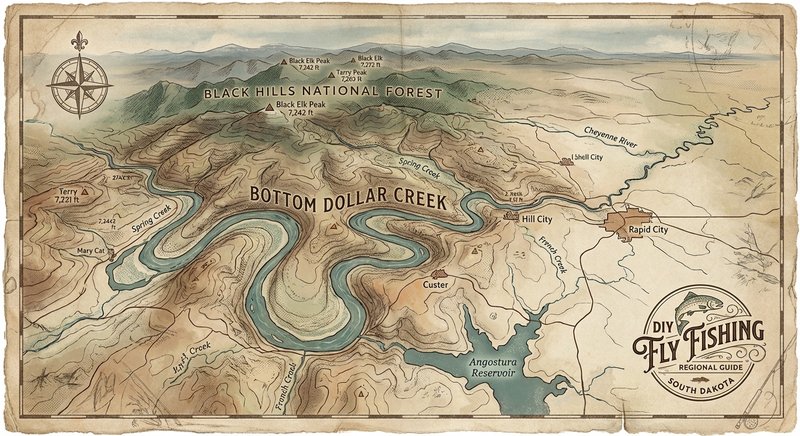
Bottom Dollar Creek
Fly fishing in South Dakota · advanced · Best seasons: summer
Target Species
Brook Trout
About This Water
Black Hills stream with wild brook trout. Historic gold mining area.
Fishing Recommendations
Welcome to the Black Hills of South Dakota. As your guide, I’m excited to point you toward Bottom Dollar Creek. While many anglers flock to the larger, more famous Rapid Creek or Spearfish Creek, Bottom Dollar is a hidden gem for the "blue-lining" enthusiast. It is a quintessential small-stream experience where stealth and precision trump long casts.
Here are my professional recommendations for finding success on Bottom Dollar Creek.
🎣 Location Overview
Bottom Dollar Creek is a cold, high-gradient tributary located in the Black Hills National Forest. It is characterized by its intimate size, crystal-clear water, and rugged, forested surroundings.
What makes this creek special is its "wildness." This isn't a manicured tailwater; it’s a tight, brushy environment with plunge pools, undercut banks, and short riffles. Anglers love it because it offers true solitude. You aren't fighting for a spot here; you are fighting the willow branches and the wary nature of the fish. The limestone-rich geology of the Black Hills ensures the water remains nutrient-dense and cool, providing a perfect sanctuary for wild char.
🐟 Target Species & Behavior
The primary resident here is the Brook Trout. These are wild, self-sustaining fish, not stockers.
- Behavior: These Brookies are opportunistic but incredibly "spooky." In water this small and clear, they can see you long before you see them.
- Holding Patterns: Look for them in the "kitchen"—the head of the pools where oxygenated water brings in food. They also love to tuck deep under overhanging brush or the shadows of downed timber during the bright midday sun.
- Feeding: In the summer, their metabolism is high. They are looking for high-calorie meals, specifically terrestrial insects falling from the dense canopy and aquatic insects like Caddis and small Mayflies.
📅 Best Times to Fish
- Optimal Months: Late June through August. This is the prime window. The spring runoff has subsided, the water temperature is perfect (50–55°F), and the terrestrial activity is at its peak.
- Best Time of Day:
- Early Morning (6 AM – 10 AM): The water is coolest, and the fish are less wary.
- Late Evening: The "witching hour" when Caddis begin to dance over the riffles.
- Conditions: Overcast days are a gift on Bottom Dollar. The lack of shadows allows you to approach the bank more aggressively without flaring the fish.
🪰 Recommended Flies & Techniques
Because the water is small, you don't need a 5-weight rod. A 2-weight or 3-weight rod (7' to 8') is ideal for navigating the brush.
Top Fly Patterns
- Dry Flies:
- Elk Hair Caddis (Size 16-18): The gold standard for the Black Hills.
- Parachute Adams (Size 18-20): Perfect for the slower, glassier tail-outs of pools.
- Stimulators (Size 14-16): Great as an attractor or a high-floating hopper imitation.
- Terrestrials:
- Black Foam Ants (Size 16-18): If the fishing gets tough, put on an ant.
- Hi-Viz Beetles (Size 14-16): Easy to see in the shadows under the trees.
- Nymphs (as a dropper):
- Pheasant Tail (Size 18-20): Classic and effective.
- Zebra Midge (Size 20): In Red or Black.
Techniques & Presentation
- The Bow-and-Arrow Cast: You will use this more than a traditional overhead cast. Hold the fly, bend the rod tip, and "fire" it into tight pockets under branches.
- Dry-Dropper Rig: Run a buoyant dry fly (like a Stimulator) with a tiny nymph 12–15 inches below it. This covers both bases without the splash of a heavy indicator.
- Stealth Approach: Kneel when you approach a pool. Wear drab colors (camo, olive, or tan) to blend into the forest backdrop.
💡 Pro Tips & Local Knowledge
- Fish Upstream: Always move against the current. Brook trout face upstream to wait for food; if you approach from behind them, you stay out of their field of vision.
- One and Done: On a creek this small, if you catch a fish or miss a strike, the pool is likely "blown" for 30 minutes. Don't linger. Keep moving to the next pocket.
- Watch the "V": In the flat water, look for the "V" shaped wake of a cruising trout. If you see it, freeze. Wait for him to settle before making your move.
- The "Hole in the Wall": Focus on the areas where the creek narrows between rocks. The increased current speed acts as a conveyor belt for food, and the biggest Brookie in the stretch usually claims that spot.
⚠️ Important Information
- Access: Much of Bottom Dollar Creek is within the Black Hills National Forest, meaning public access is generally good. However, always carry a GPS or a high-quality topographical map (like OnX) to ensure you aren't wandering onto private mining claims or homesteads.
- Regulations: A valid South Dakota Fishing License is required. Be sure to check the current South Dakota Game, Fish & Parks handbook for any specific seasonal closures or tackle restrictions.
- Safety: This is mountain lion and northern prairie rattlesnake country. While encounters are rare, stay alert. Also, summer thunderstorms in the Black Hills can cause rapid "flashy" rises in small creeks—if you hear thunder, head for the truck.
- Gear Care: Use a shorter leader (7.5 feet) tapered to 5X or 6X. A 9-foot leader is a recipe for tangles in this tight canopy.
Bottom Dollar Creek rewards the patient, quiet angler. Enjoy the colors of those wild Brookies—they are the jewels of the Black Hills!
Bug Hatches & Matching Flies
| Hatch | Type | Peak months | Time of day | Hook sizes | Matching flies |
|---|---|---|---|---|---|
| Blue Winged Olive Baetis | mayfly | March, April, September, October | Late Morning/Afternoon | #18-22 | RS2 #18-22, Parachute Adams #18-22, Pheasant Tail Nymph #18-20 |
| Pale Morning Drake Ephemerella excrucians | mayfly | June, July, August | Mid-Morning | #14-18 | PMD Sparkle Dun #16-18, Frenchie #14-16, Split Case PMD #16-18 |
| Trico Tricorythodes | mayfly | July, August, September | Early Morning | #20-24 | Trico Spinner #20-24, Sunken Trico Spinner #20-22 |
| Little Western Grannom Brachycentrus occidentalis | caddis | April, May | Afternoon/Evening | #14-16 | Elk Hair Caddis #14-16, Pupa-Joe #14-16, Peacock Caddis #16 |
| Spotted Sedge Hydropsyche | caddis | June, July, August | Late Evening | #14-18 | LaFontaine's Deep Sparkle Pupa #14-18, X-Caddis #16-18 |
| Yellow Sally Isoperla | stonefly | June, July | Late Afternoon | #14-16 | Yellow Sally Stimulator #14-16, Iron Sally #14-16 |
| Midges Chironomidae | midge | December, January, February, March | Mid-Day | #18-26 | Zebra Midge #18-22, Griffith's Gnat #20-22, Morgan's Midge #20-24 |
| Grasshoppers Orthoptera | terrestrial | July, August, September | Mid-Day/Afternoon | #8-12 | Morrish Hopper #10-12, Dave's Hopper #8-12 |