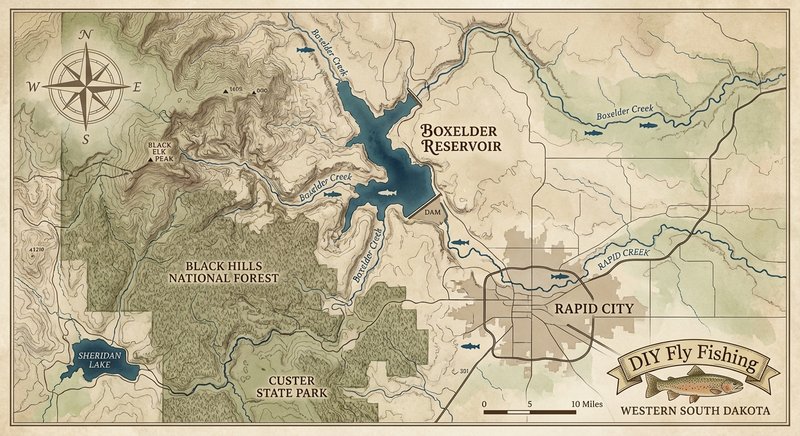
Boxelder Reservoir
Fly fishing in South Dakota · beginner · Best seasons: spring, fall
Target Species
Rainbow Trout
About This Water
Small Black Hills reservoir with stocked trout. Quiet alternative to larger lakes.
Fishing Recommendations
As an expert guide familiar with the hidden gems of the Black Hills, it is a pleasure to break down Boxelder Reservoir (and the associated Boxelder Creek drainage). While many anglers flock to the famous waters of Rapid Creek or Spearfish Creek, Boxelder offers a more intimate, rugged, and often quieter experience for those targeting Rainbow Trout in South Dakota.
🎣 Location Overview
Located in the heart of the Black Hills National Forest, northwest of Rapid City, Boxelder Reservoir is an impoundment that transitions into a classic mountain creek environment. What makes this area special is its "dual character." You have the stillwater opportunities of the reservoir itself and the technical, pocket-water fishing of the creek above and below it.
The water is generally clear but can become slightly stained after heavy rains. It is surrounded by ponderosa pines and limestone cliffs, providing a quintessential Black Hills backdrop. Anglers love it because it feels more "wild" than the urban stretches of other local streams, offering a sense of solitude that is becoming harder to find.
🐟 Target Species & Behavior
The primary target here is the Rainbow Trout.
- Behavior: In the reservoir, Rainbows tend to cruise the shorelines and the drop-offs near the old creek channel. In the moving water sections, they hold in the "textbook" spots: the heads of pools, behind large boulders, and in the undercut banks.
- Feeding: These fish are opportunistic. In the spring, they focus heavily on midge larvae and scuds. As the season progresses, they look for Blue Winged Olives (BWOs) and eventually caddis. Because the Black Hills are rich in limestone, there is a high crustacean count (scuds and sowbugs), which keeps the trout fat and healthy year-round.
📅 Best Times to Fish
While the Black Hills can be fished year-round, Boxelder shines during your requested windows:
- Spring (Late March – May): This is prime time. As the ice melts and the water warms into the 40s and 50s, the fish become highly active. Look for the BWO hatch on overcast afternoons.
- Fall (September – early November): This is arguably the most beautiful time. The water levels are usually stable, and the fish are aggressively feeding to bulk up for winter. You'll also encounter stunning fall colors.
- Best Time of Day:
- Spring: 10:00 AM to 4:00 PM (waiting for the water to warm slightly).
- Fall: Early morning for streamers; mid-afternoon for dry fly activity.
- Optimal Conditions: Overcast, "fishy" days are best for BWO hatches. Avoid peak runoff in late May if the snowpack is heavy.
🪰 Recommended Flies & Techniques
Top Fly Patterns
- Nymphs:
- Ray Charles or Soft Hackle Sowbug (Grey or Tan, sizes 16–20) — Essential local pattern.
- Zebra Midge (Red or Black, sizes 18–22).
- Pheasant Tail (Beadhead, sizes 14–18).
- Dry Flies:
- Parachute Adams (sizes 16–20).
- Elk Hair Caddis (Tan, sizes 14–16).
- BWO Sparkle Dun (sizes 18–20).
- Streamers:
- Woolly Bugger (Thin Mint or Olive, sizes 8–12).
- Pine Squirrel Leech (Black or Red).
Effective Techniques
- Indicator Nymphing: In the creek sections, use a small, sensitive indicator. Since the water is clear, a "New Zealand Style" wool indicator is preferred over loud plastic bubbles.
- Stillwater Stripping: In the reservoir, use an intermediate sinking line or a long leader with a weighted streamer. Slow, erratic strips often trigger a strike from cruising Rainbows.
- Dry-Dropper: A fantastic choice for the late spring or fall. Use a high-visibility Parachute Adams as your "bobber" and hang a small sowbug 18 inches below it.
💡 Pro Tips & Local Knowledge
- The "Inlet" Factor: If you are fishing the reservoir, focus your energy on the inlet area where the creek enters the pond. This moving water brings in oxygen and a steady conveyor belt of food. Rainbows will often stack up here.
- Stealth is Key: Because Boxelder is smaller than the main rivers, the fish can be "spooky." Wear earthy colors (tans and greens), move slowly, and try to avoid casting your shadow over the water.
- The "Sowbug Secret": If you aren't sure what to tie on, tie on a Grey Sowbug. The Black Hills are famous for these, and the trout at Boxelder see them every single day of the year. It is the "bread and butter" of their diet.
⚠️ Important Information
- Access: Much of the area is within the Black Hills National Forest, providing good public access. However, there are patches of private land interspersed. Always look for Forest Service boundary signs and respect private property.
- Regulations: A South Dakota fishing license is required. Most of Boxelder follows general state regulations, but always check the South Dakota Game, Fish & Parks (GFP) handbook for current creel limits or any seasonal tackle restrictions.
- Safety: This is mountain lion and rattlesnake country. While encounters are rare, keep your eyes open. Also, cell service can be spotty in the canyons—download your maps for offline use before heading out.
- Gear: A 3-weight to 5-weight rod (8'6" or 9') is perfect for this water. A 5x or 6x fluorocarbon tippet is recommended due to the water clarity.
Tight lines! Boxelder is a gem—treat it with respect, and it will reward you with some of the prettiest Rainbows in the Hills.
Bug Hatches & Matching Flies
| Hatch | Type | Peak months | Time of day | Hook sizes | Matching flies |
|---|---|---|---|---|---|
| Blue Winged Olive Baetis spp. | mayfly | April, May, September, October | Late Morning/Afternoon | #18-22 | RS2 #18-22, Parachute Adams #18-22, BWO Sparkle Dun #20-22 |
| Chironomids (Midges) Chironomidae | midge | March, April, May | All Day | #18-24 | Zebra Midge #18-22, Griffith's Gnat #18-24, Ice Cream Cone Midge #16-20 |
| Pale Morning Dun Ephemerella excrucians | mayfly | June, July | Late Morning/Early Afternoon | #14-18 | PMD Sparkle Dun #16-18, Pheasant Tail #14-18, PMD Quigley Cripple #16-18 |
| Little Western Grannom Brachycentrus occidentalis | caddis | April, May | Afternoon/Evening | #14-16 | Elk Hair Caddis #14-16, LaFontaine's Deep Sparkle Pupa #14-16, Peacock Caddis #14-16 |
| Cinnamon Caddis Hydropsyche spp. | caddis | July, August, September | Evening | #14-18 | Godzilla Caddis #14-16, Caddis Emerger #16-18, Soft Hackle Hare's Ear #14-18 |
| Trico Tricorythodes spp. | mayfly | August, September | Early Morning | #20-24 | Trico Spinner #20-24, Sunken Trico Spinner #22-24 |
| Grasshoppers Orthoptera | terrestrial | August, September | Late Morning/Afternoon | #8-12 | Parachute Hopper #10-12, Morrish Hopper #8-12, Joe's Hopper #10-14 |
| Damselfly Enallagma spp. | terrestrial | June, July | Morning/Afternoon | #10-14 | Marabou Damselfly Nymph #12-14, Adult Damsel #10-12 |