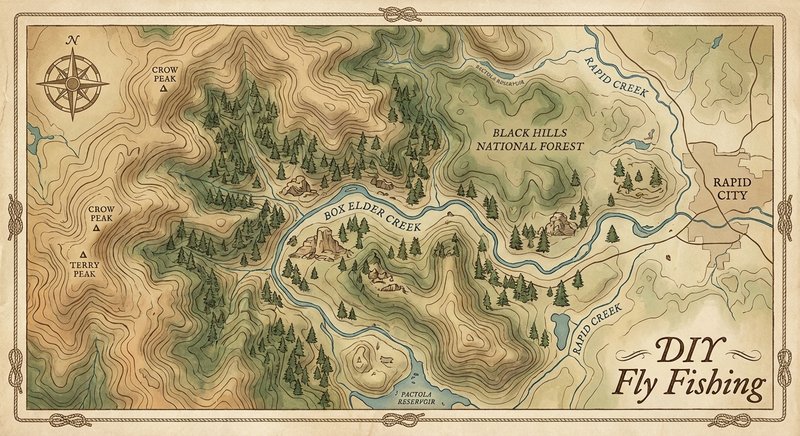
Box Elder Creek
Fly fishing in South Dakota · beginner · Best seasons: spring, summer, fall
Target Species
Rainbow Trout, Brown Trout
About This Water
Black Hills stream with stocked and wild trout. Good access near Rapid City.
Fishing Recommendations
Welcome to the Black Hills of South Dakota. As your guide, I’m excited to walk you through Box Elder Creek. While Rapid Creek and Spearfish Creek get most of the glory in this region, Box Elder is the "local’s favorite." It offers a more intimate, rugged experience with slightly less pressure and a very healthy population of wild fish.
🎣 Location Overview
Box Elder Creek is a quintessential Black Hills stream located northwest of Rapid City. It winds through high-walled limestone canyons, ponderosa pine forests, and lush meadows. What makes this water special is its diversity; you’ll find everything from tight, brushy technical water to wide-open meadow bends near the town of Nemo.
The water is limestone-influenced, meaning it is rich in nutrients and supports a massive biomass of aquatic insects. It is smaller than your average mountain river, requiring stealth and accurate casting rather than long-distance hauls. It feels wilder and more secluded than the urban stretches of Rapid Creek.
🐟 Target Species & Behavior
- Brown Trout: The primary residents. Most are wild, brilliantly colored, and can be quite "looky." They hold tight to undercut banks, submerged logs, and the deep shadows of limestone cliffs.
- Rainbow Trout: Found primarily in the faster riffles and aerated pocket water. Many are holdovers from state stocking efforts, but they quickly become "stream-wise."
- Behavior: These fish are opportunistic but spook easily. Because the creek is relatively small, a shadow on the water or a heavy footstep will send them scurrying. They feed heavily on sub-surface crustaceans (scuds and sowbugs) year-round.
📅 Best Times to Fish
- Spring (April – June): This is prime time. As the water warms, the Blue Winged Olive (BWO) hatches begin. You’ll see the first major surface activity of the year.
- Summer (July – August): Great for terrestrial fishing. The meadow stretches near Nemo are loaded with grasshoppers, ants, and beetles. Note: During very hot, dry years, keep an eye on water temperatures; if it hits 68°F, give the fish a break.
- Fall (September – October): My personal favorite. The Brown Trout become aggressive as they prepare for the spawn. The colors in the canyon are spectacular, and the "Trico" hatches in the morning can provide excellent technical dry fly fishing.
- Best Windows: In the heat of summer, fish early morning or the "golden hour" before dusk. In spring and fall, the 11:00 AM to 3:00 PM window is usually the most productive as the sun warms the water.
🪰 Recommended Flies & Techniques
Top Fly Patterns
- Nymphs:
- The Ray Charles (Grey or Tan, #14-18): A legendary Black Hills sowbug pattern.
- Flashback Pheasant Tail (#16-20): Mimics the ubiquitous Baetis nymphs.
- Zebra Midge (#18-22): Red or Black; essential for winter and early spring.
- Dry Flies:
- Elk Hair Caddis (#14-16): Great for skating across riffles.
- Parachute Adams (#16-22): The ultimate "find out what they’re eating" fly.
- Morrish Hopper (#10-12): For those breezy summer afternoons.
- Streamers:
- Thin Mint or Wooly Bugger (#8-12): Small and dark is better here than large and flashy.
Effective Techniques
- Dry-Dropper: This is the most effective way to fish Box Elder. Use a buoyant dry fly (like a Stimulator) with a weighted sowbug or scud dropped 18–24 inches below it.
- Stealth Nymphing: Because the pools are often short, a "high-stick" nymphing technique or Euro-nymphing works wonders in the pocket water.
- The "Canyon Cast": You will deal with overhanging branches. Practice your roll cast and side-arm cast before you get here.
💡 Pro Tips & Local Knowledge
- The Nemo Stretch: The area around the town of Nemo offers excellent meadow fishing. It is less strenuous to walk and perfect for practicing your dry fly presentations.
- Steamboat Rock: Look for the public access points near Steamboat Rock. This area has deeper holes that hold some of the larger, "trophy" Brown Trout (16"+).
- Think Small: Many anglers use indicators that are too large. This is small water; use a pinch of wool or a very small "Air-Lock" indicator to avoid splashing and scaring the fish.
- Wade Quietly: The streambed is a mix of slippery limestone and gravel. Move slowly. Often, the fish are right at your feet against the bank you are standing on.
⚠️ Important Information
- Access: Much of the creek runs through Black Hills National Forest, which is open to the public. However, there are significant patches of private land (especially around Nemo). Always look for "Walk-In Area" signs or USFS markers.
- Regulations: You need a South Dakota fishing license. Regulations can change, so check the current South Dakota Fishing Handbook for any specific creel limits or tackle restrictions (though most of Box Elder falls under general statewide regulations).
- Cell Service: Be prepared to lose signal once you drop into the canyons. Download your maps for offline use.
- Wildlife: This is mountain lion and northern rattlesnake country. While encounters are rare, keep your eyes open and stay alert.
Box Elder Creek is a place to slow down and enjoy the technicality of the sport. It rewards the patient angler who values the beauty of the surroundings as much as the fish in the net. Tight lines!
Bug Hatches & Matching Flies
| Hatch | Type | Peak months | Time of day | Hook sizes | Matching flies |
|---|---|---|---|---|---|
| Blue-Winged Olive (BWO) Baetis | mayfly | March, April, May, September, October | Mid-day/Afternoon | #18-22 | RS2 #18-22, Parachute Adams #18-22, Pheasant Tail Nymph #18-20 |
| Midges Chironomidae | midge | January, February, March, December | All day | #20-26 | Zebra Midge #20-24, Griffith's Gnat #20-22, Top Secret Midge #22-24 |
| Pale Morning Dun (PMD) Ephemerella excrucians | mayfly | June, July | Late Morning/Afternoon | #14-18 | PMD Sparkle Dun #16-18, Split Case PMD #16-18, Hare's Ear Nymph #14-16 |
| Little Brown Stonefly Strophopteryx fasciata | stonefly | March, April | Mid-day | #12-16 | Pats Rubber Legs #12-14, Prince Nymph #14-16, Early Brown Stone #14-16 |
| Tan Caddis Hydropsyche | caddis | May, June, July, August | Evening | #14-18 | Elk Hair Caddis #14-16, LaFontaine's Deep Sparkle Pupa #14-18, X-Caddis #16-18 |
| Trico Tricorythodes | mayfly | August, September | Morning | #20-24 | Trico Spinner #20-24, Trico Female Dun #20-22, Sunken Trico Spinner #22-24 |
| Yellow Sally Isoperla | stonefly | June, July | Afternoon/Evening | #14-16 | Yellow Sally Dry #14-16, Little Yellow Sloan #14-16, Stimulator #14-16 |
| Grasshoppers Orthoptera | terrestrial | July, August, September | Afternoon | #8-12 | Joe's Hopper #10-12, Morrish Hopper #8-12, Chubby Chernobyl #10-14 |