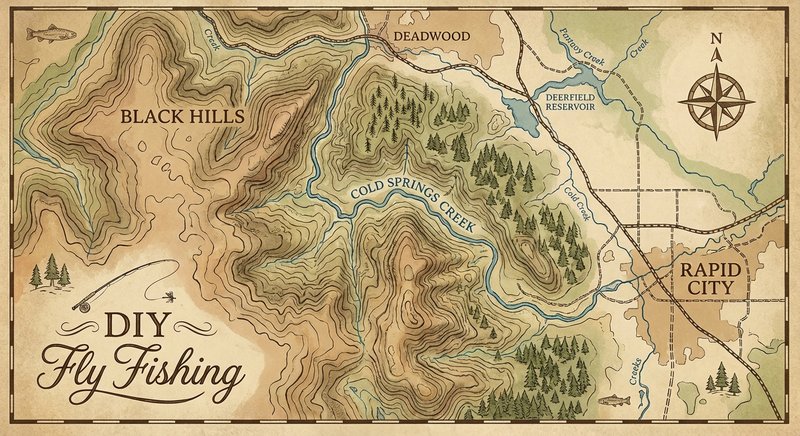
Cold Springs Creek
Fly fishing in South Dakota · intermediate · Best seasons: spring, summer, fall
Target Species
Brown Trout, Brook Trout
About This Water
Spring-fed Black Hills stream. Wild trout in cool, clear water.
Fishing Recommendations
Welcome to the Black Hills of South Dakota. As a guide in this region, I can tell you that Cold Springs Creek is one of the "hidden gems" of the northern Hills. While most anglers flock to the heavy hitters like Rapid Creek or Spearfish Creek, Cold Springs offers a wilder, more intimate experience for those who don't mind a bit of hiking and some tight-quarters casting.
Here is your comprehensive guide to fly fishing Cold Springs Creek.
🎣 Location Overview
Cold Springs Creek is a stunning, spring-fed tributary located in the northwestern Black Hills, eventually feeding into Sand Creek. What makes this water special is its rugged intimacy. This isn't big water; it is a "blue-ribbon" style small stream that flows through timbered canyons and lush meadows.
The water is crystal clear and remains relatively cool even in the heat of summer due to the spring influence. It is characterized by classic "pocket water," small plunge pools, and deep undercut banks carved into the limestone and volcanic soil. Anglers love it because it feels like a wilderness experience—you are far more likely to see a mountain lion track than another fisherman.
🐟 Target Species & Behavior
The creek is home to a healthy population of Wild Brown Trout and Brook Trout.
- Brook Trout: Mostly found in the upper reaches and the colder, shaded headwaters. They are opportunistic and aggressive but easily spooked. They favor the small, bubbly plunge pools.
- Brown Trout: These dominate the middle and lower stretches. They are notoriously "snobby" compared to the brookies. They hold tight to undercut banks and under fallen timber.
- Behavior: Because the water is so clear, these fish have excellent vision. They are highly attuned to overhead movement. If they see your shadow or your rod tip flashing against the sky, the pool is "blown" for thirty minutes.
📅 Best Times to Fish
- Spring (Late April – June): This is the window for the best hatches. While other Hills streams might be murky from snowmelt, Cold Springs clears up quickly. Look for Mother’s Day Caddis hatches.
- Summer (July – August): This is Terrestrial Time. This is arguably the most fun season on Cold Springs. The fish are looking up, waiting for insects to fall from the overhanging grass and brush.
- Fall (September – October): My personal favorite. The Brookies are in their brilliant spawning colors, and the Browns become aggressive as they prepare for their own spawn. The cottonwoods and aspens turning gold make for a spectacular backdrop.
- Prime Window: 10:00 AM to 4:00 PM. In this deep canyon, the "Golden Hour" happens earlier than on the plains because the sun drops behind the canyon walls quickly.
🪰 Recommended Flies & Techniques
Top Fly Patterns
- Dry Flies:
- Elk Hair Caddis (Tan or Olive, size 14-18)
- Parachute Adams (Size 16-20)
- Stimulators (Orange or Yellow, size 12-14) — Great for high-visibility prospecting.
- Terrestrials:
- Black Ants (Size 16-18) — A local "secret weapon."
- Hopper Juan or Morrish Hopper (Size 12-14)
- Beetles (Size 14-16)
- Nymphs:
- Gold Ribbed Hare’s Ear (Size 16-18)
- Zebra Midge (Red or Black, size 18-22)
- Pheasant Tail (Size 16-20)
Techniques & Presentation
- The Bow-and-Arrow Cast: You will need this. The brush is thick, and traditional backcasts are often impossible.
- Stealth Approach: Walk softly. Vibrations through the bank will send fish scurrying. Always fish upstream (from tail to head) so you are approaching the fish from behind their field of vision.
- Dry-Dropper: A very effective setup here. Use a buoyant Stimulator or Hopper as your "indicator" and hang a small Pheasant Tail nymph about 18 inches below it.
💡 Pro Tips & Local Knowledge
- Gear Down: Leave your 5-weight at home. This is the realm of the 2-weight or 3-weight rod. A shorter rod (7’ to 7’6”) is much better than a standard 9-foot rod for navigating the tight canopy.
- The "One-Cast" Rule: On a stream this small, your first cast is your only real chance at the biggest fish in the pool. Make it count.
- Focus on the Under-cuts: In the meadow sections, the fish aren't in the middle of the stream; they are literally under the grass bank. You need to land your fly within an inch of the bank to coax them out.
- The Hike-In Factor: Most people fish within 100 yards of the road crossings. If you hike in a half-mile, the fish become much less wary and the average size tends to increase.
⚠️ Important Information
- Access: Much of Cold Springs Creek is within the Black Hills National Forest, providing good public access. However, there are pockets of private mining claims and ranch land. Always look for "Post No Trespassing" signs and use an app like OnX Maps to stay on public ground.
- Regulations: A South Dakota fishing license is required. Most of this water falls under general state regulations, but always check the current SD Game, Fish & Parks (GFP) handbook for any seasonal closures or tackle restrictions.
- Wildlife & Safety: This is mountain lion and northern timber rattlesnake country. While encounters are rare, stay alert. Cell service is non-existent in the canyon—tell someone where you are going before you head out.
- Leave No Trace: This ecosystem is fragile. Pack out what you pack in and handle these wild fish with wet hands and a quick release.
Guide’s Final Word: Cold Springs isn't about catching "trophy" 20-inch fish; it’s about the beauty of the surroundings and the purity of the wild trout. Bring your camera—the colors on a Cold Springs Brook Trout are something you'll want to remember.
Bug Hatches & Matching Flies
| Hatch | Type | Peak months | Time of day | Hook sizes | Matching flies |
|---|---|---|---|---|---|
| Blue-Winged Olive Baetis | mayfly | April, May, September, October | Late Morning/Afternoon | #18-22 | BWO Parachute #18-22, RS2 #20-22, Pheasant Tail Nymph #18-20 |
| Trico Tricorythodes | mayfly | July, August, September | Early Morning | #20-24 | Trico Spinner #20-24, Trico Parachute #20-22, Zebra Midge #20-22 |
| Pale Morning Dun Ephemerella | mayfly | June, July | Mid-Morning/Early Afternoon | #14-18 | PMD Sparkle Dun #16-18, Split Case PMD #16-18, Hare's Ear Nymph #14-16 |
| Little Yellow Stonefly Isoperla (Yellow Sally) | stonefly | June, July | Late Afternoon/Evening | #14-16 | Yellow Sally Parachute #14-16, Little Yellow Sloan #14-16, Iron Lotus #16 |
| Mother's Day Caddis Brachycentrus | caddis | May | Afternoon/Evening | #14-16 | Peacock Caddis #14-16, Deep Sparkle Pupa #14-16, Elk Hair Caddis (Olive) #14-16 |
| Cinnamon Caddis Hydropsyche | caddis | July, August, September | Evening | #16-18 | Tan Elk Hair Caddis #16-18, LaFontaine's Emerger #16-18, Prince Nymph #16-18 |
| Terrestrials (Grasshoppers, Ants, Beetles) Formicidae/Gryllidae | terrestrial | August, September | All Day | #10-18 | Parachute Ant #16-18, Dave's Hopper #10-14, Black Foam Beetle #14-16 |
| Midges Chironomidae | midge | January, February, March, November, December | Late Morning | #20-26 | Griffith's Gnat #20-24, Zebra Midge (Red/Black) #20-24, Morgan's Midge #20-22 |