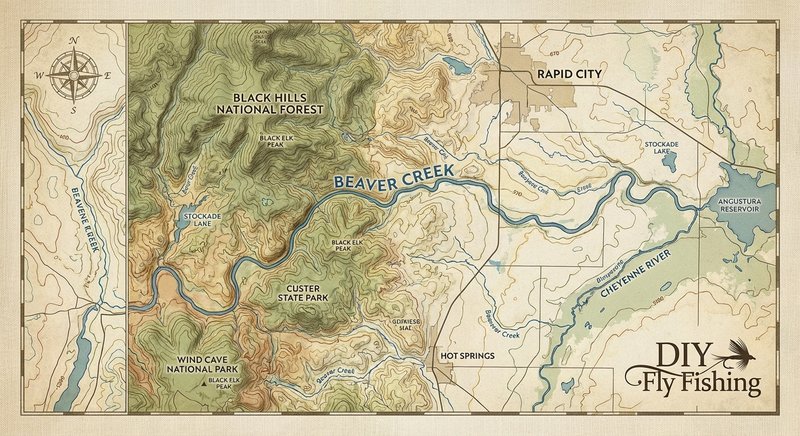
Beaver Creek
Fly fishing in South Dakota · intermediate · Best seasons: spring, summer, fall
Target Species
Brown Trout
About This Water
Black Hills stream with wild trout. Scenic canyon setting.
Fishing Recommendations
Welcome to one of the Black Hills’ best-kept secrets. As your guide, I’m excited to walk you through Beaver Creek. This isn’t your typical big-river drift boat experience; this is "blue-lining" at its finest. Located primarily within Wind Cave National Park and stretching into the surrounding Black Hills National Forest, Beaver Creek offers a technical, intimate, and incredibly rewarding experience for the dedicated trout angler.
🎣 Location Overview
Beaver Creek is a small, spring-influenced limestone stream that carves a rugged path through the southern Black Hills. What makes it special is its wild character. Unlike some of the more heavily stocked waters in the region, Beaver Creek is home to a robust population of wild, stream-born Brown Trout.
The water is crystal clear and flows through a mix of deep limestone canyons and open meadows. Because it is spring-fed, it stays cooler in the summer and warmer in the winter than other Black Hills streams. Anglers love it for the solitude—you’ll often share the water with bison and elk rather than other fishermen—and the challenge of stalking wary fish in tight quarters.
🐟 Target Species & Behavior
The primary draw here is the Wild Brown Trout. While they don't often reach massive "trophy" proportions (averaging 8–12 inches, with a 14-incher being a great fish), they are some of the most beautiful, buttery-yellow trout you will ever see.
- Behavior: These fish are notoriously "spooky." The water is clear and the stream is narrow. If they see your shadow or a heavy splash, the pool is done for the hour.
- Holding Spots: Look for them in the "undercut banks" carved into the limestone, behind submerged logs, and in the deep tail-outs of the small plunge pools.
- Feeding: They are opportunistic but selective regarding presentation. They feed heavily on scuds and caddis larvae year-round, with dramatic terrestrial feeding in late summer.
📅 Best Times to Fish
Seasons
- Spring (April – June): This is prime time. As the canyon warms, the first major hatches of Blue Winged Olives (BWOs) appear. Water levels are usually at their best.
- Summer (July – August): The "Hopper" season. While other streams might get too warm, the spring-fed nature of Beaver Creek keeps it fishable, though stealth becomes even more critical as water levels drop.
- Fall (September – October): My personal favorite. The Brown Trout become aggressive as they prepare for the spawn. The colors of the canyon change, and the fish are eager to bulk up.
Time of Day & Conditions
- Low Light is King: Early morning and late evening are the most productive windows.
- Cloudy Days: On overcast days, the fish lose some of their wariness, and you’ll see much more surface activity.
🪰 Recommended Flies & Techniques
Top Fly Patterns
- Nymphs:
- Flashback Pheasant Tail (#16-20): A staple for the BWO hatches.
- Ray Charles or Scud (#16-18): In orange or grey; essential for spring-fed limestone waters.
- Perdigons (#18): Great for getting deep quickly in the small, tight plunge pools.
- Dry Flies:
- Elk Hair Caddis (#14-18): Tan or Olive.
- Parachute Adams (#16-22): The ultimate "match-all" fly for this creek.
- Morrish Hopper (#10-14): In late summer, a foam hopper is irresistible.
- Streamers:
- Woolly Bugger (#10-12): In olive or black. Fish these deep in the bigger canyon holes.
Techniques & Presentation
- The "Crouch and Crawl": Approach every pool from downstream. Stay low—literally on your knees if necessary—to avoid being silhouetted against the sky.
- Short Line Nymphing: You rarely need to cast more than 15–20 feet. A "high-sticking" or Euro-style approach works wonders in the pocket water.
- Dry-Dropper: This is the most effective way to cover Beaver Creek. Use a buoyant dry fly (like a Stimulator or Hopper) and hang a small weighted nymph 18 inches below it.
💡 Pro Tips & Local Knowledge
- The "Red Rock" Stretch: Focus on the sections within Wind Cave National Park where the creek enters the canyon. The limestone walls provide shade and deeper holding water.
- Light Tackle: Leave your 5-weight or 6-weight at home. A 7.5' to 8.5' 3-weight rod is the perfect tool for this water. It allows for delicate presentations and makes a 10-inch wild brown feel like a monster.
- Long Leaders: Use a 9-foot to 12-foot leader tapering to 5X or 6X fluorocarbon. The thin diameter is crucial for the glassy tail-outs.
- Watch for Bison: This is no joke. Beaver Creek runs through prime bison territory. If a herd is near the water, give them a wide berth. They have the right of way!
⚠️ Important Information
Access
- Wind Cave National Park: Access is generally via Highway 385 or Highway 87. You can hike in from various trailheads (like the Highland Creek Trail).
- Custer State Park: The creek also flows through portions of Custer State Park, requiring a park entry permit.
Regulations & Permits
- License: You need a valid South Dakota Fishing License.
- National Park Rules: Fishing is permitted in Wind Cave National Park, but you must follow park-specific regulations. Check at the visitor center for any temporary closures.
- Tread Lightly: This is a fragile ecosystem. Use barbless hooks and practice 100% Catch and Release for these wild browns to ensure the population thrives.
Special Considerations
- Rattlesnakes: The southern Black Hills are home to Prairie Rattlesnakes. Watch your step when hiking through the tall grass near the creek.
- Cell Service: Expect zero bars once you drop into the canyon. Let someone know your plan before heading in.
Beaver Creek is a place for the angler who values the quality of the surroundings and the purity of the fish over the size of the catch. Move slowly, stay low, and enjoy one of South Dakota's true gems!
Bug Hatches & Matching Flies
| Hatch | Type | Peak months | Time of day | Hook sizes | Matching flies |
|---|---|---|---|---|---|
| Blue Winged Olive (BWO) Baetis spp. | mayfly | April, May, September, October | Midday | #18-22 | Parachute Adams #18-22, RS2 #20-22, Pheasant Tail Nymph #18-20 |
| Chironomids (Midges) Chironomidae | midge | February, March, April | All Day | #20-26 | Zebra Midge #20-24, Griffith's Gnat #20-22, Morgan's Midge #22-24 |
| Pale Morning Dun (PMD) Ephemerella excrucians | mayfly | June, July | Late Morning/Afternoon | #16-18 | PMD Sparkle Dun #16-18, Split Case PMD #16-18, CDC PMD Emerger #16-18 |
| Trico Tricorythodes | mayfly | July, August, September | Early Morning | #20-24 | Trico Spinner #22-24, Trico Dun #20-22 |
| Little Brown/Tan Caddis Hydropsyche | caddis | May, June, July | Evening | #14-18 | Elk Hair Caddis #14-18, LaFontaine's Deep Sparkle Pupa #14-16, Holy Grail Caddis #16-18 |
| Yellow Sally Isoperla spp. | stonefly | June, July | Afternoon/Evening | #14-16 | Yellow Sally Stone #14-16, Iron Lotus #16 |
| Terrestrials (Hoppers/Ants) Orthoptera/Formicidae | terrestrial | July, August, September | Midday/Afternoon | #10-18 | Dave's Hopper #10-14, Cinnamon Ant #16-18, Black Foam Beetle #14-16 |
| Little Black Stonefly Capniidae | stonefly | March, April | Midday | #16-18 | Little Black Sloan #16-18, Prince Nymph #14-18 |