Battle Creek
Fly fishing in South Dakota · intermediate · Best seasons: spring, summer, fall
Target Species
Brown Trout, Rainbow Trout
About This Water
Black Hills stream with wild trout. Historic significance and good fishing.
Fishing Recommendations
Battle Creek is one of the "hidden gems" of the Black Hills of South Dakota. While it often takes a backseat to more famous waters like Rapid Creek or Spearfish Creek, Battle Creek offers some of the most technical and rewarding small-stream fly fishing in the region.
As your guide, here is the breakdown of how to find success on this beautiful Black Hills stream.
🎣 Location Overview
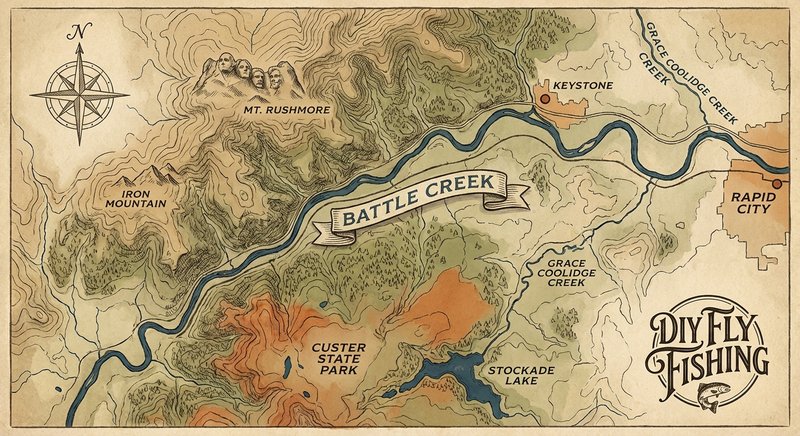
Battle Creek originates in the central Black Hills, flowing through the town of Keystone and past the base of Mount Rushmore before winding east toward the prairie. It is a classic freestone-style stream characterized by a mix of high-gradient "pocket water," deep plunge pools, and technical meadow sections.
What makes Battle Creek special is its diversity of character. Near Keystone, you’ll find rocky canyons and fast water. As it moves toward Hermosa, it transitions into a meandering meadow stream with undercut banks. It feels more "wild" and less manicured than the stretches of water running through Rapid City, offering anglers a true sense of solitude.
🐟 Target Species & Behavior
The primary residents are Brown Trout and Rainbow Trout.
- Brown Trout: These are the stars of Battle Creek. Many are wild, displaying brilliant buttery colors and red spots. They are notoriously wary. They hold tight to undercut banks, submerged logs, and the dark shadows of canyon walls.
- Rainbow Trout: Often found in the faster, more oxygenated riffles and at the "heads" of pools. While some are stocked near bridge access points, there are plenty of hardy holdovers that fight significantly above their weight class.
- Behavior: These fish are opportunistic but easily spooked. Because the water is often crystal clear, your shadow or a heavy footfall will send them scurrying. They feed heavily on aquatic insects but become aggressive predators of grasshoppers and beetles in the late summer.
📅 Best Times to Fish
Seasons
- Spring (April – May): Excellent fishing as the water warms. Look for Blue Winged Olive (BWO) hatches on overcast days. This is the best time to find hungry fish after a long winter.
- Summer (June – August): The "Golden Era" for Battle Creek. The canyon sections stay cooler. This is prime dry-fly and terrestrial season. Note: In late August, keep an eye on water temps in the lower meadow sections; if it's over 68°F, head to higher elevations.
- Fall (September – October): My personal favorite. The Brown Trout become aggressive as they prepare to spawn. The fall colors in the Black Hills are world-class, and the crowds disappear.
Best Times of Day
- Summer: First light until 11:00 AM, then again from 6:00 PM until dark.
- Spring/Fall: The "heat of the day" (11:00 AM – 3:00 PM) is often the most productive.
🪰 Recommended Flies & Techniques
Top Fly Patterns
- Dries: Parachute Adams (#14-18), Elk Hair Caddis (#14-16), Stimulators (Orange or Yellow, #12-14).
- Nymphing: Bead-head Pheasant Tails (#16-18), Zebra Midges (Red or Black, #18-20), and Perdigons for fast-sinking in pocket water.
- Terrestrials: Fat Albert (#10-14), Morrish Hopper (#12), and Foam Beetles or Ants (#14-16). Ants are essential here.
- Streamers: Small Wooly Buggers (Olive or Thin Mint, #10-12) or Pine Squirrel leeches.
Effective Techniques
- Dry-Dropper: This is the most effective way to fish Battle Creek. Use a buoyant dry fly (like a Stimulator) and hang a small nymph 18–24 inches below it. This allows you to cover two zones and acts as a subtle strike indicator.
- Tight-Line Nymphing: In the rocky sections near Keystone, use a Euro-style or tight-line approach to get nymphs deep into the small pockets behind boulders.
- Stealth Approach: Fish upstream. If you walk downstream, you will send silt and "scare signals" to every fish in the hole.
💡 Pro Tips & Local Knowledge
- The "Meadow Stealth" Rule: In the lower stretches, stay 10 feet back from the bank. Use the tall grass as cover. If you can see the fish, they have likely already seen you.
- Focus on the Shadows: Even at high noon, look for the sliver of shade against a rock or bank. Black Hills trout hate being in direct sun and will stack up in the smallest patches of shade.
- The Bridge Factor: While many anglers fish right at the bridges, the best fishing is usually a 15-minute hike upstream or downstream from any road access point.
- Watch the Flow: Battle Creek is sensitive to rainfall. If there is a heavy thunderstorm, it can blow out (turn muddy) quickly. If it does, give it 24 hours to clear, or move to the higher headwaters.
⚠️ Important Information
- Access: Much of the upper creek is within the Black Hills National Forest, providing great public access. However, as the creek moves east toward Hermosa, it passes through significant private ranch land. Always look for "Walk-In Area" signs or USFS boundary markers. Respect private property.
- Regulations: A South Dakota fishing license is required. You can purchase these online or at local fly shops in Rapid City or Hill City.
- Safety:
- Rattlesnakes: Be cautious in the lower, drier elevations near Hermosa during summer.
- Tics: They are thick in the tall meadow grass; wear repellent.
- Wildlife: This is mountain lion and buffalo country (if you wander near Custer State Park). Keep your head on a swivel.
Guide’s Final Word: Battle Creek rewards the patient angler. Scale down your tippet to 5X or 6X, move slowly, and enjoy the rhythm of one of South Dakota's most underrated trout streams.
Bug Hatches & Matching Flies
| Hatch | Type | Peak months | Time of day | Hook sizes | Matching flies |
|---|---|---|---|---|---|
| Blue Winged Olive Baetis spp. | mayfly | April, May, September, October | Late Morning/Afternoon | #18-22 | RS2 #18-22, Parachute Adams #18-22, WD-40 #20-22 |
| Pale Morning Dun Ephemerella excrucians | mayfly | June, July | Late Morning | #16-18 | Pheasant Tail Nymph #16-18, PMD Sparkle Dun #16-18, Split Case PMD #16 |
| Little Brown Caddis Glossosoma spp. | caddis | May, June | Morning/Evening | #14-18 | Elk Hair Caddis #14-18, LaFontaine's Deep Pupa #14-16, Soft Hackle Hare's Ear #14-16 |
| Trico Tricorythodes | mayfly | August, September | Early Morning | #20-24 | Trico Spinner #20-24, Sunken Trico Spinner #22, Griffith's Gnat #20-24 |
| Yellow Sally Isoperla spp. | stonefly | June, July | Afternoon/Evening | #12-16 | Yellow Stimulator #14-16, Iron Lotus #14-16, Little Yellow Sloan #14-16 |
| Midge Chironomidae | midge | January, February, March, December | Mid-day | #18-26 | Zebra Midge #18-22, Morgan's Midge #20-24, Black Fly #20-22 |
| Grasshopper Acrididae | terrestrial | August, September | Late Morning/Afternoon | #8-12 | Dave's Hopper #10-12, Morrish Hopper #8-12, Parachute Hopper #12 |
| Cinnamon Ant Formicidae | terrestrial | July, August | All Day | #14-18 | Cinnamon Ant #14-18, Transparant #16-18, Chernobyl Ant #12-14 |