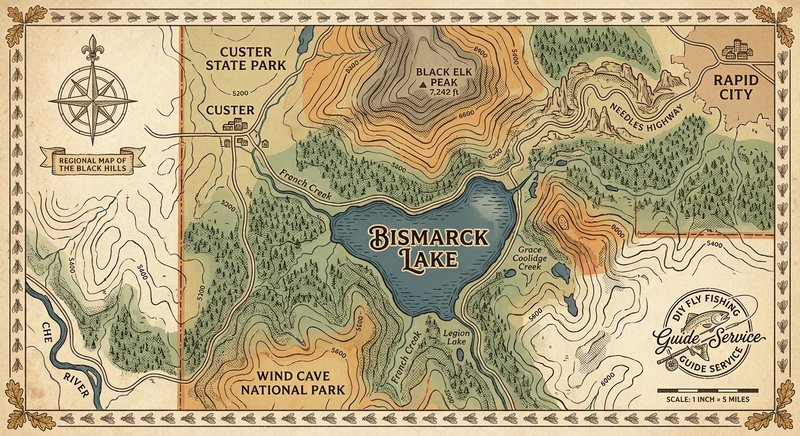
Bismarck Lake
Fly fishing in South Dakota · intermediate · Best seasons: summer, fall
Target Species
Rainbow Trout, Brook Trout
About This Water
Black Hills National Forest lake with trout. Remote setting with primitive access.
Fishing Recommendations
Bismarck Lake is one of the hidden gems of the Southern Black Hills. Located just a few miles east of Custer, South Dakota, it offers an quintessential "Black Hills" experience: crystal clear water, towering ponderosa pines, and dramatic granite outcroppings.
As your guide, here is the comprehensive breakdown for fishing this beautiful alpine-style lake.
🎣 Location Overview
Bismarck Lake is a 25-acre mountain reservoir located at an elevation of approximately 5,200 feet. Unlike some of the larger, busier reservoirs in the Black Hills, Bismarck is known for its tranquility. It is a "no-wake" lake, making it a sanctuary for fly anglers in float tubes, kayaks, or canoes.
The water is remarkably clear, which allows for excellent sight-fishing opportunities but also requires a stealthy approach. The shoreline is a mix of accessible gravel banks and steep granite cliffs. The lake's structure includes submerged weed beds, fallen timber, and deep channels near the dam, providing diverse habitats for trout.
🐟 Target Species & Behavior
The primary draws here are Rainbow Trout and Brook Trout.
- Rainbow Trout: These are the most active and are frequently stocked by the SD Game, Fish & Parks. They tend to cruise the littoral zones (near the shore) in the mornings and evenings, moving to the deeper center channels during the heat of the mid-day sun.
- Brook Trout: While smaller on average than the rainbows, the brookies in Bismarck are stunningly vibrant. They are "structure-oriented" fish—look for them near the submerged logs on the western end or tucked under the shadows of the granite boulders.
- Feeding Patterns: Because of the clear water, these fish are highly visual. They key in on heavy midge hatches, scuds (freshwater shrimp) in the weed beds, and damselfly larvae. In late summer, terrestrial insects (hoppers and ants) falling from the pines become a primary food source.
📅 Best Times to Fish
Summer (June – August)
- Optimal Window: Early morning (sunrise to 10:00 AM) and "the magic hour" (the last 90 minutes of daylight).
- Conditions: Look for calm, glassy water for dry fly action. Mid-day summer fishing can be tough unless you use sinking lines to reach the cooler, deeper water.
Fall (September – October)
- Optimal Window: This is arguably the best time to fish Bismarck. As water temperatures drop, fish become more aggressive.
- Conditions: Brook trout begin their spawning colors and become very territorial. The "Fall Turnover" usually happens in October, which can briefly cloud the water, but the weeks leading up to it offer some of the best streamer fishing of the year.
🪰 Recommended Flies & Techniques
Top Fly Patterns
- Dry Flies: Parachute Adams (#16-20), Griffith’s Gnat (#18-22) for midge hatches, and Foam Beetles or Ants (#14-16) in late summer.
- Nymphs: Zebra Midge (Black or Red, #18-22), Gold-Ribbed Hare’s Ear (#14-16), and flashback Pheasant Tails (#16-18).
- Streamers/Wets: Pine Squirrel Leeches (Black or Olive), Woolly Buggers (#8-12), and the "Black Hills Special" (a local favorite).
Effective Techniques
- The "Hanging" Nymph: Use a long leader (9-12 feet) with a tiny Zebra Midge suspended 4–6 feet under a small, sensitive indicator. Cast this near the weed edges and let it sit.
- Slow-Strip Streamers: From a float tube, cast toward the granite walls and use a slow, "inch-worm" retrieve with a leech pattern.
- Dry-Dropper: In the summer, a hopper or a large Parachute Adams with a small unweighted nymph dropped 18 inches below is deadly for covering water.
💡 Pro Tips & Local Knowledge
- The Western Inflow: Focus on the western end where small trickles of water enter the lake. This area stays oxygenated and cooler, attracting brook trout even in the heat of July.
- Stealth is Key: Because the water is so clear, avoid wearing bright colors. If fishing from the bank, stay back from the water's edge to avoid "lining" the fish or casting a shadow over them.
- The "Granite Shadow": In the late afternoon, the granite peaks cast long shadows over the water. Fish will move out from the depths into these shadows earlier than they do in other parts of the lake. Target the edge of the shadow line.
- 6x Tippet: Don't be afraid to drop down to 6x fluorocarbon. These fish can be leader-shy, especially on bright, windless days.
⚠️ Important Information
- Access: There is a well-maintained US Forest Service campground at Bismarck Lake. There is a small day-use fee for parking if you aren't camping.
- Regulations: A valid South Dakota fishing license is required. Bismarck is subject to general state inland water regulations. Always check the current SDGFP Fishing Handbook for the latest creel limits.
- Gear Recommendation: A 9-foot, 4-weight or 5-weight rod is the perfect tool for this water. It provides enough backbone for the occasional 16-inch rainbow but enough finesse for the smaller brookies.
- Connectivity: Cell service is spotty at the lake. Download your maps and licenses for offline use before heading out from Custer.
Guide’s Final Word: Bismarck Lake isn't about catching the biggest fish in South Dakota; it’s about the quality of the experience. It is one of the most photogenic spots in the Black Hills. Bring a camera, a slow pace, and a handful of midges. Tight lines!
Bug Hatches & Matching Flies
| Hatch | Type | Peak months | Time of day | Hook sizes | Matching flies |
|---|---|---|---|---|---|
| Chironomids (Midges) Chironomidae | midge | April, May, September, October | All Day | #18-24 | Zebra Midge #18-22, Ice Cream Cone #16-20, Griffith's Gnat #20-24 |
| Callibaetis (Speckled Duns) Callibaetis | mayfly | June, July, August | Morning/Afternoon | #14-16 | Callibaetis Spinner #14-16, Hare's Ear Nymph #14-16, Parachute Adams #14-18 |
| Damselflies Enallagma | terrestrial | June, July | Morning/Afternoon | #10-14 | Marabou Damsel Nymph #10-14, Adult Damsel #12-14 |
| Cinnamon Caddis Ceraclea | caddis | July, August | Evening | #14-16 | Elk Hair Caddis (Cinnamon) #14-16, LaFontaine's Emerger #14-16 |
| Dragonflies Anisoptera | terrestrial | July, August | Afternoon | #6-10 | Dragonfly Nymph #6-10, Woolly Bugger (Olive) #8-12 |
| Terrestrial Ants Formicidae | terrestrial | August, September | Afternoon | #14-18 | Black Foam Ant #14-18, Cinnamon Ant #16-18 |
| Tricos Tricorythodes | mayfly | August, September | Morning | #20-24 | Trico Spinner #20-24, Trico Nymph #22-24 |
| Water Boatmen Corixidae | terrestrial | September, October | Afternoon | #14-16 | Water Boatman #14-16, Prince Nymph #14-16 |