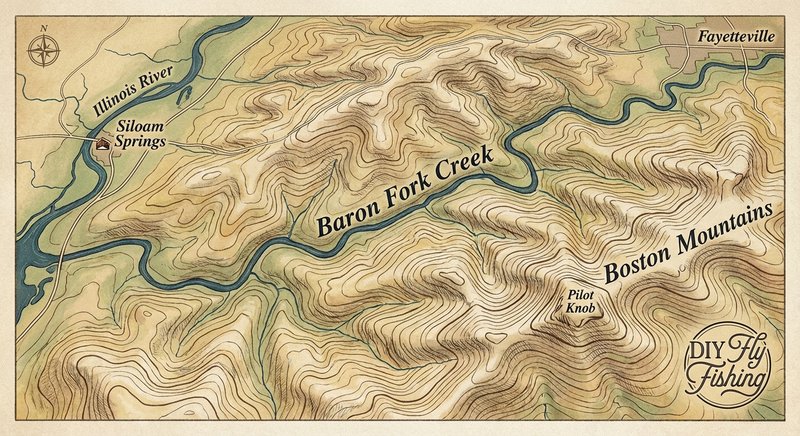
Baron Fork Creek
Fly fishing in Arkansas · Intermediate · Best seasons: Spring, Summer, Fall
Target Species
Smallmouth Bass, Spotted Bass
About This Water
Clear Ozark stream near the Oklahoma border. Excellent smallmouth bass.
Fishing Recommendations
Welcome to one of the Ozarks' best-kept secrets. As your guide, I’m excited to walk you through the Baron Fork Creek. While many anglers flock to the larger Kings or Buffalo Rivers, the Baron Fork (a major tributary to the Illinois River) offers an intimate, technical, and incredibly rewarding fly fishing experience for native "Ozark Smallies."
🎣 Location Overview
Baron Fork Creek is a classic Ozark mountain stream characterized by crystal-clear water, gravel bars, and dramatic limestone bluffs. Located in Northwest Arkansas (near Dutch Mills and Evansville), it flows across the Oklahoma border before joining the Illinois River.
What makes it special is its intermittent nature. In the heat of summer, sections of the creek may go subsurface through the gravel, creating isolated, deep "emerald pools" where fish congregate. It is a smaller, more intimate fishery than its famous neighbors, requiring stealth and precise casting. Anglers love it because it feels wild, remote, and holds surprisingly large Smallmouth Bass for such a small volume of water.
🐟 Target Species & Behavior
- Smallmouth Bass (The "Bronze Back"): The undisputed king of the creek. These fish are lean, muscular, and incredibly wary in the clear water. They hold in the "seams" where fast water enters a pool or tucked deep under root wads and limestone ledges.
- Spotted Bass: Often found in the slower, deeper sections of the pools. They are aggressive hitters but tend to stay deeper than the Smallmouth.
- Behavior & Diet: These fish are opportunistic but spook easily. Their diet consists primarily of crayfish (about 70% of their intake), sculpins, stonerollers, and during the summer months, a massive amount of terrestrial insects like grasshoppers and cicadas.
📅 Best Times to Fish
- Spring (Late March – May): This is prime time. As water temperatures hit the 55°F–60°F mark, the bass become highly active pre-spawn. This is your best chance at a trophy fish using larger streamers.
- Summer (June – August): The "topwater window." While the water levels drop, the morning and evening dry-fly/popper action is world-class. Focus on the oxygenated water at the heads of pools.
- Fall (September – early November): As the water cools, bass feed heavily to prepare for winter. The clarity is at its peak, so long leaders and stealth are mandatory.
- Prime Window: Low-light conditions are your best friend here. The first two hours of daylight and the "golden hour" before dusk are when the biggest Smallmouth move out of the deep shadows to hunt.
🪰 Recommended Flies & Techniques
Top Fly Patterns
- Crayfish Patterns: Near-Nuff Crayfish, Clouser Crayfish (Olive/Orange), and the classic Whitlock’s Near-Nuff. Size 4–8.
- Streamers: The Clouser Minnow (Chartreuse/White or Olive/White) is the gold standard. For deeper pools, try a black or olive Woolly Bugger with a copper bead.
- Topwater: BoogleBugs (Poppers) in yellow or "frog," and foam patterns like the Murdich Minnow or a Fat Albert for terrestrial season.
Techniques
- The "Crayfish Hop": Fish your crayfish patterns on a sink-tip line or a long leader. Cast upstream, let it sink to the bottom, and use short, erratic strips to mimic a fleeing crawdad.
- Swing and Strip: Cast streamers across the current at the head of a pool, let them swing into the slack water, and use "wounded baitfish" retrieves.
- Dead-Drifting: In the spring, dead-drifting a large rubber-legged stonefly nymph under an indicator can be surprisingly effective for Spotted Bass.
💡 Pro Tips & Local Knowledge
- The Stealth Factor: Because the water is so clear, if you can see the fish, they have likely already seen you. Wear earthy tones (camo, olive, or tan), stay low, and avoid "lining" the fish with your fly line.
- Focus on the Ledges: Baron Fork has beautiful limestone shelf rock. Bass love to tuck under these shelves. You need to land your fly inches from the rock face to coax them out.
- The "Gravel Push": After a rain, the creek moves a lot of gravel. Look for new "tail-outs" at the end of pools where the water thins over gravel; Smallmouth often sit here to intercept nymphs and small baitfish moving downstream.
- Wading is King: This is not a float-trip creek. It is a wade-fisherman’s paradise. Be prepared to hike through the woods to find the best holes.
⚠️ Important Information
- Access: Much of the land surrounding Baron Fork is private. Always seek permission before crossing private property. Public access can be found at bridge crossings (like Hwy 59 or Co Rd 420), but be prepared to walk several miles upstream or downstream to get away from the road noise.
- Regulations: You must have a valid Arkansas Fishing License. Follow all AGFC (Arkansas Game and Fish Commission) regulations regarding size and creel limits. Many local conservationists practice 100% Catch and Release for Smallmouth on this creek to preserve the fragile population.
- Safety: Watch out for the "Ozark Three": Poison Ivy, Ticks, and Copperheads. During the summer, the humidity can be intense—carry more water than you think you need.
- Water Levels: Check the USGS gauges for the Illinois River basin. If the Illinois is flooding, the Baron Fork will be blown out. Conversely, in a drought, the creek can get very low—if the water is too warm (above 75°F), give the fish a break to avoid mortality.
Tight lines, and enjoy the solitude of the Baron Fork!
Bug Hatches & Matching Flies
| Hatch | Type | Peak months | Time of day | Hook sizes | Matching flies |
|---|---|---|---|---|---|
| Blue-Winged Olive Baetis spp. | mayfly | March, April, October, November | Mid-day | #18-22 | Parachute Adams #18-22, RS2 #20-22, Pheasant Tail Nymph #18-20 |
| Light Cahill Stenacron interpunctatum | mayfly | June, July | Evening | #12-14 | Light Cahill Dry #12-14, Gold Ribbed Hare's Ear #12-14 |
| Cinnamon Caddis Hydropsyche spp. | caddis | May, June, September | Late Afternoon/Evening | #14-16 | Elk Hair Caddis (Tan) #14-16, LaFontaine's Deep Sparkle Pupa #14-16 |
| Little Yellow Sally Isoperla spp. | stonefly | May, June | Afternoon/Evening | #14-16 | Yellow Sally Dry #14-16, Iron Lotus #16 |
| Hellgrammite (Dobsonfly) Corydalus cornutus | terrestrial | June, July, August | Night (Adults) / All day (Larvae) | #4-8 | Bitch Creek Nymph #6-8, Murray's Hellgrammite #4-8 |
| Hexagenia (Giant Mayfly) Hexagenia limbata | mayfly | July, August | Dusk/Night | #6-10 | Hexagenia Dry #6-10, Wiggle Nymph #8-10 |
| Grasshopper Orthoptera | terrestrial | July, August, September | Mid-day/Afternoon | #8-12 | Dave's Hopper #8-12, Morrish Hopper #10-12 |
| Black Ant Formicidae | terrestrial | June, July, August | All Day | #16-20 | Chernobyl Ant #12-14, Black Foam Ant #16-18 |
| White Winged Black Midge Chironomidae | midge | January, February, December | Mid-day | #20-24 | Zebra Midge #20-22, Griffith's Gnat #20-24 |
| March Brown Maccaffertium vicarium | mayfly | April, May | Afternoon | #12-14 | March Brown Dry #12-14, Hare's Ear Nymph #12-14 |