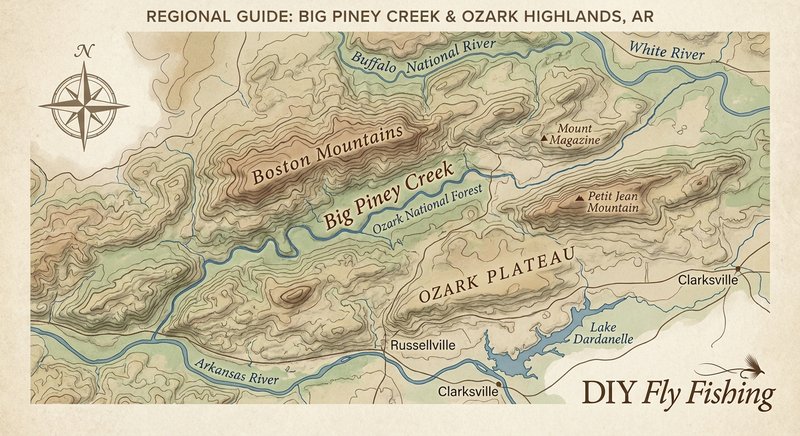
Big Piney Creek
Fly fishing in Arkansas · Intermediate · Best seasons: Spring, Summer, Fall
Target Species
Smallmouth Bass, Spotted Bass
About This Water
Wild and scenic Ozark stream with smallmouth bass. Remote wilderness paddling and fishing.
Fishing Recommendations
Welcome to the Ozark National Forest. As your guide, I’m excited to walk you through one of the crown jewels of Arkansas fly fishing: Big Piney Creek.
Often overshadowed by the White or Little Red Rivers, the "Piney" is a classic Ozark freestone stream. It offers a rugged, scenic experience characterized by turquoise-tinted pools, massive sandstone boulders, and some of the hardest-fighting Smallmouth Bass in the South.
🎣 Location Overview
Big Piney Creek is a designated National Wild and Scenic River. Carving its way through the Boston Mountains, the Piney is defined by its dramatic elevation drops and diverse water structures.
What makes it special is the "Pool-and-Drop" morphology. You’ll find long, slow-moving emerald pools separated by quick, rocky riffles and "willow jungles." The water is remarkably clear, demanding a stealthy approach. Unlike the muddy lowland rivers, the Piney feels like a mountain trout stream, but with the warm-water aggression of predatory bass.
🐟 Target Species & Behavior
Smallmouth Bass (The "Bronzeback")
The star of the show. These are native "Neosho" strain genetics in some stretches. They are lean, muscular, and utilize the current.
- Holding Water: Look for "slack water" adjacent to fast currents. They love the deep side of large boulders (bluff holes) and the transition zones where a riffle enters a pool.
- Feeding: They are opportunistic. They key in on crawfish, hellgrammites, and stoneroller minnows.
Spotted Bass
Often found in the slightly slower, deeper sections of the lower Piney.
- Holding Water: They tend to congregate more around submerged timber and root balls than the Smallmouth do.
- Feeding: More likely to chase smaller baitfish and shad imitations in the mid-column.
📅 Best Times to Fish
Spring (April – June)
- The Window: This is prime time. As water temperatures hit 55°F, fish become active. When it hits 60°F–65°F, the pre-spawn and spawn occur.
- Conditions: Watch the water levels. Spring rains can turn the Piney into a dangerous torrent. You want the "dropping and clearing" stage.
Summer (July – Early September)
- The Window: Low, clear water. Early morning and late evening are the only times to be on the water.
- Conditions: Mid-day heat pushes fish into the deepest "bluff holes" or under heavy overhead cover. This is the best time for topwater action at dawn and dusk.
Fall (Late September – November)
- The Window: The "Second Prime." As temperatures drop, bass feed heavily to prepare for winter.
- Conditions: Crystal clear water and falling leaves can make fishing technical. Focus on aggressive streamer stripping.
🪰 Recommended Flies & Techniques
Topwater (The Most Fun)
- Patterns: BoogleBugs (Size 4-8), Rainy’s Foam Bass Poppers, and Murdich Minnows (fished on a sink-tip but worked near the surface).
- Technique: "Pop and Stop." Cast against the rock bluffs or tight to willow banks. Let the rings disappear before moving the fly. Often, the strike occurs while the fly is motionless.
Sub-Surface (The Most Effective)
- Crawfish: Near-Nuff Crayfish, Clouser Minnows (Olive/Orange), and Meat Whistles.
- Technique: Bounce these along the bottom of pools. If you aren't ticking rocks, you aren't in the strike zone.
- Streamers: Game Changers or Woolly Buggers (Black or Olive). Use a "strip-strip-pause" retrieve to mimic a wounded minnow.
💡 Pro Tips & Local Knowledge
- The "Willow Fly" Hatch: In early summer, keep an eye out for Hexagenia or large stoneflies. While not a "hatch" in the trout sense, a large dry fly (like a size 8 Chubby Chernobyl) dropped near overhanging willows can induce violent strikes.
- Go Light, but Not Too Light: I recommend a 6-weight or 7-weight rod. While the fish average 10–14 inches, a 3-pounder in heavy current will snap a light rod. Use 10lb to 12lb fluorocarbon tippet—the rocks are sharp, and the fish aren't particularly leader-shy.
- The "Sneak": Because the water is so clear, if you can see the fish, they’ve already seen you. Wade upstream when possible and wear natural-colored clothing (camo or tan) to blend into the bluffs.
⚠️ Important Information
Access & Logistics
- Put-ins/Take-outs: Popular stretches include Helton’s Farm to Long Pool and Long Pool to Moore Bayou.
- Wading vs. Floating: The Piney is best fished from a raft or kayak during Spring. During Summer low-flow, it becomes a "drag-and-wade" fishery. Long Pool Recreation Area offers excellent bank and wade access.
Regulations
- License: An Arkansas Fishing License is required.
- Special Rules: Check the AGFC (Arkansas Game and Fish Commission) guidebook. There are specific length limits for Smallmouth Bass on the Big Piney (usually a 12-inch minimum, but many anglers practice 100% Catch and Release to preserve the trophy quality).
Safety
- Cell Service: Expect zero cell service once you drop into the canyon. Bring a physical map or a GPS satellite messenger.
- Flow Rates: Always check the USGS gauge at Highway 7 or Long Pool. For fishing, you want the gauge between 2.0 and 3.5 feet. Above 4 feet, it becomes a whitewater destination and is dangerous for fishing.
Guide’s Final Word: The Piney isn't about numbers; it's about the environment. Respect the river, pack out your trash, and keep those Smallmouth wet. Tight lines!
Bug Hatches & Matching Flies
| Hatch | Type | Peak months | Time of day | Hook sizes | Matching flies |
|---|---|---|---|---|---|
| March Brown Maccaffertium vicarium | mayfly | March, April | Mid-day to Afternoon | #12-14 | March Brown Dry #12-14, Hare's Ear Nymph #12-14 |
| Grannom Caddis Brachycentrus | caddis | April | Late Afternoon/Evening | #14-16 | Elk Hair Caddis (Olive) #14-16, Deep Sparkle Pupa #14-16 |
| Golden Stonefly Acroneuria abnormis | stonefly | May, June | Evening | #6-10 | Pat's Rubber Leg #6-10, Stimulator (Yellow) #8-10 |
| Light Cahill Stenacron candense | mayfly | June, July | Evening/Dusk | #12-14 | Light Cahill #12-14, Pheasant Tail Nymph #14 |
| Hellgrammite (Dobsonfly) Corydalus cornutus | terrestrial | June, July, August | All Day | #4-8 | Murray's Hellgrammite #4-8, Wooly Bugger (Black) #6-10 |
| Little Yellow Sally Isoperla | stonefly | May, June | Late Afternoon | #14-16 | Yellow Sally Dry #14-16, Copper John (Yellow) #14-16 |
| Spotted Sedge Hydropsyche | caddis | July, August, September | Evening | #16-18 | Caddis Variant #16-18, LaFontaine Emerger #16-18 |
| Blue-Winged Olive Baetis | mayfly | March, October, November | Mid-day | #18-22 | RS2 #20-22, Parachute Adams #18-20 |
| Grasshopper Acrididae | terrestrial | July, August, September | Mid-day to Evening | #6-12 | Dave's Hopper #8-12, Fat Albert #6-10 |
| Trico Tricorythodes | mayfly | August, September | Early Morning | #20-24 | Trico Spinner #22-24, Zebra Midge #20-22 |