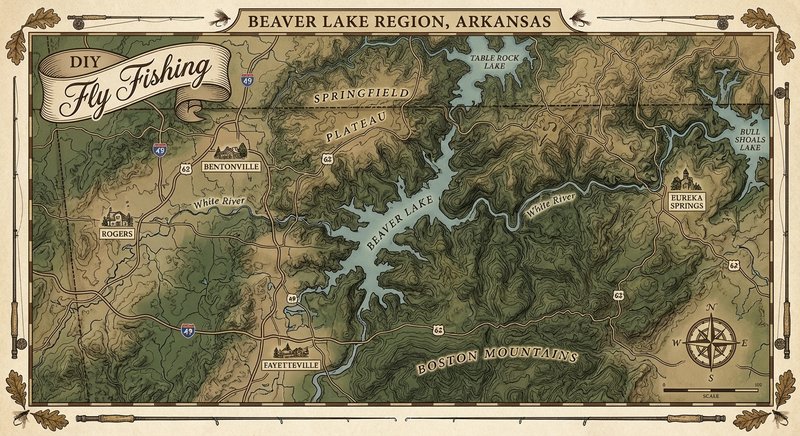
Beaver Lake
Fly fishing in Arkansas · Intermediate · Best seasons: Spring, Summer, Fall
Target Species
Largemouth Bass, Smallmouth Bass, Striped Bass
About This Water
Northwest Arkansas reservoir with excellent bass fishing. Striped bass and walleye too.
Fishing Recommendations
Welcome to the Ozarks. As your guide, I can tell you that Beaver Lake is a unique gem in the Natural State. While many fly anglers head to the tailwaters of the White River for trout, those in the know look to the main lake for some of the best warm-water fly fishing in the mid-south.
Beaver Lake is a massive highland reservoir with over 450 miles of shoreline, characterized by crystal-clear water, towering limestone bluffs, and deep submerged timber.
🎣 Location Overview
Beaver Lake is the first impoundment on the White River system. Located in Northwest Arkansas near Rogers and Eureka Springs, it is a "highland reservoir," meaning it is deep, rocky, and relatively clear compared to lowland lakes.
What makes it special for the fly angler is the diversity of structure. You have everything from shallow mud flats in the upper riverine sections to vertical limestone walls and deep gravel points in the lower lake. The clarity of the water allows for sight-fishing opportunities that are rare in many Southern reservoirs, but it also means the fish can be "spooky," requiring tactical presentations and long casts.
🐟 Target Species & Behavior
Largemouth Bass
- Behavior: The kings of the shoreline. They relate heavily to "buck brush" (flooded willow/bushes), submerged cedar trees, and docks.
- Feeding: They focus on bluegill, crawfish, and shad. In the spring, they move shallow to spawn; in summer/fall, they tuck into deep shade or suspended timber.
Smallmouth Bass
- Behavior: Found primarily in the lower, clearer end of the lake (near the dam). They prefer rocky points, pea-gravel banks, and submerged "stair-step" rock ledges.
- Feeding: Highly focused on crawfish and small threadfin shad. They are more aggressive than largemouths but prefer cooler, deeper water.
Striped Bass
- Behavior: These are the "ghosts" of the lake. They are open-water predators that travel in schools, following massive pods of shad. They move into the river arms in the spring and retreat to the deep, oxygen-rich basins in the summer.
- Feeding: Almost exclusively shad. When they "bust" on the surface, it is one of the most exciting sights in fly fishing.
📅 Best Times to Fish
Spring (March – May) - Prime Window
- Conditions: As water hits 55°F, fish move shallow.
- Window: Pre-spawn and spawn. April is the "Goldilocks" month.
- Time of Day: All day, but mid-day sun warms the shallows and draws fish onto beds.
Summer (June – August)
- Conditions: Water temps rise, fish head deep or into heavy cover.
- Window: Low light is mandatory.
- Time of Day: 4:30 AM to 8:00 AM is the "Topwater Window." Night fishing with large dark flies is also highly effective for trophy bass.
Fall (September – November)
- Conditions: As water cools, shad migrate toward the backs of creeks. Bass and Stripers follow them.
- Window: October is phenomenal for "blitz" fishing.
- Time of Day: Activity can happen all day as fish feed heavily to prepare for winter.
🪰 Recommended Flies & Techniques
Top Fly Patterns
- For Bass (Topwater): BoogleBugs (size 2-4), Rainey’s Bubble Belly Poppers, and Dahlberg Divers in chartreuse or white/red.
- For Bass (Subsurface): Gamechangers (white/pearl), Clouser Minnows (chartreuse/white), and Near Nuff Craws (olive/brown).
- For Stripers: Cowen’s Baitfish, Kinky Muddlers, and large (4-6 inch) EP Fiber Minnows. Use heavy-duty hooks; these fish break gear.
Techniques
- The "Count Down": Since Beaver is deep, you need a Type 3 or Type 6 sinking line. Cast toward rocky points, let the fly sink for 10–15 seconds, and strip it back up the "stairs" of the underwater ledges.
- Popper/Dropper: In late spring, fish a large popper with a small woolly bugger or crawfish pattern tied 2 feet behind it. This triggers "competitive" strikes.
- The Strip: For Stripers, use a "two-handed strip" (rod under arm) to move the fly as fast as possible. You cannot outswim a Striper.
💡 Pro Tips & Local Knowledge
- Focus on the "Transition Zones": Look for where a bluff wall ends and turns into a gravel bank. These "corners" are high-traffic areas for all three species.
- Watch the Birds: If you see gulls or terns diving in open water, get there immediately. They are feeding on shad pushed to the surface by Stripers or Bass.
- The "Mud Line": After a heavy rain, the upper end of the lake (near War Eagle Creek) gets muddy. Fish the edge where the muddy water meets the clear water; bass use this "wall" to ambush prey.
- Gear Up: For Largemouth/Smallmouth, an 8-weight rod is standard to handle the wind and bulky flies. For Stripers, a 9 or 10-weight is necessary to turn their heads before they dive into submerged timber.
⚠️ Important Information
Access
- Public Access: Beaver Lake has excellent Arkansas Game & Fish Commission (AGFC) ramps. Rocky Branch, Prairie Creek, and Hickory Creek are prime starting points.
- Wading: Very limited. This is a boat/kayak fishery. If you are on foot, check out the War Eagle Creek area or the shoreline around Dam Site Park during low water.
Regulations & Permits
- An Arkansas Fishing License is required.
- Striped Bass: Limit is 3 per day.
- Smallmouth/Largemouth: Combined limit of 6 per day. Check current AGFC guidebooks for specific length minimums (usually 13" for blacks, 12" for smallmouth), as they can change seasonally.
Special Considerations
- Boater Safety: Beaver Lake is a popular recreational lake. In the summer, "wake boats" create large swells. If you are in a kayak, stay in the "no wake" coves or fish very early to avoid heavy traffic.
- Wind: Because it is a highland lake, wind can whip down the bluff channels. Always check the forecast; a 15mph wind can make the main channel dangerous for small craft.
Tight lines, and enjoy the beauty of the Ozarks!
Bug Hatches & Matching Flies
| Hatch | Type | Peak months | Time of day | Hook sizes | Matching flies |
|---|---|---|---|---|---|
| Midges Chironomidae | midge | January, February, March, December | All Day | #18-24 | Zebra Midge #18-22, Griffith's Gnat #20-24, Palomino Midge #20-22 |
| Sulphurs Ephemerella invaria | mayfly | May, June, July | Late Afternoon/Evening | #14-18 | Sulphur Parachute #16-18, Pheasant Tail Nymph #14-18, Sulphur Emerger #16-18 |
| Hexagenia (The Great White Drake) Hexagenia limbata | mayfly | June, July | Dusk/Night | #6-10 | Hexagenia Dry #6-8, Hex Spinner #8-10, Hex Nymph #6-10 |
| Blue Winged Olives (BWO) Baetis | mayfly | March, April, October, November | Afternoon | #18-22 | BWO Sparkle Dun #18-22, RS2 #20-22, WD-40 #18-22 |
| Spotted Sedge Hydropsyche | caddis | April, May, September | Evening | #14-18 | Elk Hair Caddis #14-16, LaFontaine's Deep Sparkle Pupa #14-18, Holy Grail Caddis #14-16 |
| Grasshoppers Acrididae | terrestrial | July, August, September | Late Morning/Afternoon | #8-12 | Dave's Hopper #8-12, Fat Albert #8-10, Parachute Hopper #10-12 |
| Trico Tricorythodes | mayfly | July, August, September | Early Morning | #20-24 | Trico Spinner #22-24, Sunken Trico Spinner #20-22 |
| Carpenter Ants Camponotus | terrestrial | May, June, August | All Day | #12-16 | Chernobyl Ant #12-14, Black Fur Ant #14-16 |