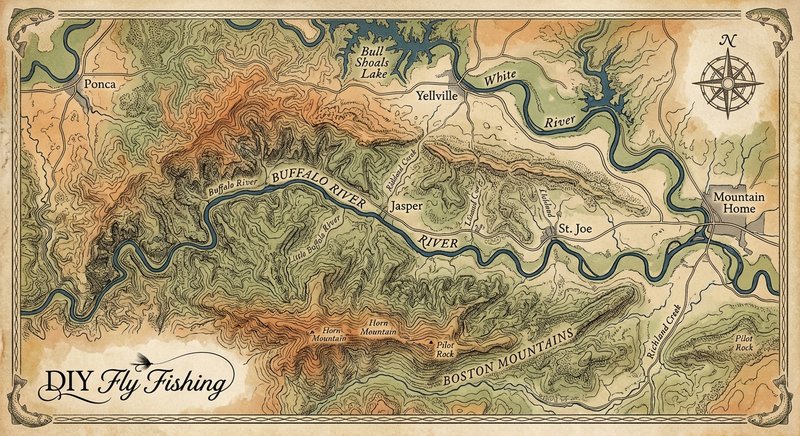
Buffalo River
Fly fishing in Arkansas · Beginner · Best seasons: Spring, Summer, Fall
Target Species
Smallmouth Bass, Rainbow Trout
About This Water
America's first national river. Smallmouth bass and some trout in scenic Ozark setting.
Fishing Recommendations
The Buffalo National River in the Arkansas Ozarks is a crown jewel of American fly fishing. As the nation’s first National River, it remains undammed, free-flowing, and hauntingly beautiful, characterized by towering limestone bluffs, turquoise pools, and massive gravel bars.
Here is your comprehensive guide to fly fishing the Buffalo River.
🎣 Location Overview
The Buffalo River is a classic Ozark freestone stream. Unlike the tailwaters (like the White or Norfork) that stay cold year-round, the Buffalo’s temperature fluctuates with the seasons. It is primarily a Smallmouth Bass paradise.
What makes it special is the water clarity and the scenery. You aren't just fishing; you are floating through a geological masterpiece. The river is divided into three sections:
- Upper District: Steep gradients, spectacular bluffs, but very dependent on rainfall.
- Middle District: Stable flows, excellent Smallmouth habitat with deep pools and fast runs.
- Lower District: Larger water, slower pace, and home to the biggest "Bronzebacks."
🐟 Target Species & Behavior
Smallmouth Bass (The Main Event)
Smallmouth here are "river smallies"—lean, aggressive, and incredibly strong.
- Behavior: They hold in the "seams" where fast water meets slow water, behind submerged boulders, and under the shadow of the bluffs.
- Feeding: They are opportunistic. They key in on crayfish, sculpin, and various minnow species (shiners and chubs). During summer evenings, they look up for terrestrial insects and topwater action.
Rainbow Trout (The Confluence Specialty)
Note: Rainbow Trout are not found throughout the Buffalo. They are limited to the last few miles of the Lower Buffalo, where cold water from the White River "backs up" into the Buffalo, or near cold-spring inflows.
- Behavior: These fish behave like tailwater trout, feeding on midges, scuds, and small nymphs.
📅 Best Times to Fish
Spring (April – June)
- Prime Time: This is the peak for Smallmouth. As the water hits 55–60°F, the fish become highly active pre-spawn and post-spawn.
- Conditions: Watch for water levels; spring rains can blow the river out.
Summer (July – August)
- Prime Time: Best for topwater action.
- Time of Day: Early morning and late evening. During the heat of the day, fish go deep into the "blue holes" under the bluffs.
- Note: This is also "canoe season." Expect crowds of recreational floaters; start at dawn to beat the traffic.
Fall (September – November)
- Prime Time: My personal favorite. The crowds vanish, the leaves turn, and the Smallmouth feed heavily before winter.
- Conditions: Lower, clearer water requires stealth and longer leaders.
🪰 Recommended Flies & Techniques
For Smallmouth Bass
- Topwater: BoogleBugs (size 4-8), Rainy’s Bubble Belly Poppers, and Murdich Minnows fished on the surface.
- Sub-Surface: Clouser Minnows (Olive/White or Chartreuse/White), Near Nuff Crayfish, and Gamechangers.
- Technique: Use a 6-weight or 7-weight rod. Cast tight to the bluff walls or logs. If using a popper, "twitch-twitch-pause"—the strike often comes during the pause.
For Rainbow Trout (Lower Confluence)
- Nymphs: Zebra Midges (size 18-22), Pheasant Tails, and Ruby Sows.
- Streamers: Woolly Buggers in black or olive.
- Technique: Use a 4-weight or 5-weight rod with a long, 9-foot 5X leader. Dead-drift nymphs under a small indicator.
💡 Pro Tips & Local Knowledge
- The "Push" Factor: Smallmouth often sit at the very head of a pool where the riffle enters. Many anglers float right over the best fish. Anchor up-stream and fish the "push" of water thoroughly.
- Color Matching: If the water has a slight green tint, use chartreuse or olive. If it’s crystal clear, switch to natural tans, browns, and whites.
- The "Shadow" Trick: In the heat of summer, Smallmouth will hug the shadows created by the high limestone bluffs. Even at noon, a well-placed cast into a sliver of shade can produce a trophy.
- Stay Stealthy: Because the water is so clear, these fish can see you. Long casts and drab clothing are your friends.
⚠️ Important Information
Access & Floating
- The Buffalo is best fished by boat (canoe or drift boat), but wading is possible at various NPS campgrounds (Steel Creek, Ozark, Pruitt, Tyler Bend).
- Shuttle Services: Local outfitters (like Buffalo River Canoes or Wild Bill’s) offer vehicle shuttles for a fee—essential for point-to-point floats.
Regulations
- Permit: An Arkansas Fishing License is required.
- Smallmouth Limits: There are specific length and creel limits. Generally, the Buffalo is managed for quality; many areas require a 14-inch or 18-inch minimum. Catch and release is highly encouraged to preserve this unique fishery.
- Glass Ban: There is a strict ban on glass containers on the river.
Safety
- Cell service is virtually non-existent in the river corridor.
- Check the USGS River Gauges before heading out. If the Ponca gauge is over 2.5 feet, it's great for floating but can be tricky for fishing. If it's too low, you'll be dragging your boat over gravel bars.
Bug Hatches & Matching Flies
| Hatch | Type | Peak months | Time of day | Hook sizes | Matching flies |
|---|---|---|---|---|---|
| Blue Winged Olive Baetis | mayfly | March, April, October, November | Late Morning/Afternoon | #18-22 | Parachute Adams #18-20, RS2 #20-22, Pheasant Tail #18-22 |
| March Brown Maccaffertium vicarium | mayfly | March, April | Afternoon | #12-14 | March Brown Dry #12-14, Gold Ribbed Hare's Ear #12-14 |
| Grannom Caddis Brachycentrus | caddis | April | All Day | #14-16 | Elk Hair Caddis #14-16, Holy Grail #14-16, Green Soft Hackle #14-16 |
| Light Cahill Stenacron / Stenonema | mayfly | May, June | Evening | #14-16 | Light Cahill Dry #14-16, Light Cahill Parachute #14-16 |
| White Miller Nectopsyche | caddis | July, August | Evening/Dusk | #12-16 | White Elk Hair Caddis #12-14, White Wulff #12-14, White Soft Hackle #14-16 |
| Golden Stonefly Acroneuria | stonefly | May, June | Morning/Evening | #6-10 | Golden Stone Nymph #6-10, Stimulator (Yellow) #8-12, Pats Rubber Legs #6-10 |
| Grasshoppers Orthoptera | terrestrial | July, August, September | Late Morning/Afternoon | #8-12 | Dave's Hopper #8-12, Morrish Hopper #10-12, Chernobyl Ant #8-10 |
| Hellgrammite (Dobsonfly) Corydalus cornutus | terrestrial | June, July | Night/Dusk | #2-6 | Murray's Hellgrammite #4-8, Woolly Bugger (Black) #4-10 |
| Trico Tricorythodes | mayfly | August, September | Early Morning | #20-24 | Trico Spinner #20-24, Trico Nymph #20-22 |