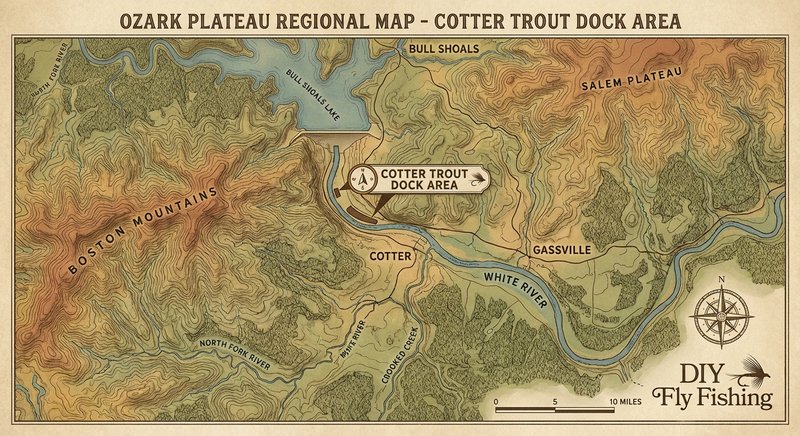
Cotter Trout Dock Area
Fly fishing in Arkansas · Intermediate · Best seasons: Spring, Summer, Fall, Winter
Target Species
Brown Trout, Rainbow Trout
About This Water
Classic White River trout water near Cotter. Year-round guided and wade fishing.
Fishing Recommendations
Welcome to "Trout Capital USA." As a guide on these waters, I can tell you that the stretch of the White River around Cotter, Arkansas, is hallowed ground. Located just downstream from Bull Shoals Dam, Cotter offers a unique blend of high-volume stocking and legitimate trophy potential, all set against the backdrop of the stunning Ozark Mountains.
Here is your comprehensive guide to fly fishing the Cotter Trout Dock area.
🎣 Location Overview
The Cotter area is the heart of the White River’s tailwater system. What makes this area special is the Bull Shoals Dam generation cycle. The water stays a constant, chilly temperature (around 48–54°F) year-round, creating a "refrigerator effect" that allows trout to grow at incredible rates.
The river here is wide and powerful. Unlike mountain freestones, the White is governed by hydroelectric demand. You might find a shallow, wadeable stream in the morning and a massive, rolling river by the afternoon. The "Big Spring" at Cotter adds a constant flow of cold water and provides a beautiful park setting that is arguably the most famous access point on the entire 100-mile trout section.
🐟 Target Species & Behavior
Rainbow Trout
These are the bread and butter of Cotter. They are heavily stocked but quickly become "riverized."
- Behavior: They hold in faster riffles, oxygenated runs, and behind submerged boulders.
- Feeding: Aggressive feeders. They focus on scuds, sowbugs, and aquatic larvae. During high water, they move toward the banks to escape the heavy current.
Brown Trout
This is why people travel from across the globe to Cotter. The White River holds world-record-class Browns.
- Behavior: Large Browns are apex predators. They are structure-oriented, hiding under sunken logs, undercut banks, and deep shelf drop-offs.
- Feeding: While juveniles eat insects, the "trophy" Browns are piscivorous. They eat sculpin, fingerling rainbows, and shad (during dam spills). They are most active during low light or rising water.
📅 Best Times to Fish
The White is a year-round fishery, but each season offers a different "game."
- Spring (March–May): Excellent. This is the time for the Caddis hatch (April). If you hit the Mother’s Day Caddis hatch right, the dry fly fishing is world-class.
- Summer (June–August): Prime time for "Terrestrials." As the Ozark heat sets in, hoppers, beetles, and ants become the primary meal. This is also when the water is most refreshing.
- Fall (September–November): The Brown Trout spawn begins. Browns become aggressive and move toward gravel bars. Note: Please avoid stepping on "redds" (spawning nests) to protect future generations.
- Winter (December–February): The Shad Kill. If Bull Shoals Lake gets cold enough and the dam generates heavy water, threadfin shad are pulled through the turbines. It creates a feeding frenzy for massive trout.
🪰 Recommended Flies & Techniques
Nymphing (The Consistent Producer)
This is the most effective way to catch numbers. Use a 9ft 5wt or 6wt rod with an indicator.
- Top Patterns:
- Sowbugs & Scuds: (Sizes 14–18) Grey or tan. This is the primary protein source.
- Ruby Slipper / Zebra Midge: (Sizes 18–22) Red or silver.
- San Juan Worm: Red or bright pink, especially when the water is rising.
Streamer Fishing (The Trophy Hunter)
Use a 7wt or 8wt rod with a sink-tip line.
- Top Patterns:
- Galloup’s Sex Dungeon: White, Olive, or Black.
- Dungeon Sculpins: To mimic the native sculpin population.
- White Zonkers: To mimic shad during a kill.
- Technique: "Pound the banks." Cast tight to the shore from a boat and strip aggressively.
Dry Flies
- Patterns: Elk Hair Caddis (Size 14–16), Foam Hoppers (Size 8–12), and Dave’s Hopper.
- Technique: Dead drift near overhanging brush or along the "seams" where fast and slow water meet.
💡 Pro Tips & Local Knowledge
- Watch the Horn: The most important thing to know is the siren. If you hear a siren from the dam (audible for miles), the water is rising. Move to your exit point immediately if wading.
- The "Cotter Seam": Right in front of the Cotter Big Spring, there is a distinct line where the spring water meets the river. Trout stack up here for the oxygen and temperature transition.
- Low Water vs. High Water:
- Low water (0-1 units): Best for wading and technical nymphing.
- High water (4+ units): Best for drifting in a boat and throwing massive streamers for trophy Browns.
- The "Drag-Free" Myth: While a dead drift is usually best, White River rainbows often love a "swing" at the end of the drift. Don't be afraid to let your nymph rise through the water column.
⚠️ Important Information
- Access: Big Spring Park in Cotter is the premier public access point. It offers plenty of parking, a boat ramp, and wade-access during low water.
- Permits: You need an Arkansas Fishing License PLUS a Trout Permit. These can be purchased online via the Arkansas Game and Fish Commission (AGFC).
- Regulations:
- The Cotter area has specific "Catch and Release" zones and "Artificial Lures Only" zones nearby (specifically the Bull Shoals Catch and Release area upstream).
- Always check the current AGFC guidebook, as limits on Brown Trout are very strict (usually 1 fish over 24 inches).
- Safety: The White River is deceptive. The current is stronger than it looks, and the water is cold enough to cause hypothermia even in July. Always wear a wading belt.
Guide’s Final Word: If you want the fish of a lifetime, bring a heavy sink-tip line and big white streamers in February. If you want a relaxing day with 30+ fish, bring a 5wt and a box of sowbugs in May. Tight lines!
Bug Hatches & Matching Flies
| Hatch | Type | Peak months | Time of day | Hook sizes | Matching flies |
|---|---|---|---|---|---|
| Chironomids (Midges) Chironomidae | midge | January, February, March, December | All Day | #18-24 | Zebra Midge #18-22, Griffith's Gnat #20-22, WD-40 #18-20 |
| Blue Winged Olive (BWO) Baetis | mayfly | February, March, October, November | Late Morning/Afternoon | #16-20 | RS2 #18-20, Parachute Adams #16-20, Pheasant Tail Nymph #16-18 |
| Grannom Caddis Brachycentrus | caddis | April | Afternoon/Evening | #14-16 | Elk Hair Caddis #14-16, Holy Grail #14-16, Green Caddis Pupa #14-16 |
| Sulfurs Ephemerella dorothea | mayfly | May, June | Evening | #14-18 | Sulfur Parachute #16-18, Sulfur Soft Hackle #14-16 |
| White Fly Ephoron leukon | mayfly | August, September | Evening/Dusk | #12-14 | White Wulff #12-14, White Sparkle Dun #14 |
| Terrestrials (Hoppers) Orthoptera | terrestrial | July, August, September | All Day | #8-12 | Fat Albert #8-12, Dave's Hopper #10-12, Yee's Carpet Hopper #10 |
| Tricos Tricorythodes | mayfly | July, August, September | Early Morning | #20-24 | Trico Spinner #22-24, Trico Drown #20-22 |
| Terrestrials (Ants/Beetles) Formicidae/Coleoptera | terrestrial | June, July, August | All Day | #14-18 | Chernobyl Ant #12-14, Black Foam Beetle #14-16, Cinnamon Ant #16-18 |