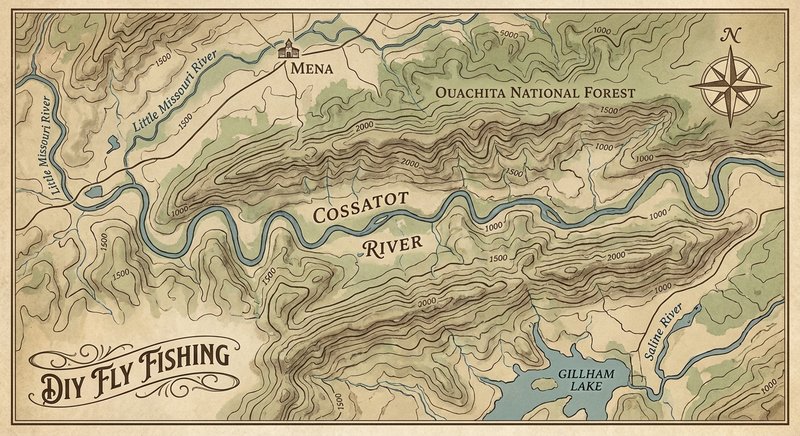
Cossatot River
Fly fishing in Arkansas · Advanced · Best seasons: Spring, Fall
Target Species
Smallmouth Bass, Spotted Bass
About This Water
Remote Ouachita Mountains stream. Challenging whitewater and bass fishing.
Fishing Recommendations
The Cossatot River is often referred to as the "Skull Crusher" (an interpretation of its indigenous name), and for good reason. Located in Southwest Arkansas within the Ouachita Mountains, it is arguably the most rugged and scenic river in the Natural State. As a National Wild and Scenic River, it offers a "wilderness" fly fishing experience that is rare in the mid-South.
Here is your comprehensive guide to fly fishing the Cossatot.
🎣 Location Overview
The Cossatot is defined by its extreme clarity and its dramatic geology. Unlike the lazy, winding rivers of the delta, the Cossatot is a high-gradient mountain stream characterized by steep drop-offs, massive boulder gardens, and "stair-step" pool-and-drop formations.
What makes it special: It is one of the few places in the region where you can find "wild" water that hasn't been overly tamed by dams. The water is gin-clear, meaning you often see the fish before they see you. It’s a physical river—fishing here requires scrambling over rocks and navigating tight corridors—but the reward is some of the hardest-fighting, most beautiful Smallmouth Bass in the Ozark/Ouachita region.
🐟 Target Species & Behavior
- Smallmouth Bass: The undisputed king of the Cossatot. These fish are lean, muscular, and adapted to high-flow environments. They hold in the "seams" between fast water and deep pools, often tucked behind large boulders (eddies).
- Spotted Bass: Found more frequently in the lower, slower sections of the river. They tend to congregate near submerged timber or at the very tail-ends of long pools.
- Longear Sunfish: While not the primary target, these are some of the most vibrantly colored panfish in the world and provide excellent action on light tackle.
Feeding Behavior: In this nutrient-lean environment, these bass are opportunistic. They key in on crawfish (the primary protein source), hellgrammites, and stoneroller minnows. During the summer and fall, they also look to the surface for "terrestrials" like grasshoppers and cicadas.
📅 Best Times to Fish
The Cossatot is rain-dependent. If it’s too dry, it becomes a series of disconnected puddles; if it’s too wet, it’s a Class IV-V whitewater nightmare.
- Spring (April – Early June): This is the prime window. Water levels are usually stable enough for floating or wading, and the fish are aggressive post-spawn. Look for water temperatures between 55°F and 65°F.
- Fall (September – November): My personal favorite. The water clears up significantly, and the fish begin feeding heavily to prepare for winter. The "topwater bite" can be spectacular as the shadows lengthen.
- Best Time of Day: During the clear-water months, the "Golden Hours" (dawn and dusk) are critical. Smallmouth are light-sensitive; use the low-light periods to fish topwater flies, then switch to deep streamers as the sun gets high.
🪰 Recommended Flies & Techniques
Top Fly Patterns
- Streamers:
- Clouser Minnow (Chartreuse/White or Olive/White) - Size 2-6.
- Gamechanger or Smallie-Slayer (Crawfish patterns) - Rusty orange and brown are essential.
- Woolly Bugger (Black or Olive) - A classic for a reason.
- Topwater:
- Boogle Bug or Sneaky Pete (Yellow or Chartreuse).
- Rainy’s Foam Hopper (Tan or Green) in late summer/fall.
- Sub-Surface/Nymphs:
- Pat’s Rubber Legs (Stonefly imitation) - Size 6-8.
- Hellgrammite imitations (Heavy lead-eyed patterns).
Techniques & Presentation
- The "Crayfish Crawl": Use a weighted fly with a weed guard. Cast into the head of a pool, let it sink to the bottom, and use short, erratic strips to mimic a fleeing crawfish.
- The Swing: In the faster runs, swing a streamer across the current exactly like you would for trout. Smallmouth often strike at the end of the swing as the fly begins to "rise" toward the surface.
- Stealth: Because the water is so clear, long leaders (9ft 2X or 3X) are recommended. Avoid wearing bright colors; stick to earth tones to blend in with the canyon walls.
💡 Pro Tips & Local Knowledge
- The "Corridor" Stretch: Focus on the area between Hwy 278 and the Cossatot Falls. While the Falls are famous for kayakers, the pockets of water above and below them hold the largest Smallmouth.
- Read the Bubbles: Look for the "bubble line" where the fast water enters a pool. Smallmouth will sit just under that foam line waiting for the current to deliver food.
- The Low-Water Secret: If the river is too low to float, don't stay home. This is the best time for "Wet Wading." Park at a bridge or access point and hike a mile up or downstream. You’ll find isolated "blue holes" that rarely see a fly.
- The "Shadow Cast": In the steep canyon sections, the sun disappears early. Fish the shadowed side of the river even in the middle of the afternoon; the bass will move out of the deep cracks and into the shallows once the direct sun is gone.
⚠️ Important Information
- Access: The Cossatot River State Park-Natural Area provides excellent access points at Hwy 278, Ed Banks, and Sandbar.
- Safety: This is a rugged area. Cell service is non-existent in the canyon. If you are floating, check the USGS gauges. A flow of 150-400 cfs is ideal for fishing; anything over 1,000 cfs is for experienced whitewater paddlers only.
- Regulations: Ensure you have a valid Arkansas Fishing License. There are specific length limits for Smallmouth (usually 12 inches), but I strongly advocate for 100% Catch and Release on this river to preserve the fragile mountain genetics.
- Footwear: Do not attempt to fish this river in flip-flops or cheap boots. You need felt soles or high-quality sticky rubber with studs. The rocks are notoriously slick and jagged.
Guide’s Final Word: The Cossatot isn't about high fish counts; it's about the quality of the environment and the fight of a wild Smallmouth in moving water. Respect the river, watch the weather, and hold on tight—these fish punch way above their weight class.
Bug Hatches & Matching Flies
| Hatch | Type | Peak months | Time of day | Hook sizes | Matching flies |
|---|---|---|---|---|---|
| Blue-Winged Olive Baetis spp. | mayfly | March, April, October, November | Midday/Afternoon | #18-22 | Parachute Adams #18-22, RS2 #20-22, Pheasant Tail #18-20 |
| Grannom Caddis Brachycentrus | caddis | April, May | Morning/Evening | #14-16 | Elk Hair Caddis #14-16, LaFontaine's Deep Sparkle Pupa #14-16, Holy Grail #14-16 |
| March Brown Maccaffertium vicarium | mayfly | April, May | Afternoon | #12-14 | March Brown Western #12-14, Hare's Ear Nymph #12-14, Gold Ribbed Hare's Ear #12-14 |
| Giant Golden Stonefly Hesperoperla pacifica | stonefly | May, June | Morning/Evening | #6-10 | Pat's Rubber Legs #6-10, Kaufmann's Stimulator #8-12, Golden Stone Nymph #8-10 |
| Light Cahill Stenacron interpunctatum | mayfly | June, July | Evening | #12-14 | Light Cahill #12-14, Sulfur Emerger #14-16, Pheasant Tail (Bleached) #14 |
| Hex Hexagenia limbata | mayfly | June, July | Dusk/Night | #6-8 | Hexagenia Dry #6-8, Hex Nymph #6-8 |
| Terrestrials (Hopper/Ant/Beetle) Orthoptera/Formicidae | terrestrial | July, August, September | Afternoon | #8-16 | Chernobyl Ant #8-12, Dave's Hopper #10-14, Black Foam Beetle #14-16 |
| White Winged Curse (Tricos) Tricorythodes | mayfly | August, September, October | Early Morning | #20-24 | Trico Spinner #20-24, Trico Nymph #22 |