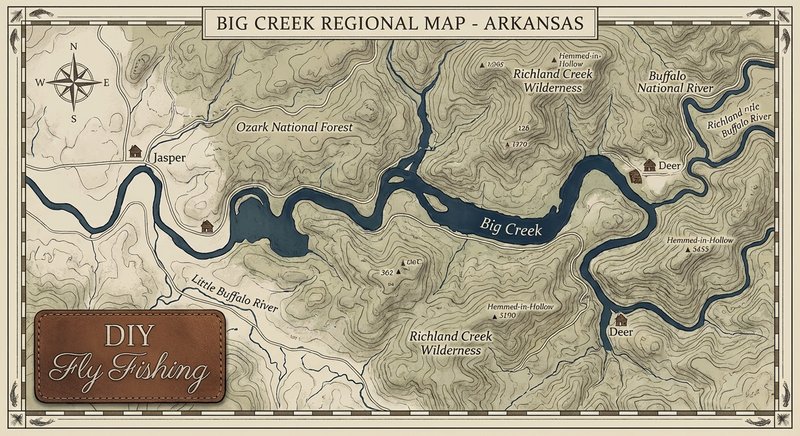
Big Creek
Fly fishing in Arkansas · Intermediate · Best seasons: Spring, Summer, Fall
Target Species
Smallmouth Bass, Largemouth Bass
About This Water
Ozark stream with smallmouth bass. Wild and scenic fishing near Mammoth Spring.
Fishing Recommendations
Welcome to the Ozarks. As a guide in these waters, I can tell you that Big Creek—specifically the major tributary of the Buffalo National River in Newton and Searcy counties—is one of the crown jewels of Arkansas smallmouth fishing.
While there are several "Big Creeks" in the state, this specific drainage is legendary among fly anglers for its "blue ribbon" water quality, stunning limestone bluffs, and aggressive "Bronzebacks."
🎣 Location Overview
Big Creek is a classic Ozark mountain stream. It is characterized by gin-clear water, intricate rock formations, deep turquoise pools, and fast-moving riffles. What makes it special is its isolation; while the main stem of the Buffalo River can get crowded with canoes, Big Creek offers a more intimate, "wilderness" fly fishing experience.
The substrate is a mix of hand-sized cobble, massive sunken boulders, and limestone shelf rock. This provides the perfect habitat for high-protein forage, which in turn supports a robust population of Smallmouth Bass that are famously "punchy" for their size.
🐟 Target Species & Behavior
Smallmouth Bass (The Primary Target)
- Behavior: Ozark Smallmouth are ambush predators. In Big Creek, they are highly light-sensitive due to the water clarity.
- Holding Zones: They hold on the "seams" where fast water meets slow water, in the shadows of large boulders, and under "root balls" along the banks.
- Feeding: Their diet consists heavily of crawfish, Ozark sculpins, and hellgrammites (dobsonfly larvae).
Largemouth Bass
- Behavior: Found more frequently in the lower reaches where the creek slows down and deepens.
- Holding Zones: They prefer "slack water" areas, deep bluff holes with submerged timber, and lily pad edges in the slower sloughs.
📅 Best Times to Fish
Spring (April – May)
- Conditions: The "Pre-spawn" is the best time for a trophy fish. As water temps hit 55–60°F, the big females become aggressive.
- Caveat: This is also the rainy season. Watch the gauges; Big Creek can flash-flood and turn chocolate milk overnight.
Summer (June – August)
- Conditions: The most consistent time for fly fishing. The water is low and clear.
- Prime Window: "Low light or no light." Be on the water at dawn or stay until dusk for legendary topwater action. Mid-day can be tough unless you fish deep with heavy sink tips.
Fall (September – November)
- Conditions: My personal favorite. As the water cools, bass feed heavily to prepare for winter. The "October Caddis" and falling terrestrial insects (grasshoppers) make for excellent dry-fly-style fishing.
🪰 Recommended Flies & Techniques
Topwater (The "Heart Attack" Hits)
- BoogleBug Poppers (Size 4-8): The gold standard in the Ozarks. Yellow, Olive, and "Electric Blue" are local favorites.
- Murdich Minnow: Technically a sub-surface fly, but when fished on a floating line, it mimics a dying minnow perfectly.
Sub-Surface (The "Meat and Potatoes")
- Near-Nuff Craw: Smallmouth here live on crawfish. Fish these on a dead drift or with short, erratic strips along the bottom.
- Gamechanger / Woolly Bugger: Olive or Black. These mimic sculpins and leeches.
- Pat’s Rubber Legs: A stonefly/hellgrammite imitation that works wonders in the riffles.
Techniques
- The "Ozark Twitch": Cast a popper against a bluff wall. Let the rings disappear. Twitch it once. Wait 10 seconds. This patience often triggers the biggest fish.
- Pound the Bank: When floating or wading, stay 30 feet back and target the "willow line" along the bank.
💡 Pro Tips & Local Knowledge
- The Stealth Factor: Because the water is so clear, these fish can see you from a long way off. Wear natural colors (tan/green) and avoid "lining" the fish with a heavy fly line. Use a 9-foot leader tapered to 10lb or 12lb fluorocarbon.
- The "Bluff Leap": Smallmouth often pin baitfish against the vertical limestone bluffs. If you see a splash against a rock wall, get your fly there immediately.
- Gene Rush WMA: This is a key area for access. Exploring the stretches within the Wildlife Management Area provides miles of public wading water that is often overlooked.
⚠️ Important Information
- Access: Much of the land surrounding Big Creek is private. Always stay within the high-water mark or use established public access points like the bridges or the Buffalo National River park boundaries.
- Regulations: Arkansas Game & Fish Commission (AGFC) regulations apply. Note that some sections of the Buffalo River watershed have "Smallmouth Bass Management Zones" with specific length limits (often a 12-inch minimum). Catch and release is highly encouraged to preserve this fragile fishery.
- Safety: Cell service is non-existent in the canyons. Always tell someone where you are going. If you are wading, be wary of "sycamore holes"—deep drop-offs hidden near large trees.
Guide’s Final Word: Big Creek isn't about high fish counts; it's about the quality of the environment and the beauty of the fish. Bring a 6-weight rod, a box of crawfish patterns, and your camera—you're going to need it.
Bug Hatches & Matching Flies
| Hatch | Type | Peak months | Time of day | Hook sizes | Matching flies |
|---|---|---|---|---|---|
| Blue-winged Olive Baetis spp. | mayfly | March, April, October, November | Overcast Afternoons | #18-22 | RS2 #20-22, Parachute Adams #18-22, Pheasant Tail Nymph #18-20 |
| Mother's Day Caddis Brachycentrus occidentalis | caddis | April, May | Midday to Evening | #14-16 | Elk Hair Caddis #14-16, Holy Grail #14-16, Peacock Caddis #16 |
| Little Yellow Sally Isoperla spp. | stonefly | May, June, July | Late Afternoon/Evening | #14-16 | Yellow Sally Dry #14-16, Iron Lotus #16, Little Yellow Stone #14-16 |
| Light Cahill Stenacron interpunctatum | mayfly | June, July | Evening | #12-14 | Light Cahill Dry #12-14, Gold Ribbed Hare's Ear #12-14, Cream Usual #14 |
| Spotted Sedge Hydropsyche spp. | caddis | May, June, September | Evening | #14-18 | LaFontaine's Deep Sparkle Pupa #14-16, Tan Elk Hair Caddis #14-18, Soft Hackle Hare's Ear #14-16 |
| Trico Tricorythodes spp. | mayfly | July, August, September | Early Morning | #22-26 | Trico Spinner #22-24, Griffith's Gnat #22-24, Zebra Midge #22 |
| Golden Stonefly Acroneuria spp. | stonefly | May, June | Morning/Evening | #6-10 | Pat's Rubber Leg #6-10, Golden Stone Dry #8-10, Kaufmann's Stone #8-12 |
| Terrestrials Orthoptera/Formicidae | terrestrial | July, August, September | All Day | #8-16 | Chernobyl Ant #8-12, Dave's Hopper #10-12, Black Foam Beetle #14-16 |