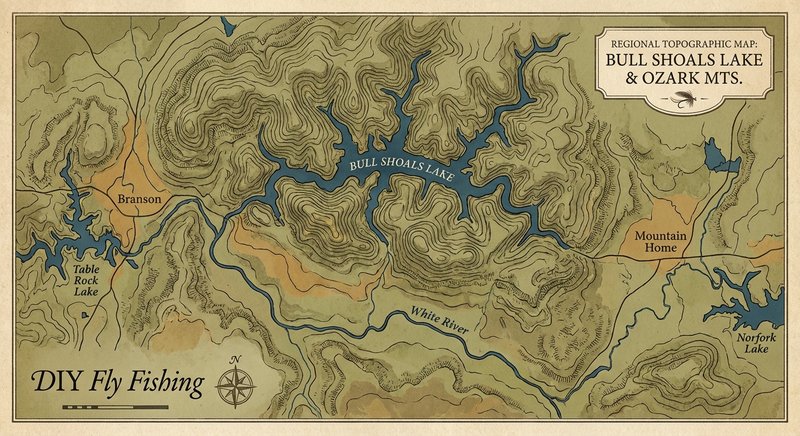
Bull Shoals Lake
Fly fishing in Arkansas · Intermediate · Best seasons: Spring, Summer, Fall
Target Species
Largemouth Bass, Smallmouth Bass, Crappie
About This Water
Large Ozark reservoir with diverse fishing. Bass, crappie, and catfish.
Fishing Recommendations
Welcome to one of the crown jewels of the Ozarks. As a guide, I can tell you that Bull Shoals Lake is a bit of a chameleon. While its tailwater (the White River) is world-famous for trout, the lake itself is a premier warm-water fishery characterized by deep, gin-clear water and over 700 miles of rugged shoreline.
Here is your comprehensive guide to fly fishing Bull Shoals for Bass and Crappie.
🎣 Location Overview
Bull Shoals Lake is a massive impoundment of the White River, straddling the Arkansas-Missouri border. What makes it special for the fly angler is the water clarity. In many areas, you can see 15–20 feet down. This "big water" feels more like a highland reservoir than a typical southern lake.
The shoreline is dominated by steep limestone bluffs, flooded timber, and long gravel points. Because the water is so clear, the fish are often deeper than in other lakes, but they are also highly visual predators. This makes for heart-pounding sight fishing during the right windows and aggressive strikes on streamers.
🐟 Target Species & Behavior
Largemouth Bass
- Behavior: The kings of the wood. They hold tight to flooded timber, cedar piles, and buckbrush.
- Diet: Gizzard shad, threadfin shad, and bluegill.
- Fly Strategy: They are ambush predators here. You need to put your fly deep into the "junk" (cover) to coax them out.
Smallmouth Bass
- Behavior: These are "brown fish" country favorites. They prefer the rocky points, bluff shelves, and transition zones where gravel turns to chunk rock.
- Diet: Heavily focused on crawfish and shad.
- Fly Strategy: Smallmouth here are roamers. They follow baitfish schools and often suspend over deep water off the tips of points.
Crappie
- Behavior: Schooling fish that orient strictly to vertical structure (standing timber) or submerged brush piles.
- Diet: Almost exclusively small minnows and shad.
- Fly Strategy: Precision is key. You must get your fly to the specific depth where the school is suspended, often 8–15 feet down.
📅 Best Times to Fish
Spring (March – May) - PRIME TIME
- Window: This is the pre-spawn and spawn. Fish move out of the depths into the "flats" and secondary points.
- Conditions: Look for water temps hitting 55°F for Smallmouth and 62°F for Largemouth.
- Time of Day: Mid-day is actually excellent as the sun warms the shallow pockets.
Summer (June – August)
- Window: Early morning and late evening (dawn/dusk).
- Conditions: The fish go deep during the day. However, the topwater bite at first light is legendary.
- Night Fishing: Experienced Ozark anglers fish big black streamers and poppers on moonless nights for trophy Smallmouth.
Fall (September – November)
- Window: As water temps drop, shad migrate into the backs of creeks.
- Conditions: The "Shad Kill" or shad busts. Look for birds diving. If you find the shad, you find the bass.
- Time of Day: All day, provided there is some "Ozark Chop" (wind) on the water.
🪰 Recommended Flies & Techniques
Top Fly Patterns
- For Bass (Topwater): BoogleBug Poppers (Size 4) in Solar Flare or Frog. Also, Dahlberg Divers for a more subtle "gurgle."
- For Bass (Subsurface): Game Changers (white/silver to mimic shad) and Clouser Minnows (Chartreuse/White). For Smallmouth, use Rusty Trombone or crawfish patterns with lead eyes.
- For Crappie: Wooly Buggers (Size 8-10) in white or pink, and small Marabou Minnows.
Techniques & Presentation
- Intermediate Sinking Lines: In this clear water, a floating line often isn't enough. An intermediate (slow sink) line keeps your shad-mimicking streamer in the "strike zone" longer without spooking fish.
- The "Count Down": When fishing bluffs, cast toward the rock, then count to 10 or 15 before starting your retrieve. These fish are often suspended 10 feet down against the wall.
- The Strip-Pause: For Smallmouth, a fast strip followed by a long pause (mimicking a dying shad) is lethal.
💡 Pro Tips & Local Knowledge
- The Wind is Your Friend: Because the water is so clear, a dead calm surface makes fish "spooky." A light breeze breaks up the surface refraction, making fish more likely to commit to a fly.
- Fish the "Secondary Points": Everyone fishes the main lake points. Professional guides look for the first point inside a major creek arm. This is where big Largemouth staging occurs.
- Follow the "Blue Goo": Local slang for the deeper blue water near bluffs. If you see schools of shad "dimpling" the surface over deep water, don't ignore it. Smallmouth will "wolf pack" shad over 100 feet of water.
- Crappie on the Fly: Use a 4-weight rod and a "vertical strip." Drop the fly next to standing timber, let it sink, and twitch it upward. It mimics a minnow trying to escape the tree.
⚠️ Important Information
Access
- Boat is Best: Bull Shoals is difficult to fly fish from the bank due to steep terrain. A kayak, bass boat, or drift boat with a motor is highly recommended.
- Public Ramps: The Bull Shoals State Park, Howard Cove, and Lakeview Park offer excellent launch points.
Regulations
- Licenses: You need an Arkansas Fishing License. If you cross the invisible line into the Missouri side of the lake, you must have a Missouri permit (or ensure you stay within the "reciprocal agreement" zones, though it's safer to have the license for the state you are standing/floating in).
- Length Limits: Pay close attention to minimum length limits for Smallmouth (typically 12" or 15" depending on the specific zone) and Crappie.
Special Considerations
- The "Clearness" Factor: Use longer leaders than you would at a murky pond. 9-foot to 12-foot fluorocarbon leaders (10lb - 12lb test) are standard here to prevent fish from seeing your fly line.
Bug Hatches & Matching Flies
| Hatch | Type | Peak months | Time of day | Hook sizes | Matching flies |
|---|---|---|---|---|---|
| Chironomids (Midges) Family Chironomidae | midge | January, February, March, December | All Day | #18-24 | Zebra Midge #18-22, Griffith's Gnat #20-24, WD-40 #20-22 |
| Blue Winged Olives (BWO) Baetis spp. | mayfly | March, April, October, November | Mid-day/Afternoon | #16-20 | Parachute Adams #16-20, Pheasant Tail Nymph #16-20, RS2 #18-20 |
| Grannom Caddis Brachycentrus spp. | caddis | April, May | Afternoon/Evening | #14-16 | Elk Hair Caddis #14-16, Holy Grail #14-16, Peacock Caddis #14-16 |
| Sulphurs Ephemerella dorothea | mayfly | May, June, July | Late Afternoon/Evening | #14-18 | Sulphur Parachute #14-16, Sulphur Emerger #16-18, Gold Ribbed Hare's Ear #14-16 |
| Cinnamon Caddis Hydropsyche spp. | caddis | June, July, August, September | Evening | #16-18 | Sparkle Pupa #16-18, Cinnamon Caddis #16-18, Soft Hackle Pheasant Tail #16-18 |
| White Flies Ephoron leukon | mayfly | August, September | Dusk/Late Evening | #12-14 | White Wulff #12-14, Ephoron Spinner #12-14 |
| Tricos Tricorythodes spp. | mayfly | July, August, September | Early Morning | #22-26 | Trico Spinner #22-26, Trico Nymph #22-24 |
| Crane Flies Family Tipulidae | terrestrial | August, September, October | Morning/Afternoon | #8-12 | Crane Fly Adult #10-12, Crane Fly Larva #8-12 |
| Terrestrials Orthoptera / Formicidae | terrestrial | July, August, September | All Day | #8-16 | Chernobyl Ant #8-12, Black Foam Beetle #14-16, Dave's Hopper #10-12 |