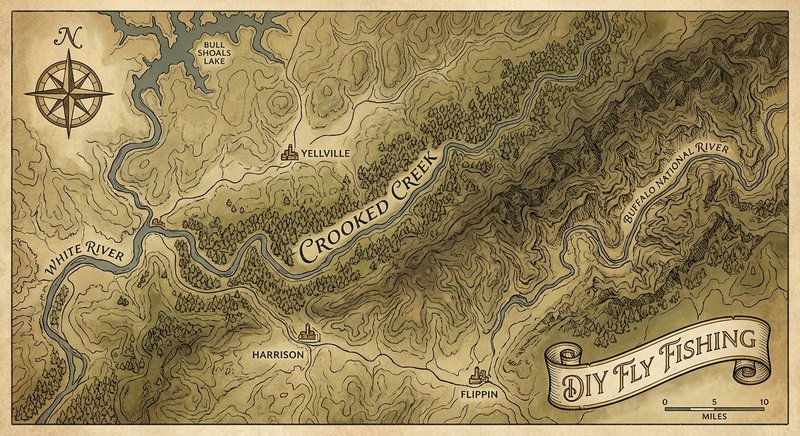
Crooked Creek
Fly fishing in Arkansas · Beginner · Best seasons: Spring, Summer, Fall
Target Species
Brown Trout, Rainbow Trout
About This Water
Smaller tailwater with good brown and rainbow trout. Less crowded than major rivers.
Fishing Recommendations
While Crooked Creek is nationally renowned as one of the premier Smallmouth Bass streams in the United States, its lower reaches—specifically where it confluence with the White River near Cotter—offer a unique and often overlooked fly fishing experience for Brown and Rainbow Trout.
As your guide, I will focus on the trout-specific opportunities found in the lower section of this Ozark gem, while noting how the creek’s unique hydrology influences trout behavior.
🎣 Location Overview
Crooked Creek winds through the limestone heart of the Ozark Mountains in North Central Arkansas. Unlike the tailwaters of the White or Norfork, Crooked Creek is a freestone-style stream. What makes it special for trout anglers is the "backwater effect."
When the White River is running high due to heavy power generation at Bull Shoals Dam, cold, oxygenated water is pushed upstream into the mouth of Crooked Creek. This creates a temporary trout sanctuary that can extend several hundred yards (and sometimes miles) upstream. Anglers love it because it offers a smaller, more intimate "creek" feel compared to the massive flows of the main stem White River.
🐟 Target Species & Behavior
- Rainbow Trout: These are often "refugees" from the White River. They move into the creek seeking relief from high flows or to forage on the creek’s prolific insect life. They tend to hold in the swifter riffles and at the heads of pools.
- Brown Trout: The "kings" of the creek. Large migratory Browns enter the lower reaches of Crooked Creek to hunt. They are highly predatory and territorial.
- Behavior: Unlike the tailwater trout that are used to constant flow changes, Crooked Creek trout behave more like wild fish. They are spookier and rely heavily on the abundant overhead cover (fallen timber and undercut limestone banks) provided by the creek.
📅 Best Times to Fish
- Spring (March – May): This is prime time. High water on the White River is common, pushing trout into the creek. You’ll also see the best aquatic insect activity, including Blue Winged Olives and early Caddis.
- Fall (October – November): This is the window for "Trophy Browns." As the spawning urge hits, large Browns from the White River move into the lower gravel bars of Crooked Creek. Note: Please avoid fishing for trout actively sitting on redds (spawning beds).
- Summer (June – August): Early mornings are essential. As the day warms, trout will retreat toward the mouth of the creek where the water is cooler. This is also peak season for terrestrial patterns (hoppers and beetles).
- The "Generation Window": The best fishing often occurs when Bull Shoals Dam is running 4+ units. This "pushes" the trout and the cold water deepest into the creek.
🪰 Recommended Flies & Techniques
Nymphing (The Bread & Butter)
Because Crooked Creek has a limestone base, it is rich in crustaceans and small nymphs.
- Sowbugs & Scuds: Sizes 14–18 in gray or tan. These are staples of the Arkansas diet.
- Zebra Midges: Sizes 18–22 in black/silver or red/silver.
- Pheasant Tails: Size 16–18 for general Mayfly representation.
Streamers (For the Big Browns)
The creek is full of structure, making it a streamer chaser's dream.
- Wooly Buggers: Olive or black with a bit of flash.
- Sculpin Patterns: Near-Nuff Sculpins or White River Specials.
- Technique: Cast tight to the woody debris or undercut banks and use erratic strips.
Dry Flies
- Elk Hair Caddis (Size 14-16): Effective during the late spring evenings.
- Parachute Adams (Size 16-20): A great searcher pattern.
- Terrestrials: Fat Albert or Dave’s Hopper in mid-to-late summer.
💡 Pro Tips & Local Knowledge
- The Confluence Strategy: Most trout activity is concentrated in the last 2 miles of the creek before it hits the White River. Access this area by launching a boat at the Cotter Ramp or Ranchette Access on the White and motoring/rowing to the mouth of the creek.
- Wading Caution: Crooked Creek has a "slab" rock bottom that can be incredibly slick. Felt soles or studs are highly recommended.
- The Stealth Factor: Because the water in the creek is often clearer and shallower than the White River, long leaders (9–12 feet) and 6x tippet are frequently necessary for spooky Rainbows.
- The "Smallie" Bonus: If you find the water is too warm for trout as you move upstream, don't leave! Switch to a Clouser Minnow or a Popper—you are in some of the best Smallmouth Bass water in the country.
⚠️ Important Information
- Access: Much of the land surrounding Crooked Creek is private. Ensure you stay within the high-water marks if wading. Public access points like Kelly’s Slab or Pyatt are too far upstream for consistent trout; for trout, focus on the White River-Crooked Creek Confluence.
- Regulations: You must have an Arkansas Fishing License AND a Trout Permit.
- Catch & Release: While state law allows keep limits on certain sections, most local guides and conservationists practice strict Catch & Release for Brown Trout to preserve the trophy quality of the fishery.
- Water Levels: Always check the USACE Little Rock App for dam generation schedules. If the White River drops suddenly, the cold water will drain out of Crooked Creek quickly, and the trout will follow it back to the main river.
Bug Hatches & Matching Flies
| Hatch | Type | Peak months | Time of day | Hook sizes | Matching flies |
|---|---|---|---|---|---|
| Hellgrammite (Dobsonfly) Corydalus cornutus | other | May, June, July | All Day | #2-6 | Clouser's Hellgrammite #4-6, Murray's Hellgrammite #4-8 |
| White Winged Black Mayfly (Trico) Tricorythodes | mayfly | July, August, September | Morning | #20-24 | Trico Spinner #22, RS2 #20-22 |
| Tan Caddis Hydropsyche | caddis | May, June, September | Evening | #14-16 | Elk Hair Caddis #14-16, Soft Hackle Hare's Ear #14-16 |
| Hex (The White Fly) Ephoron album | mayfly | August, September | Evening/Night | #10-12 | White Wulff #10-12, Snowshoe Mayfly #12 |
| Damselfly Calopteryx | other | June, July, August | Afternoon | #8-12 | Adult Damselfly #10-12, Braided Butt Damsel #10 |
| Dragonfly Anisoptera | other | June, July, August | All Day | #4-10 | Dragonfly Nymph #6-10, Poppers (Blue/Green) #4-8 |
| Grasshopper Acrididae | terrestrial | July, August, September | Afternoon | #6-12 | Dave's Hopper #8-12, Morrish Hopper #10 |
| Cicada Magicicada | terrestrial | June, July | All Day | #4-8 | Black Cicada #4-8, Fat Albert #6-10 |