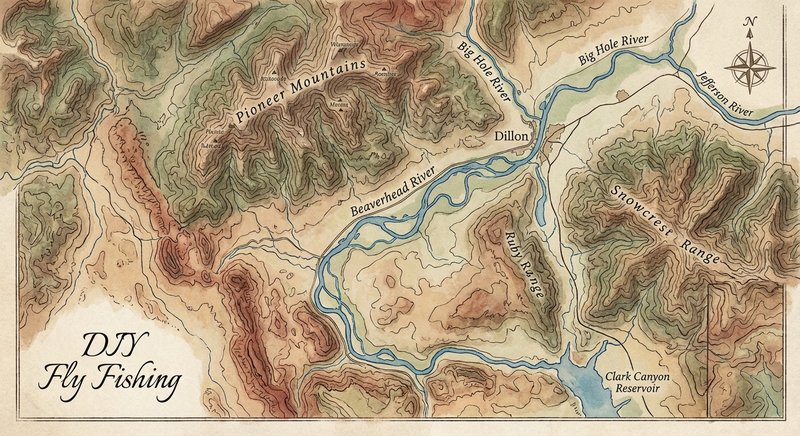
Beaverhead River
Fly fishing in Montana · Advanced · Best seasons: Spring, Summer, Fall
Target Species
Brown Trout, Rainbow Trout
About This Water
A technical tailwater known for large brown trout. The clear, cold water below Clark Canyon Dam produces fish over 20 inches regularly.
Fishing Recommendations
The Beaverhead River (or "The Beav") is a legendary Montana tailwater known for one thing: massive density and size. While it may look like a humble, willow-lined creek in some stretches, it is arguably the most productive trout water in the state per mile. It is a technical, challenging, and incredibly rewarding river for the angler who doesn't mind tight quarters.
🎣 Location Overview
The Beaverhead flows out of Clark Canyon Dam near Dillon, Montana. It is a classic "tailwater trout factory," benefitting from consistent water temperatures and a massive biomass of aquatic insects.
The river is characterized by its narrow width, deep undercut banks, and dense "walls" of willows. Unlike the wide-open spaces of the Madison or the Yellowstone, the Beaverhead is intimate and claustrophobic. It is famous for "the willow slap"—the sound of your fly line hitting the brush behind you. Anglers love it because it holds some of the highest concentrations of trophy-sized Brown Trout in the lower 48.
🐟 Target Species & Behavior
- Brown Trout: The king of the Beaverhead. These fish are thick-bodied and notoriously strong. They hold tight against the undercut banks and deep under overhanging willows. They are opportunistic but wary, requiring precise presentations.
- Rainbow Trout: Found primarily in the faster riffles and "bubbles" at the heads of pools. While outnumbered by the Browns, the Rainbows here are exceptionally hard-fighting due to the constant current.
Behavior: During the summer irrigation season, the water is high and cold. Fish move into the "soft" water right against the banks or into the deep holes. They feed heavily on nymphs throughout the day, but will move to the surface for specific, intense hatches.
📅 Best Times to Fish
- Spring (Mid-April – Early June): Before the irrigation gates at the dam are fully opened, flows are lower and wading is much easier. Look for Mother’s Day Caddis hatches and excellent nymphing.
- Summer (July – August): This is prime time. The river is high (600–800 cfs), which keeps the water cold. This is the window for the legendary PMD (Pale Morning Dun) and Yellow Sally hatches.
- Fall (September – October): As irrigation demands drop, the water levels decrease. This is "trophy season." The Brown Trout become aggressive as they prepare for the spawn. Streamer fishing becomes the primary tactic.
- Daily Windows:
- Morning: Trico hatches (late summer).
- Mid-day: Peak PMD activity.
- Late Afternoon: Grasshoppers and terrestrials against the banks.
🪰 Recommended Flies & Techniques
Nymphing (The Bread & Butter)
About 80-90% of fish on the Beaverhead are caught on nymphs. Because the water is often discolored or "mossy," you need flies that stand out.
- Patterns:
- Sowbugs: Ray Charles (Grey, Tan, Pink), Firebead Soft Hackle Sowbugs.
- Scuds: Orange or Olive (Size 14-18).
- Mayflies: Split Case PMDs, Pheasant Tails, Psycho Prince.
- Attractors: San Juan Worms (Red or Wine), Mop Flies.
Dry Fly (Technical Precision)
- Patterns:
- PMDs: Sparkle Duns, Tilt-Wing PMDs (Size 16-18).
- Craneflies: The "Orange Crane Fly" is a Beaverhead staple in late summer.
- Terrestrials: Morrish Hoppers, Fat Alberts, and small Beetles.
- Technique: Use a short, accurate "poke" cast. You often only have a 2-foot window between willows to land your fly.
Streamers (For the Monsters)
- Patterns: JJ Special, Home Invader, Sparkle Minnow.
- Technique: "Pounding the banks." Cast as close to the willow roots as possible and give the fly an erratic, fleeing motion.
💡 Pro Tips & Local Knowledge
- The "High Bridge to Pipe Organ" Stretch: This is the most famous section of the upper river. It holds the highest fish counts but also sees the most pressure. If it’s crowded, head downstream toward Barretts.
- Short-Line Nymphing: You don't need to cast 50 feet. In fact, you shouldn't. Most fish are within 15 feet of you. Use a "high-stick" technique to keep your line off the complex currents.
- Heavy Tippet: Do not fish 6X here. The fish are too strong and the cover is too thick. Start with 3X or 4X for nymphs and streamers. Even for dry flies, try to stay at 5X.
- The "Beaverhead Side-Arm": Learn to cast side-arm and underhand. If you try a traditional overhead loop, you will spend half your day untangling your rig from the willow branches.
⚠️ Important Information
- Access: Much of the river flows through private land, but Montana’s Stream Access Law allows you to fish anywhere below the ordinary high-water mark. Access points like High Bridge, Pipe Organ, and Barretts are well-marked.
- Regulations: The Beaverhead has specific "Catch and Release" sections and restrictions on fishing from a boat. In the upper miles, you can use a boat for transportation, but you cannot fish from the boat—you must get out and wade. Always check the current Montana FWP Regulations.
- Wading Safety: The Beaverhead is deceptively powerful. The bottom is slick and the current is heavy during the summer. A wading staff is highly recommended.
- Permits: A valid Montana Fishing License and Conservation License are required.
Guide’s Final Word: The Beaverhead is not a beginner's river—it will test your patience and your casting. But if you can master the "willow slap" and find the right sowbug pattern, you have a legitimate chance at a 24-inch Brown Trout on every single cast.
Bug Hatches & Matching Flies
| Hatch | Type | Peak months | Time of day | Hook sizes | Matching flies |
|---|---|---|---|---|---|
| Midges Chironomidae | midge | February, March, April | All Day | #18-24 | Zebra Midge #18-22, Griffith's Gnat #20-22, Morgan's Midge #20-24 |
| Blue-Winged Olives (BWO) Baetis | mayfly | April, May, September, October | Late Morning/Afternoon | #18-22 | RS2 #18-22, Parachute Adams #18-20, Baetis Nymph #18-20 |
| Pale Morning Dun (PMD) Ephemerella excrucians | mayfly | June, July, August | Late Morning/Early Afternoon | #16-18 | Split Case PMD #16-18, Sparkle Dun #16-18, PMD Cripple #16-18 |
| Yellow Sally Isoperla | stonefly | June, July | Afternoon/Evening | #14-16 | Yellow Sally Dry #14-16, Jim's Yellow Sally #14-16 |
| Caddis Hydropsyche / Glossosoma | caddis | May, June, July | Evening | #14-18 | Elk Hair Caddis #14-16, Peeping Caddis #14-16, LaFontaine's Deep Sparkle Pupa #16-18 |
| Trico Tricorythodes | mayfly | July, August, September | Early Morning | #20-24 | Trico Spinner #20-24, Sunray Trico #22-24 |
| Crane Fly Tipulidae | terrestrial | August, September | All Day | #8-12 | Foam Crane Fly #10-12, Crane Fly Larva #8-10 |
| Terrestrials Formicidae / Gryllidae | terrestrial | July, August, September | Afternoon | #8-18 | Morrish Hopper #8-12, Cinnamon Ant #16-18, Black Beetle #14-16 |