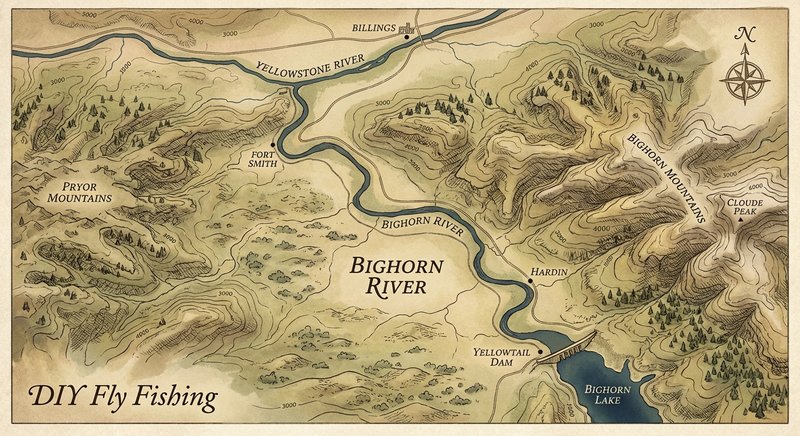
Bighorn River
Fly fishing in Montana · Beginner · Best seasons: Spring, Summer, Fall, Winter
Target Species
Brown Trout, Rainbow Trout
About This Water
A tailwater fishery with consistent temperatures year-round, producing large brown and rainbow trout. Excellent midging opportunities in winter.
Fishing Recommendations
The Bighorn River in Fort Smith, Montana, is often referred to as a "trout factory." It is one of the most productive tailwater fisheries in the world, boasting staggering fish counts—often exceeding 3,000 to 5,000 trout per mile. As an expert guide, I can tell you that while the Bighorn is prolific, it is also a "Ph.D. water" where technical precision often separates a good day from a legendary one.
🎣 Location Overview
The Bighorn River flows from the bottom of Yellowtail Dam through the high plains of the Crow Indian Reservation. Because it is a tailwater, the water temperature remains relatively stable year-round (cool in summer, warm in winter), creating a massive biomass of aquatic insects and crustaceans.
The river is characterized by its crystal-clear water, lush emerald-green weed beds, and long, glassy glides. It lacks the classic "bouldery" pocket water of the Gallatin or Madison; instead, it features sweeping bends, deep slots, and side channels. Anglers love the Bighorn because it offers a rare trifecta: massive numbers of fish, high average size (15–18 inches), and world-class dry fly opportunities.
🐟 Target Species & Behavior
- Brown Trout: The kings of the Bighorn. They favor the "bucket" spots, undercut banks, and the edges of the thick weed beds. During the fall spawn, they become aggressive, but during the summer, they are notorious for sipping tiny Tricos in the flats.
- Rainbow Trout: Known for their incredible strength and "hot" runs. You’ll find them in the faster riffles and at the heads of the islands. They tend to be less shy than the browns and will often hold in shallower, oxygenated water.
Behavior Note: These fish are highly educated. Because the river sees a lot of drift boat traffic, the trout are accustomed to boats and fisherman. They aren't easily spooked by a boat passing by, but they are extremely sensitive to poor presentations and thick tippet.
📅 Best Times to Fish
The Bighorn is a year-round fishery, but each season offers a different game:
- Spring (March – May): This is "Midge and BWO" season. Late March and April offer excellent Baetis (Blue Winged Olive) hatches. It’s also the best time for nymphing with scud patterns before the moss gets too thick.
- Summer (July – August): The "Golden Age" of the Bighorn. July brings the PMD (Pale Morning Dun) hatch, followed by the legendary Trico hatch in August. Expect technical dry fly fishing to rising pods of fish.
- Fall (September – November): My personal favorite. The crowds thin out, the Brown trout are in their vibrant spawning colors, and the BWO hatches return. Streamer fishing becomes very effective as the Browns get territorial.
- Winter (December – February): For the hardy angler. The first 3 miles below the dam rarely freeze. You’ll have the river to yourself, and the nymphing remains consistent with midge larvae and sowbugs.
🪰 Recommended Flies & Techniques
Nymphing (The Primary Producer)
Nymphing is the most effective way to rack up numbers here.
- Top Patterns: Ray Charles (Grey, Tan, Pink), Firebead Soft Hackle Sowbugs, Scuds (Orange or Pink), and the "Bighorn Special."
- Technique: Use a 9ft 5wt or 6wt rod. The "Bighorn Twitch"—a very subtle lift of the rod tip at the end of the drift—often triggers a strike. Use enough weight to get the fly down quickly, but be prepared to clean "moss" off your flies every few casts.
Dry Fly (The Purest Experience)
- Top Patterns: Parachute Adams (size 18-22), Sparkle Duns (PMD), and the Trico Female/Spinner (size 22-24). For midges, use a Griffith’s Gnat or a Mother’s Day Caddis in the spring.
- Technique: Long leaders (12–15 feet) and light tippet (6X is standard for Tricos). You must lead the fish significantly; if you land the fly directly on their head, they will go down.
Streamers (The Trophy Hunter)
- Top Patterns: Thin Mints, Wooly Buggers (Olive/Black), and JJ Specials.
- Technique: Swing streamers through the deep holes or strip them tight against the banks from a drifting boat.
💡 Pro Tips & Local Knowledge
- The "Scum Line" is Your Friend: During the Trico hatch, look for "scum lines" (bubbles and foam) trapped in eddies. The spent spinners get trapped there, and the trout will line up to vacuum them in. It looks like a slow-motion feeding frenzy.
- Mind the Redds: In the fall, please do not walk on the gravelly "clean" spots in shallow water. These are spawning beds (redds). Stepping on them kills the next generation of trout.
- The Three-Mile Section: The stretch from the Afterbay to 3-Mile Access is the most crowded but holds the highest density of fish. If you want solitude, float the "Lower" from 13-Mile to Two Leggins, though the fish counts are lower.
- The "Bighorn Moss": The river is full of aquatic vegetation. If your indicator wiggles slightly, set the hook! But if you haven't had a bite in 10 minutes, check your flies. A tiny piece of moss on your hook will prevent any fish from biting.
⚠️ Important Information
- Access: The river is located within the Crow Indian Reservation. While the river itself is public under Montana law, the land surrounding it is private/tribal. Use the designated public access points: Afterbay, 3-Mile, and 13-Mile.
- Regulations: A Montana fishing license and an AIS (Aquatic Invasive Species) Prevention Pass are required. Always check the current Montana FWP regulations as special restrictions or "Hoot Owl" (temperature) closures can occur in late summer.
- Boat Etiquette: This is a heavy drift-boat river. If you are wading, be aware that boats have the right of way in the main channel, but polite rowers will give you space.
- Shuttles: Fort Smith is a tiny town centered entirely on the river. Several local shops (Bighorn Angler, Trout Shop) provide vehicle shuttles for a fee—this is essential for float trips.
Guide’s Final Word: Bring plenty of 6X tippet, a good pair of polarized glasses to spot fish in the weeds, and your patience. The Bighorn is a masterpiece of a river—treat it with respect, and it will reward you with the fish of a lifetime.
Bug Hatches & Matching Flies
| Hatch | Type | Peak months | Time of day | Hook sizes | Matching flies |
|---|---|---|---|---|---|
| Midges Chironomidae | midge | January, February, March, April | All day | #18-24 | Zebra Midge #18-22, Griffith's Gnat #20-22, Morgan's Midge #20-24 |
| Blue Winged Olives (BWO) Baetis | mayfly | April, May, September, October | Afternoon | #18-22 | RS2 #18-22, Parachute Adams #18-22, Pheasant Tail Nymph #18-20 |
| Pale Morning Dun (PMD) Ephemerella excrucians | mayfly | June, July, August | Late Morning to Mid-Afternoon | #16-18 | Split Case PMD #16-18, PMD Sparkle Dun #16-18, Rusty Spinner #16-18 |
| Tricos Tricorythodes | mayfly | August, September | Early Morning | #20-24 | Trico Spinner #20-24, Drowned Trico Spinner #20-22, Sunken Trico #22-24 |
| Little Tan/Black Caddis Hydropsyche / Brachycentrus | caddis | May, June, July | Evening | #14-18 | Elk Hair Caddis #14-18, LaFontaine's Deep Sparkle Pupa #14-16, X-Caddis #16-18 |
| Yellow Sallies Isoperla | stonefly | June, July | Late Afternoon/Evening | #14-16 | Yellow Sally Stone #14-16, Iron Lotus #16, Little Yellow Sloan #14-16 |
| Grasshoppers Acrididae | terrestrial | August, September | Mid-Day to Evening | #8-12 | Morrish Hopper #10-12, Rainy's Hopper #8-10, Parachute Hopper #12 |
| Scuds & Sowbugs Gammarus / Asellidae | crustacean | March, April, May, June, July, August, September, October, November, December | All day | #14-18 | Ray Charles #14-18, Firebead Soft Hackle Sowbug #16-18, Scud (Pink or Orange) #14-16 |