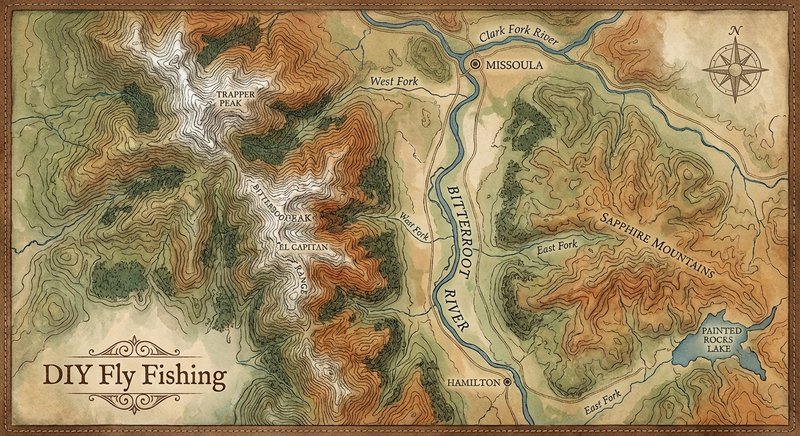
Bitterroot River
Fly fishing in Montana · Intermediate · Best seasons: Spring, Summer, Fall
Target Species
Rainbow Trout, Brown Trout, Cutthroat Trout
About This Water
Flowing through the Bitterroot Valley near Missoula. Excellent dry fly fishing for rainbow and brown trout.
Fishing Recommendations
The Bitterroot River is one of Montana’s true gems. Running north through a lush, scenic valley between the jagged Sapphire Mountains and the towering Bitterroot Range, "The Root" offers some of the most consistent dry fly fishing in the Rocky Mountain West.
As your guide, I’m here to break down how to fish this complex and rewarding river system.
🎣 Location Overview
The Bitterroot is unique because it is composed of three distinct sections: the West Fork, the East Fork, and the Main Stem.
- The West Fork: Tailwater-influenced, colder, and highly consistent. It’s a "fish factory" with high counts per mile.
- The East Fork: Smaller, more technical, and feels like a classic mountain stream.
- The Main Stem: Formed by the confluence of the two forks near Conner, it transforms into a larger, braided river with cottonwood-lined banks and deep woody debris.
What makes the Bitterroot special is its biomass. It has incredible insect diversity, leading to legendary hatches. Unlike the nearby Clark Fork or Blackfoot, the Bitterroot is often the first river to "turn on" in the spring, making it the epicenter of early-season fly fishing in Montana.
🐟 Target Species & Behavior
- WestSlope Cutthroat Trout: The crown jewel of the river. They are opportunistic, love dry flies, and generally hold in "soft" water—foam lines, eddy lines, and slow-moving bank water.
- Rainbow Trout: Found primarily in the faster riffles and oxygenated "heavy" water. They are the hardest fighters in the river and will often hold right at the head of a pool.
- Brown Trout: The river’s predators. They prefer structure—undercut banks, fallen logs (sweepers), and deep holes. To catch a trophy Bitterroot Brown, you often have to fish close to the "lumber."
- Mountain Whitefish: Abundant and a sign of a healthy river. They will take nymphs readily in the deep buckets.
📅 Best Times to Fish
Spring (March – May)
- The Window: Mid-March through April is legendary for the Skwala Stonefly hatch.
- Time of Day: 1:00 PM – 5:00 PM. The water needs to warm up a few degrees to trigger activity.
- Conditions: Look for overcast days for the best BWO (Blue Winged Olive) and March Brown hatches.
Summer (July – August)
- The Window: Post-runoff (usually late June) through August.
- Time of Day: Early morning (6:00 AM – 11:00 AM) is prime. Once the sun hits the water, the bite can slow down until the evening caddis flight.
- Conditions: High summer means Terrestrial Season. Hoppers, ants, and beetles are the name of the game.
Fall (September – October)
- The Window: September is prime for Hecubas (Great Red Quills) and October brings the massive October Caddis.
- Time of Day: Late morning through late afternoon.
- Conditions: Crisp mornings and warm afternoons. This is when the big Brown trout become aggressive as they prepare for the spawn.
🪰 Recommended Flies & Techniques
Dry Flies (The Bitterroot's Bread & Butter)
- Skwalas: Bullet Head Skwala (size 8-12), Pat’s Rubber Legs (dropper).
- Mayflies: Purple Haze (size 14-18), Parachute Adams, Sparkle Duns.
- Terrestrials: Morrish Hopper (tan/pink), Amy’s Ant, Black Ants (size 16).
- Caddis: Elk Hair Caddis (tan), Goddard Caddis.
Nymphing
- Patterns: Perdigons (Spanish Bullet), San Juan Worms (during high water), and the "Girdle Bug" (Pat's Rubber Legs) in coffee/black.
- Technique: Use a "hopper-dropper" rig in the summer to cover two columns of water. In the spring/fall, use a traditional indicator rig to get deep in the runs.
Streamers
- Patterns: Sparkle Minnow (gold/olive), Sex Dungeon (black or white).
- Technique: "Pounding the banks" from a drift boat. Cast tight to the wood and strip aggressively.
💡 Pro Tips & Local Knowledge
- The "Braids" Strategy: The Main Stem is full of islands and braids. Don't just stay in the main channel. The smaller side channels often hold the most cooperative Cutthroat trout and are easier to wade.
- The West Fork Cold Snap: If the Main Stem gets too warm in August (reaching 70°F), head to the West Fork. The bottom-release dam keeps the water in the 50s and 60s, keeping the fish active all day.
- Twitch Your Skwala: When fishing the Skwala hatch, don't be afraid to give your fly a tiny "skitter" or twitch. These stones are clumsy and move on the surface; the movement often triggers a violent strike.
- Stealth Matters: The Bitterroot is clear. Long leaders (9–12 feet) and 5X tippet are often necessary for the slower pools, especially for the wary Cutthroats.
⚠️ Important Information
Access
- Drift Boats: The Bitterroot is a premier float river. Popular ramps include Hannon Memorial, Woodside, and Florence.
- Wading: Montana has excellent stream access laws. You can wade anywhere below the high-water mark, provided you enter from a public bridge or FAS (Fishing Access Site).
Regulations
- Licenses: A Montana fishing license and a Conservation License are required.
- Catch & Release: While regulations vary by section, most local anglers practice 100% catch and release for trout to preserve the fishery.
- Safety: The Bitterroot is notorious for downed timber (sweepers). If you are rowing, be extremely cautious, especially during the spring. Logjams can shift overnight and create deadly strainers.
Final Guide Advice:
If you only have one day, fish the West Fork for numbers and scenery, or the Main Stem near Stevensville for a chance at a trophy Brown. Respect the river, watch for moose on the banks, and keep your fly on the water!
Bug Hatches & Matching Flies
| Hatch | Type | Peak months | Time of day | Hook sizes | Matching flies |
|---|---|---|---|---|---|
| Skwala Stonefly Skwala americana | stonefly | March, April | Late Morning/Afternoon | #8-12 | Pat's Rubber Leg #8-12, Skwala Stone #10-12, Bullet Head Skwala #10-12 |
| Blue Winged Olive (BWO) Baetis | mayfly | April, May, September, October | Late Morning/Afternoon | #16-20 | RS2 #18-20, Parachute Adams #16-20, Pheasant Tail Nymph #16-20 |
| March Brown Rhithrogena morrisoni | mayfly | April, May | Afternoon | #12-14 | March Brown Western Deceiver #12-14, Hare's Ear Nymph #12-14 |
| Salmonfly Pteronarcys californica | stonefly | June | All Day | #4-8 | Fluttering Salmonfly #4-6, Cat Puke #4-8, Girdle Bug #4-8 |
| Golden Stonefly Hesperoperla pacifica | stonefly | June, July | Morning/Evening | #8-12 | Chubby Chernobyl (Gold) #8-12, Golden Rogue Stone #10-12 |
| Pale Morning Dun (PMD) Ephemerella excrucians | mayfly | June, July, August | Morning/Afternoon | #14-18 | PMD Sparkle Dun #16-18, Rusty Spinner #14-18, Split Case PMD #16-18 |
| Green Drake Ephemerella grandis | mayfly | June, July | Afternoon | #10-12 | Green Drake Hairwing #10-12, 20 Incher Stone #10-12 |
| Trico Tricorythodes | mayfly | August, September | Early Morning | #20-24 | Trico Spinner #20-24, Sunken Trico Spinner #20-22 |
| Grasshoppers Acrididae | terrestrial | August, September | Late Morning/Afternoon | #8-12 | Morrish Hopper #8-12, Pink Pookie #10-12 |
| October Caddis Dicosmoecus gilvipes | caddis | September, October | Afternoon/Evening | #8-12 | Orange Stimulator #8-12, October Caddis Pupa #10-12 |