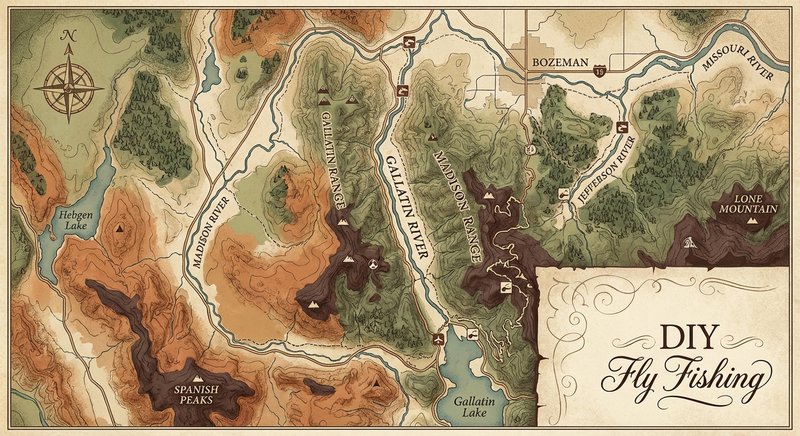
Gallatin River
Fly fishing in Montana · Intermediate · Best seasons: Summer, Fall
Target Species
Rainbow Trout, Brown Trout, Cutthroat Trout
About This Water
A freestone river flowing through scenic canyon country, offering pocket water fishing and excellent dry fly opportunities. Featured in 'A River Runs Through It'.
Fishing Recommendations
The Gallatin River is one of Montana’s most iconic blue-ribbon trout streams. Rising in the high peaks of Yellowstone National Park and carving a dramatic path through the Gallatin Canyon before spilling into the fertile Gallatin Valley, it offers a diverse range of water types. It is famous for its accessibility and its "walk-and-wade" purity—per Montana law, fishing from a boat is prohibited on much of the river, ensuring a fair playing field for every angler.
🎣 Location Overview
The Gallatin is a river of two personalities. The Canyon Stretch (from the Yellowstone Park boundary to the mouth of the canyon) is a classic freestone river characterized by tumbling pocket water, massive boulders, and crystalline riffles. It’s the quintessential mountain stream—fast, cold, and rugged.
Once it exits the canyon near Spanish Creek, the Valley Stretch slows down, becoming more braided with undercut banks and gravel bars. The river is incredibly productive, holding high fish counts per mile. Anglers love it because you can pull over almost anywhere along Highway 191 and find world-class trout water within a 30-second walk of your truck.
🐟 Target Species & Behavior
- Rainbow Trout: The most common resident. In the canyon, they hold in the "cushion" in front of large boulders or in the soft seams on the edges of fast current. They are opportunistic and known for their aerial acrobatics.
- Brown Trout: More prevalent in the lower Valley stretches and the deep, dark pools of the canyon. They are more nocturnal and predatory, often found tucked tight against undercut banks or logs.
- Westslope Cutthroat Trout: Primarily found in the upper reaches within Yellowstone National Park and the high canyon. They are notoriously surface-oriented and will often rise to a dry fly even when no hatch is present.
Feeding Behavior: Gallatin fish are generally "opportunistic." Because it is a cold freestone river with a shorter growing season, the fish can't afford to be too picky. However, during major hatches (Spruce Moths or Brachycentrus caddis), they can become very selective about profile and size.
📅 Best Times to Fish
Summer (Late June – August)
- Window: After the "Big Muddy" (runoff) subsides, usually around late June or early July.
- Prime Time: 9:00 AM to 2:00 PM for hatches; late evening for caddis activity.
- Condition: This is the peak of dry fly season. Look for the Salmonfly hatch in late June/early July, followed by Golden Stones and PMDs.
Fall (September – October)
- Window: This is many guides' favorite time. The crowds thin out, and the colors are spectacular.
- Prime Time: 11:00 AM to 4:00 PM. The water needs to warm up slightly to trigger insect activity.
- Condition: Low, clear water. This is the time for Blue Winged Olives (BWOs) on cloudy days and aggressive streamer stripping for pre-spawn Brown trout.
🪰 Recommended Flies & Techniques
Dry Flies
- Salmonflies (Early Summer): Rogue River Stone (#4-6), Cat’s Whisker.
- Attractors: Royal Wulff, Parachute Adams, and the Chubby Chernobyl (Gold, Red, or Royal) are staples here.
- Terrestrials (Late Summer): Morrish Hopper (#8-12), Gallatin Spruce Moth (#12-14) — the Spruce Moth is a local legend in August.
Nymphing
- Patterns: Pat’s Rubber Legs (Black/Tan), San Juan Worm, Pheasant Tail (#14-18), and the Lightning Bug (Silver or Gold).
- Technique: Use a "Dry-Dropper" rig in the canyon to cover the pocket water efficiently without tangling in the boulders.
Streamers
- Patterns: Woolly Bugger (Olive/Black), Sparkle Minnow, and the Gallatin-specific "Silk Kitty."
- Technique: "Pound the banks" in the lower valley or swing through deep pools in the canyon.
💡 Pro Tips & Local Knowledge
- The "Pocket Water" Secret: Most anglers bypass the fastest water. On the Gallatin, trout will sit in a pocket the size of a hula hoop behind a rock. Short, accurate casts with a high rod tip (Euro-style or high-sticking) will out-fish long casts every time.
- The Spruce Moth Hatch: In August, the canyon is home to a massive Spruce Moth outbreak. These tan moths fall into the water in the mornings. It is some of the most frantic dry fly fishing of the year. Use a tan Elk Hair Caddis if you don't have a specific moth pattern.
- Bridge Strategy: The water near the bridges (Greek Creek, Big Sky bridge) gets hammered. If you walk just 15 minutes away from a major turnout, the fish become significantly less "educated."
⚠️ Important Information
Access
- Highway 191: Follows the river for miles. Look for Fishing Access Site (FAS) signs.
- Yellowstone National Park: The upper miles are inside the park. You must have a separate Yellowstone National Park Fishing Permit; a Montana state license is not valid inside the park boundary.
Regulations
- No Fishing from Boats: You can use a raft to move from point A to point B in the canyon, but you must be out of the boat and standing on the bank or bed to cast.
- Catch and Release: While regulations vary by section, most local anglers and guides practice strict catch and release to preserve the high-density populations.
Special Considerations
- Safety: The Gallatin is notoriously slippery. The rocks are "greased" with algae. Felt-soled boots or studs, along with a wading staff, are highly recommended.
- Bears: You are in Grizzly Country, especially as you move toward the Park and the Taylor Fork area. Always carry bear spray and know how to use it.
Bug Hatches & Matching Flies
| Hatch | Type | Peak months | Time of day | Hook sizes | Matching flies |
|---|---|---|---|---|---|
| Salmonfly Pteronarcys californica | stonefly | June, July | All Day | #4-8 | Sofa Pillow #6-8, Pat's Rubber Leg #4-8, Fluttering Salmonfly #6-8 |
| Blue Winged Olive (BWO) Baetis | mayfly | April, May, September, October | Late Morning/Afternoon | #18-22 | Parachute Adams #18-22, Pheasant Tail #18-20, RS2 #20-22 |
| Mother's Day Caddis Brachycentrus | caddis | May | Late Morning/Afternoon | #14-16 | Elk Hair Caddis (Olive) #14-16, LaFontaine's Deep Sparkle Pupa #14-16, Peacock Caddis #14-16 |
| Pale Morning Dun (PMD) Ephemerella excrucians | mayfly | July, August | Morning | #16-18 | Sparkle Dun #16-18, Split Case PMD #16-18, Quigley Cripple #16-18 |
| Golden Stonefly Hesperoperla pacifica | stonefly | July | Morning/Afternoon | #8-12 | Chubby Chernobyl (Gold) #8-12, Golden Stone Nymph #10-12, Water Walker #10-12 |
| Spruce Moth Choristoneura occidentalis | terrestrial | August | Morning/Afternoon | #12-14 | Spruce Moth Dry #12-14, Elk Hair Caddis (Tan) #12-14 |
| Yellow Sally Isoperla | stonefly | July, August | Afternoon/Evening | #14-16 | Yellow Sally Foam Dry #14-16, Iron Lotus #14-16, Little Yellow Stone #14-16 |
| Midge Chironomidae | midge | February, March, April | Mid-day | #18-24 | Zebra Midge #18-22, Griffith's Gnat #18-22, Morgan's Midge #20-22 |