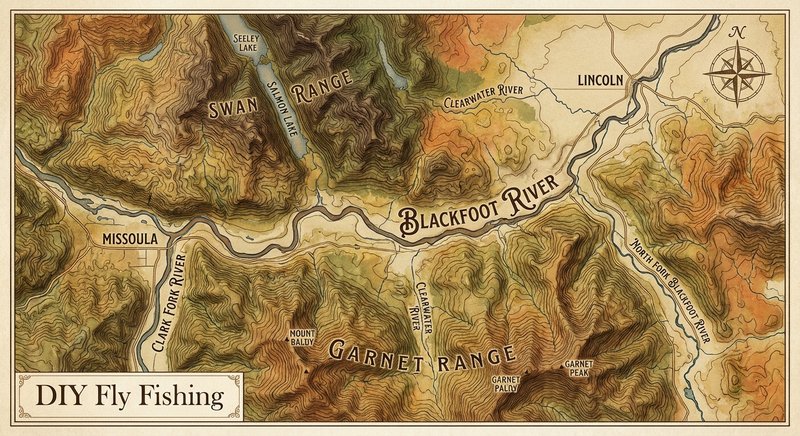
Blackfoot River
Fly fishing in Montana · Beginner · Best seasons: Summer, Fall
Target Species
Rainbow Trout, Brown Trout, Cutthroat Trout
About This Water
Made famous by Norman Maclean's writings, this scenic freestone river offers classic dry fly fishing in a pristine wilderness setting.
Fishing Recommendations
Welcome to the Big Blackfoot. Immortalized by Norman Maclean’s A River Runs Through It, this is one of Montana’s most storied and scenic freestone rivers. As your guide, I’m here to tell you that while the movie made it famous, the fishing is what keeps it legendary.
The Blackfoot is a high-gradient river characterized by massive boulders, deep turquoise pools, and exhilarating whitewater. It is a "pocket water" paradise that demands precise casting and rewards those who can read complex currents.
🎣 Location Overview
The Blackfoot River flows through a dramatic canyon carved by glacial floods, stretching from the Continental Divide down to its confluence with the Clark Fork near Missoula. Unlike the wide, flat valleys of the Madison or the Bitterroot, the Blackfoot feels rugged and intimate.
What makes it special is its freestone nature. There are no dams here; the river is wild and reactive to the snowpack. Anglers love it for the variety of water—you’ll fish everything from glassy glides to churning rapids where trout wait in the "buckets" behind house-sized rocks. It is also one of the best places in the lower 48 to catch large, native Westslope Cutthroat trout on dry flies.
🐟 Target Species & Behavior
- Westslope Cutthroat Trout: The crown jewel of the Blackfoot. They are opportunistic and famously "look up." They hold in softer water near the banks and in the tail-outs of pools.
- Rainbow Trout: Known for their aerial acrobatics, these fish love the heavy oxygenated water. Look for them in the "seams" where fast water meets slow water.
- Brown Trout: The river’s predators. Large Browns hold in the deep, dark woody debris or under the shadows of the canyon walls. They are most active during low-light conditions or during the fall spawn.
- Bull Trout (Protected): You may hook these massive native char while streamer fishing. Note: It is illegal to intentionally target them. If you hook one, keep it in the water and release it immediately.
📅 Best Times to Fish
While the river is open year-round, your requested window of Summer and Fall is truly the "Golden Era" on the Blackfoot.
Summer (Late June – August)
- The Salmonfly Hatch: Usually hits in late June. It’s chaotic, big-bug fishing.
- Terrestrial Season: July and August are prime for grasshoppers, ants, and beetles.
- Time of Day: Early morning is best as water temperatures rise. Mid-day is great for terrestrial "splat" fishing near the banks.
Fall (September – October)
- The Hecuba & Mahoganies: Large Hecuba mayflies provide some of the year's best dry fly action.
- Streamer Window: As temperatures drop in October, the big Browns become aggressive.
- Time of Day: Mid-morning to late afternoon. The "bank bite" stays hot all day as the sun warms the water.
🪰 Recommended Flies & Techniques
Top Fly Patterns
- Dry Flies:
- Salmonflies: Rogue River Stone (Size 4-6).
- Terrestrials: Morrish Hopper (Tan/Pink), Amy’s Ant, and Fat Albert.
- Mayflies: Parachute Adams (12-16), Purple Haze (14-18), Sparkle Dun.
- Nymphs:
- Pat’s Rubber Legs (the "Blackfoot Special") in black/brown.
- Prince Nymph, Pheasant Tail, and Jiggy Caddis (Size 14-16).
- Streamers:
- Dungeon (Olive/White), Sparkle Minnow, or a classic Black Bugger.
Techniques & Presentation
- The "Hopper-Dropper": This is the bread and butter of the Blackfoot. Use a high-floating foam hopper as your indicator and hang a weighted nymph (like a Copper John) 2–3 feet below it.
- Pocket Water Picking: Don't just cast into the middle. Cast into the "cushion" in front of boulders and the "slack" behind them.
- Skating the Fly: During the Salmonfly or Spruce Moth hatches, don't be afraid to give your dry fly a little twitch or skate it across the surface.
💡 Pro Tips & Local Knowledge
- Respect the "Bucket": On the Blackfoot, a hole the size of a hula hoop can hold a 20-inch fish. If you see a calm spot behind a rock in the middle of a rapid, hit it.
- The "Inside Turn": In the canyon stretches, most people fish the deep outside bends. Experienced guides know that Cutthroats often move to the shallow, inside gravel bars to feed on insects washing in.
- Spruce Moths: In late July/August, keep an eye on the trees. If you see white moths fluttering, switch to a cream-colored Tan Caddis or a dedicated Spruce Moth pattern. The fishing can be hysterical.
- Stretches to Focus On:
- River Junction to Scotty Brown Bridge: Great for floating and scenic canyon walls.
- Whites Gap to Roundup: Classic pocket water and excellent wading access.
⚠️ Important Information
- Access: Montana has excellent stream access laws. You can wade anywhere below the ordinary high-water mark, but you must enter through public access points (FWP Fishing Access Sites).
- Regulations: The Blackfoot has specific catch-and-release regulations for certain species (especially Cutthroats and Bull Trout). Always check the Montana FWP current regulations before hitting the water.
- Wading Safety: This river is slippery and powerful. Felt soles (where legal) or studded boots and a wading staff are highly recommended.
- Bear Safety: This is Grizzly country. Always carry bear spray on your person (not in your pack) and know how to use it.
Guide’s Final Word: The Blackfoot is a river of moods. One day she’s generous, the next she’s stubborn. Keep your fly moving, stay light on your feet, and remember: “Eventually, all things merge into one, and a river runs through it.” Tight lines!
Bug Hatches & Matching Flies
| Hatch | Type | Peak months | Time of day | Hook sizes | Matching flies |
|---|---|---|---|---|---|
| Salmonfly Pteronarcys californica | stonefly | June | All Day | #4-8 | Rogue River Stone #4-6, Pats Rubber Legs #4-8, Cat Puke #6 |
| Golden Stonefly Hesperoperla pacifica | stonefly | June, July | Morning/Afternoon | #8-12 | Chubby Chernobyl (Gold) #8-12, Golden Twenty Incher #10-12 |
| Spruce Moth Epinotia meritana | terrestrial | August | Morning | #12-16 | Spruce Alibi #14, Parachute Spruce Moth #12-14 |
| Pale Morning Dun Ephemerella invaria/excrucians | mayfly | June, July | Late Morning/Afternoon | #14-18 | Sparkle Dun #16-18, Pheasant Tail #14-18, Parachute PMD #16 |
| October Caddis Dicosmoecus gilvipes | caddis | September, October | Afternoon/Evening | #8-12 | Orange Stimulator #8-10, Morrish October Caddis Pupa #10 |
| Blue Winged Olive Baetis spp. | mayfly | April, May, September, October | Afternoon | #18-22 | BWO Parachute #18-20, RS2 #20, JujuBaetis #18-22 |
| Mother's Day Caddis Brachycentrus occidentalis | caddis | May | Afternoon | #14-16 | Peacock Caddis #14-16, Deep Sparkle Pupa #14-16 |
| Grasshoppers Orthoptera | terrestrial | August, September | Late Morning/Afternoon | #6-12 | Morrish Hopper #8-12, Pink Pookie #10 |
| Trico Tricorythodes spp. | mayfly | August, September | Early Morning | #20-24 | Trico Spinner #20-22, Sunken Trico Spinner #22 |