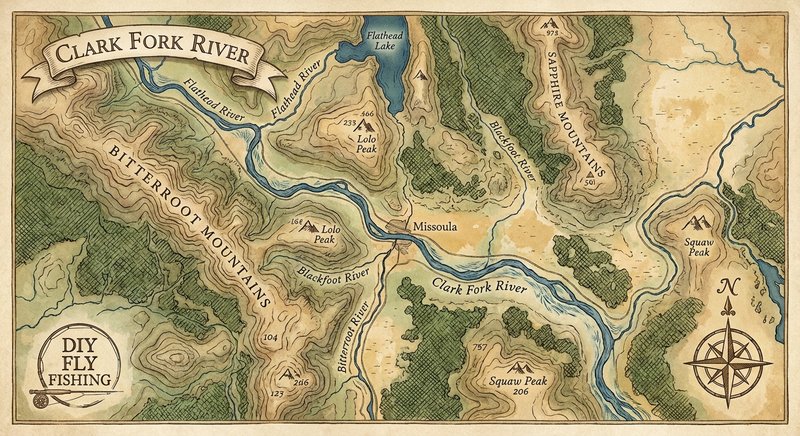
Clark Fork River
Fly fishing in Montana · Beginner · Best seasons: Spring, Summer, Fall
Target Species
Brown Trout, Rainbow Trout
About This Water
A recovering river now producing excellent fishing. Large brown trout and beautiful scenery make this an emerging destination.
Fishing Recommendations
Welcome to the "Working Man’s River." As a guide, I consider the Clark Fork one of the most diverse and rewarding fisheries in Montana. Stretching from its headwaters near Warm Springs all the way to the Idaho border, it offers everything from technical spring creek-style stalking to big-water drift boat missions.
Here is your comprehensive guide to fly fishing the Clark Fork River.
🎣 Location Overview
The Clark Fork is the largest river in Montana by volume, and its recovery is one of the greatest conservation success stories in the American West. Once plagued by mining runoff, it is now a thriving, prolific trout fishery.
What makes it special is its diversity of character.
- The Upper Clark Fork (Warm Springs to Missoula): Meandering, meadow-filled, and characterized by undercut banks and willow-lined reaches. It feels intimate and "fishy."
- The Middle Clark Fork (Missoula area): Where the river gains volume. This is prime "big water" dry fly territory, especially after the confluence with the Blackfoot River.
- The Lower Clark Fork (Below Missoula): Large, powerful, and scenic. This section is known for pods of rising fish in massive slicks and deep runs.
🐟 Target Species & Behavior
While the river holds Westslope Cutthroat and Bull Trout, your primary targets are Rainbows and Browns.
- Rainbow Trout: These are the "rocket ships" of the Clark Fork. They prefer highly oxygenated water—look for them in the heads of riffles, bubbly seams, and fast runs. They are notorious for long runs and acrobatic jumps.
- Brown Trout: The "predators" of the river. They hold in the shadows. Look for them against the "tight" banks (right against the grass), under submerged logs, or in the deep, slow pools. During hatches, they will move into the flats to sip duns with minimal disturbance.
📅 Best Times to Fish
Spring (March – May)
- The Window: Late March through April is "Skwala Season." This is the first big hatch of the year.
- Conditions: Water is cold but warming. You’ll see Skwala Stoneflies and March Browns. If the "Mother's Day Caddis" hatch hits before runoff, it can be the best fishing of the year.
Summer (July – August)
- The Window: Post-runoff (usually late June) through August.
- Conditions: This is prime dry-fly season. Pale Morning Duns (PMDs) dominate July, followed by the famous Spruce Moth hatch in August. Tricos provide technical morning fishing for those who like small flies.
Fall (September – October)
- The Window: The "local's favorite" season.
- Conditions: Cooler water temps trigger aggressive feeding. You'll see Mahogany Duns and Blue Winged Olives (BWOs). This is also the best time to throw large streamers for trophy Brown Trout as they prepare to spawn.
🪰 Recommended Flies & Techniques
Dry Fly Fishing (The Gold Standard)
The Clark Fork is a dry-fly paradise.
- Patterns: Skwala Stones (size 8-10), Chubby Chernobyls (Gold/Tan), Parachute Adams (14-18), Spruce Moths (12-14), and Tilt-Wing Mahogany Duns.
- Technique: Use a long leader (9-12ft) to avoid spooking fish in the flat water. Target the "seam lines" where fast water meets slow water.
Nymphing
When fish aren't rising, go deep.
- Patterns: Pat’s Rubber Legs (the "standard"), Jig-head Pheasant Tails, and Zebra Midges.
- Technique: A "Hopper-Dropper" rig is incredibly effective in July and August. Hang a heavy nymph 3-4 feet under a high-floating foam grasshopper.
Streamer Stripping
- Patterns: Dungeon (Olive/Black), Sparkle Minnows, and Bow River Buggers.
- Technique: Pound the banks from a moving boat. In the fall, a slow "swing" through deep tail-outs can produce massive Browns.
💡 Pro Tips & Local Knowledge
- The Spruce Moth Phenomenon: In August, the Clark Fork experiences a unique hatch of Spruce Moths (they look like tan caddis). Unlike other hatches that happen in the evening, this is a mid-day dry fly event. Look for pine trees near the water; the moths fall in, and the fish go crazy.
- The "Walking Speed" Rule: The Clark Fork has a lot of "flat" water. Beginners often skip it, but experts know this is where the biggest fish reside. If the water is moving at the speed of a casual walk, look for subtle "rings" on the surface—those are big fish sipping tiny insects.
- Wind Strategy: Missoula can be windy. If the wind picks up, don't go home. Switch to a heavier fly (like a Hopper) and a shorter leader. The wind often blows terrestrials (grasshoppers/ants) into the water, triggering a feeding frenzy.
⚠️ Important Information
Access
Montana has excellent stream access laws. You can fish anywhere below the high-water mark, provided you enter from a legal access point (bridges or FWP Fishing Access Sites).
- Popular Launches: Kelly Island, Kona Bridge, and Tarkio (for the lower river).
Regulations & Permits
- License: You need a Montana Fishing License and a Conservation License.
- Hoot Owl: In late July/August, water temperatures can rise. Check for "Hoot Owl" restrictions, which close fishing from 2:00 PM to midnight to protect stressed fish.
- Bull Trout: If you accidentally hook a Bull Trout (they are protected), you must keep it in the water and release it immediately.
Safety
The Clark Fork is powerful. If you are wading, use a wading staff. If you are floating, be wary of "Alberton Gorge"—it contains Class III-IV whitewater and should only be navigated by expert rowers or via guided whitewater rafts.
Bug Hatches & Matching Flies
| Hatch | Type | Peak months | Time of day | Hook sizes | Matching flies |
|---|---|---|---|---|---|
| Skwala Stonefly Skwala americana | stonefly | March, April | Mid-day/Afternoon | #8-12 | Pat's Rubber Leg #8-12, Skwala Chubby Chernobyl #10-12, Bullet Skwala #10-12 |
| Salmonfly Pteronarcys californica | stonefly | June | All day | #2-6 | Fluttering Salmonfly #4-6, Cat Puke #4-6, Picket Pin #4-8 |
| Pale Morning Dun (PMD) Ephemerella excrucians | mayfly | June, July | Late Morning/Early Afternoon | #16-18 | Sparkle Dun #16-18, Split Case PMD #16-18, Last Chance Emerger #16-18 |
| Tricos Tricorythodes | mayfly | July, August, September | Early Morning | #20-24 | Trico Spinner #20-24, Drowned Trico Spinner #20-22, Sunken Trico #20-24 |
| Blue Winged Olive (BWO) Baetis | mayfly | April, May, September, October | Mid-day/Overcast | #18-22 | BWO Parachute #18-20, Pheasant Tail #18-22, RS2 #20-22 |
| Mother's Day Caddis Brachycentrus occidentalis | caddis | May | All day | #14-16 | Elk Hair Caddis #14-16, LaFontaine's Deep Sparkle Pupa #14-16, Peacock Caddis #14-16 |
| Golden Stonefly Hesperoperla pacifica | stonefly | June, July | Morning/Evening | #8-12 | Golden Chubby Chernobyl #8-12, Water Walker #10-12, Rubber Leg Stone #8-12 |
| Spruce Moth Choristoneura occidentalis | terrestrial | July, August | Morning/Afternoon | #12-14 | Spruce Moth Dry #12-14, Tan Elk Hair Caddis #12-14 |
| Grasshoppers Acrididae | terrestrial | August, September | Afternoon | #8-12 | Morrish Hopper #8-12, Pantone Hopper #10-12, Dave's Hopper #8-12 |
| Midges Chironomidae | midge | February, March, November | Mid-day | #18-24 | Griffith's Gnat #18-22, Zebra Midge #18-22, Morgan's Midge #20-24 |