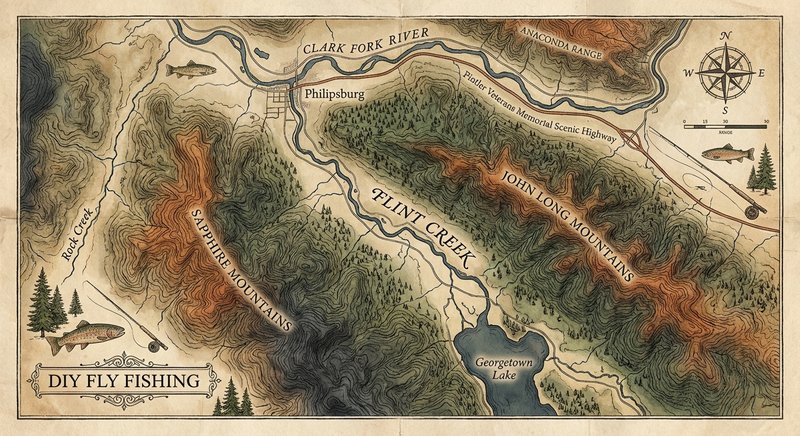
Flint Creek
Fly fishing in Montana · Beginner · Best seasons: Summer, Fall
Target Species
Brown Trout, Rainbow Trout
About This Water
Near Philipsburg with wild brown and rainbow trout. Scenic Flint Creek Valley fishing.
Fishing Recommendations
Flint Creek is one of Montana’s best-kept secrets. Flowing from the spillway of Georgetown Lake down through the lush Flint Creek Valley to its confluence with the Clark Fork River near Drummond, this is a "textbook" meadow stream. It offers intimate, technical, and highly rewarding fishing for anglers who prefer stalking undercut banks over casting from a drift boat.
🎣 Location Overview
Flint Creek is a mid-sized tributary that punches well above its weight class. Because it is fed by the nutrient-rich waters of Georgetown Lake, it functions much like a spring creek. The water stays relatively cool and is incredibly fertile, supporting a massive biomass of insects and crustaceans.
The creek is characterized by tight oxbow bends, deep undercut banks, and dense willow linings. It is not a wide river; in many places, you can jump across it, but don't let the size fool you. The deep "buckets" and overhanging brush hide surprisingly large trout. Anglers love it because it requires stealth, precision, and a "hunter’s mindset."
🐟 Target Species & Behavior
- Brown Trout: The primary draw. Flint Creek Browns are notorious for hiding deep under the overhanging willows and sod banks. They are predatory and territorial.
- Rainbow Trout: Found more frequently in the swifter riffles and the oxygenated water at the head of pools. They tend to be more opportunistic feeders than the Browns.
Behavior: These fish are spooky. Because the water is often clear and the creek is narrow, they will dart for cover at the sight of a shadow or the vibration of a heavy footstep. They feed heavily on subsurface scuds and sowbugs year-round, but look to the surface during the prolific summer hatches.
📅 Best Times to Fish
Summer (July – August)
This is the "Golden Era" on Flint Creek. Once the spring runoff subsides (usually late June), the dry fly action begins.
- Prime Windows: Early morning for tricos; evening for caddis.
- Conditions: Low, clear water. This is peak Hopper season.
Fall (September – October)
The most underrated time to fish. The Brown trout become aggressive as they prepare for the autumn spawn.
- Prime Windows: 11:00 AM to 4:00 PM.
- Conditions: Look for overcast days which trigger Blue Winged Olive (BWO) hatches and embolden the larger Browns to leave their undercut fortresses.
🪰 Recommended Flies & Techniques
Top Fly Patterns
- Dries:
- Hoppers: Morrish Hopper (size 10-12), Pink Pookie, or Tan Chubby Chernobyl.
- Mayflies/Caddis: Parachute Adams (14-18), Elk Hair Caddis (14-16), Sparkle Dun (16).
- Nymphs:
- The "Must-Haves": Ray Charles (Grey or Tan, size 14-18) and Firehole Soft Hackle Scuds.
- General: Pheasant Tail (16-18), Zebra Midge (18-20), San Juan Worm (red).
- Streamers:
- Small and articulated: Olive or Black Woolly Buggers, or a Baby Gonga. Keep them under 3 inches.
Effective Techniques
- The "Hopper-Dropper": In the summer, a buoyant hopper with a weighted sowbug or scud dropped 18-24 inches below is the deadliest setup on the creek.
- Stealth Nymphing: Use a small, sensitive indicator or "tight-line" the deeper holes.
- Dapping: Sometimes the willows are too thick to cast. Experienced guides will literally poke the rod tip through the brush and "dap" a dry fly on the surface.
💡 Pro Tips & Local Knowledge
- Stay Low and Move Slow: Before you reach the bank, crouch down. If you can see the fish, they have likely already seen you. Wear earthy tones (camo or drab green) to blend into the willows.
- Focus on the "Outside Bends": The current carves deep under the bank on the outside of every turn. Your fly needs to be within inches of the grass to trigger a strike.
- The "Power Line" Stretch: There is excellent public access near the town of Hall and various bridge crossings. The stretch near the "Allendale" area is also highly productive.
- Tailwater Influence: Remember that the upper reaches are influenced by the dam at Georgetown Lake. If the lake is "turning over" or releasing high water, the clarity can change quickly.
⚠️ Important Information
- Access: Montana’s Stream Access Law is generous, but Flint Creek flows through many private ranches. You must enter at public bridges or fishing access sites (FAS). Once in the water, stay below the ordinary high-water mark.
- Wading: The bottom can be silty and "mucky" in the meadow sections. Be careful not to get stuck in the soft mud.
- Regulations: Flint Creek falls under the Western District regulations. Generally, it is open year-round, but always check the current Montana FWP Fishing Regulations for seasonal closures or "Hoot Owl" (temperature) restrictions in late summer.
- Wildlife: This is moose and bear country. While you are focused on the water, keep an eye on the thick willow brush—moose love this drainage.
Guide’s Final Word: Flint Creek isn't about high fish counts or long-distance casting. It's about the puzzle. Solving the riddle of a 19-inch Brown Trout tucked under a willow in a stream only six feet wide is one of the greatest thrills in Montana fly fishing.
Bug Hatches & Matching Flies
| Hatch | Type | Peak months | Time of day | Hook sizes | Matching flies |
|---|---|---|---|---|---|
| Skwala Stonefly Skwala americana | stonefly | March, April | Midday | #8-12 | Skwala Chubby Chernobyl #10-12, Pat's Rubber Leg #8-12, Bullet Head Skwala #10-12 |
| Blue Winged Olive Baetis spp. | mayfly | April, May, September, October | Late Morning/Afternoon | #18-22 | RS2 #20-22, Parachute Adams #18-22, Pheasant Tail Nymph #18-20 |
| Mother's Day Caddis Brachycentrus occidentalis | caddis | May | All Day | #14-16 | Peacock Caddis #14-16, Holy Grail #14-16, Z-Wing Caddis #14-16 |
| Pale Morning Dun Ephemerella excrucians | mayfly | June, July | Morning/Early Afternoon | #16-18 | Sparkle Dun #16-18, Split Case PMD #16-18, Quigley Cripple #16-18 |
| Yellow Sally Isoperla spp. | stonefly | June, July | Afternoon/Evening | #14-16 | Little Yellow Sloan #14-16, Iron Sally #14-16, Yellow Stimulator #14-16 |
| Trico Tricorythodes spp. | mayfly | August, September | Early Morning | #20-24 | Trico Spinner #22-24, Sunken Trico Spinner #20-22, Drowned Trico #22-24 |
| Grasshoppers Orthoptera | terrestrial | July, August, September | Late Morning/Afternoon | #8-14 | Morrish Hopper #10-12, Pantone Hopper #12-14, Dave's Hopper #8-12 |
| Spotted Sedge Hydropsyche spp. | caddis | July, August | Evening | #14-18 | Elk Hair Caddis #14-18, LaFontaine's Deep Sparkle Pupa #14-16, X-Caddis #16-18 |