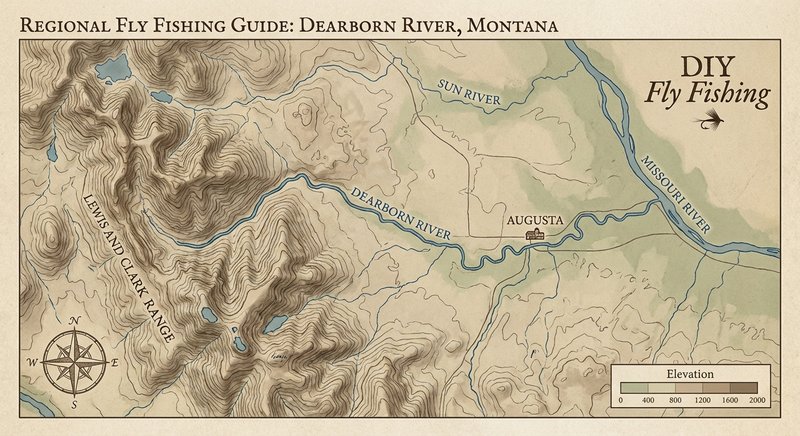
Dearborn River
Fly fishing in Montana · Intermediate · Best seasons: Summer, Fall
Target Species
Rainbow Trout, Brown Trout
About This Water
Wild and Scenic River near Augusta. Rainbow and brown trout in stunning canyon scenery.
Fishing Recommendations
The Dearborn River is one of Montana’s best-kept secrets—a stunning, semi-remote tributary of the Missouri River that carves through dramatic limestone canyons and rolling ranch land. It is often overshadowed by its famous neighbor, the Missouri, but for the angler seeking solitude and quintessential "Big Sky" scenery, the Dearborn is incomparable.
Here is your comprehensive guide to fly fishing the Dearborn River.
🎣 Location Overview
The Dearborn River is a "freestone" river, meaning its flow is dictated by snowpack and rainfall rather than dam releases. It originates in the Scapegoat Wilderness and flows southeast through spectacular towering limestone cliffs—often referred to as the "Gates of the Mountains" style geology—before joining the Missouri River near Craig, MT.
What makes the Dearborn special is its wild character. Much of the river is inaccessible by road, requiring either a float (during high water) or significant hiking (during low water). The water is crystal clear, and the scenery is some of the most dramatic in the state. Because it is a freestone river, it provides a much different experience than the "tailwater" feel of the Missouri; it is smaller, more technical, and feels much more intimate.
🐟 Target Species & Behavior
The Dearborn is primarily a Rainbow Trout and Brown Trout fishery. You may also encounter the occasional Westslope Cutthroat in the upper reaches.
- Rainbow Trout: These are the most common residents. They tend to hold in the faster oxygenated water—riffles, heads of pools, and pocket water behind large boulders. They are known for being opportunistic and hard-fighting.
- Brown Trout: The Dearborn holds some surprisingly large Brown Trout, especially in the lower sections near the confluence with the Missouri. These fish are more predatory and secretive. They hold in the deep "emerald" pools, under undercut banks, and near woody debris.
- Feeding Behavior: In early summer, they are aggressive feeders on stoneflies and caddis. By late summer, they become "hopper-focused," looking toward the banks for terrestrial insects blown in from the surrounding grasslands.
📅 Best Times to Fish
The Dearborn is a "seasonal" river. Unlike the Missouri, which fishes year-round, the Dearborn has a specific window.
- Optimal Months: June (late) through September.
- Summer (Late June – July): This is the prime window. As the spring runoff recedes, the "Salmonfly" and "Golden Stonefly" hatches occur. This is the only time the river is typically deep enough to float.
- Fall (September – October): The water is too low for boats, but the wade fishing is spectacular. The Brown Trout begin to move and become more aggressive as they prepare for the spawn.
- Best Time of Day: During the heat of summer, the "Trico" hatch occurs in the early morning (7 AM – 11 AM). For terrestrial fishing (hoppers), the afternoon heat (1 PM – 5 PM) is best as the wind picks up.
🪰 Recommended Flies & Techniques
Top Fly Patterns
- Dries:
- Chubby Chernobyl (Size 8-12) in Gold, Royal, or Purple.
- Morrish Hopper (Size 10-14) in Tan or Pink.
- Elk Hair Caddis (Size 14-18) for evening rises.
- Parachute Adams (Size 16-20) for technical sips in flat water.
- Nymphs:
- Pat’s Rubber Legs (Size 8-12) in Olive/Brown.
- Pheasant Tail (Size 14-18) - a staple for the Dearborn.
- Perdigons (Size 16-18) in Silver or Blue for fast-sinking in canyon pools.
- Streamers:
- Sculpzilla (Size 4-8) in Olive.
- Wooly Bugger in Black or Thin Mint.
Techniques
- The "Hopper-Dropper": This is the bread and butter of the Dearborn. Hang a weighted nymph (like a Pheasant Tail) 2-3 feet below a buoyant foam grasshopper. It allows you to cover two zones of the water column.
- Pocket Water Picking: Use a short line and high-stick technique to fish the small "pockets" behind rocks. Fish in the Dearborn love to sit in the soft water right behind a mid-stream boulder.
- Canyon Streamer Stripping: In the deep limestone pools, cast a streamer toward the rock wall and use jerky, aggressive strips to entice the larger Browns out of the shadows.
💡 Pro Tips & Local Knowledge
- The "Dearborn Float" Window: You can only float the Dearborn in a raft or drift boat during a very short window (usually mid-June to early July). Once the USGS gauge at Highway 287 drops below 400-500 CFS, it becomes a "drag-your-boat" nightmare.
- The High-Wall Shadow: In the deep canyons, the sun disappears early. Focus your dry fly fishing on the seams where the shadow meets the sunlight; trout use this transition zone for cover.
- Walk the Confluence: The mile of water where the Dearborn meets the Missouri is a "trophy zone." Big Missouri River Browns often move up into the cooler, clearer Dearborn water during the summer heat.
- Watch the Rattlesnakes: The Dearborn canyon is prime rattlesnake habitat. When hiking the banks in the summer, wear high wading boots and keep your eyes on the rocks.
⚠️ Important Information
Access
- Highway 287 Bridge: A popular launch point and wade access.
- Lowry Bridge: Provides access to the middle section.
- Montana Stream Access Law: You can fish anywhere on the river as long as you stay below the ordinary high-water mark. However, the banks are almost entirely private ranch land. Do not trespass above the high-water line.
Regulations & Permits
- License: A valid Montana Fishing License and Conservation License are required.
- Regulations: Generally follows the Western District regulations, but always check the current MT FWP Regulations for seasonal closures or "Hoot Owl" (temperature) restrictions.
Special Considerations
- Remote Nature: There are very few services near the river. Ensure you have a full tank of gas, plenty of water, and a spare tire. Cell service is spotty to non-existent once you drop into the canyon.
- Bear Country: While not as grizzly-dense as the Glacier area, Black Bears and the occasional Grizzly do frequent the Dearborn corridor. Carry bear spray.
Bug Hatches & Matching Flies
| Hatch | Type | Peak months | Time of day | Hook sizes | Matching flies |
|---|---|---|---|---|---|
| Skwala Stonefly Skwala americana | stonefly | March, April | Afternoon | #8-12 | Skwala Stone Dry #10-12, Pat's Rubber Legs (Olive/Brown) #8-12, Bullet Head Skwala #12 |
| Blue Winged Olive Baetis | mayfly | April, May, September, October | Midday | #18-22 | Parachute Adams #18-22, Pheasant Tail Nymph #18-20, BWO RS2 #20-22 |
| Mother's Day Caddis Brachycentrus occidentalis | caddis | May | All day | #14-16 | Elk Hair Caddis (Olive) #14-16, Peeping Caddis #14-16, LaFontaine's Deep Sparkle Pupa #14-16 |
| Golden Stonefly Hesperoperla pacifica | stonefly | June, July | All day | #8-12 | Chubby Chernobyl (Gold) #8-12, Clark's Stone #10-12, Golden Stone Nymph #8-12 |
| Pale Morning Dun Ephemerella excrucians | mayfly | June, July | Morning/Afternoon | #16-18 | Sparkle Dun #16-18, PMD Cripple #16-18, Military May #16-18 |
| Spruce Moth Choristoneura occidentalis | terrestrial | July, August | Morning/Midday | #12-14 | Spruce Moth Dry (Tan/Cream) #12-14, Fluttering Spruce Moth #14, Elk Hair Caddis (Cream) #12-14 |
| Grasshoppers Acrididae | terrestrial | August, September | Midday/Afternoon | #8-12 | Morrish Hopper #10-12, Tan Thunder Thighs #10-12, Letort Hopper #12 |
| Trico Tricorythodes | mayfly | August, September | Early Morning | #20-24 | Trico Spinner #20-22, Sunray Trico #22-24, Zebra Midge #20-22 |