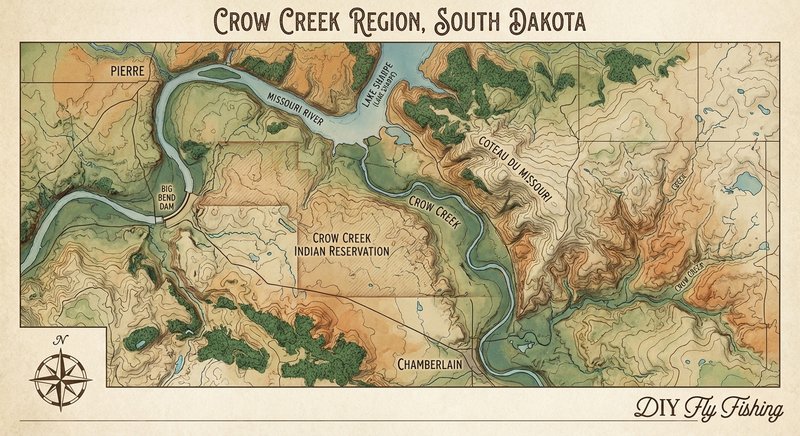
Crow Creek
Fly fishing in South Dakota · intermediate · Best seasons: spring, summer, fall
Target Species
Brown Trout
About This Water
Black Hills stream with wild brown trout. Remote fishing in scenic setting.
Fishing Recommendations
Crow Creek, located in the northern Black Hills of South Dakota (near Spearfish and Belle Fourche), is a hidden gem that offers a classic spring-fed creek experience. Unlike the larger, more famous Black Hills streams like Rapid Creek or Spearfish Creek, Crow Creek is intimate, technical, and rewards the patient angler.
Here is your comprehensive guide to fly fishing Crow Creek.
🎣 Location Overview
Crow Creek is a quintessential spring creek. Because it is fed by groundwater, it maintains a relatively stable temperature year-round—staying cool in the heat of summer and rarely freezing solid in the winter.
What makes it special is its low-gradient, meadow-style character. It winds through agricultural land and grasslands, featuring deep undercut banks, overhanging tall grasses, and slow-moving glides. It is a "test" water; the fish are wild, the water is clear, and the banks are often "beedy" (sensitive to vibrations). If you can catch fish here, you can catch them anywhere.
🐟 Target Species & Behavior
The primary draw here is the Wild Brown Trout. While you may find an occasional rainbow, the creek is a stronghold for browns that have adapted perfectly to the spring-fed environment.
- Skittish Nature: These fish are highly sensitive to shadows and bank vibrations. Stealth is more important than casting distance.
- Holding Patterns: Look for fish tucked tight against undercut banks, under overhanging grass, or at the very tail-outs of pools during a hatch.
- Diet: Because it's a spring creek, the biomass is huge. The fish feast on Scuds (freshwater shrimp) and Sowbugs year-round. They also rely heavily on Midges, Blue-Winged Olives (BWO), and terrestrial insects in the summer.
📅 Best Times to Fish
Optimal Seasons
- Spring (March – May): Excellent BWO hatches. This is when the larger browns start to get active after the winter lull.
- Summer (June – August): The "Golden Era" for Crow Creek. This is terrestrial season (hoppers, ants, beetles).
- Fall (September – October): The most scenic time. Brown trout become aggressive as they prepare for the spawn. Use streamers to trigger territorial strikes.
Best Times of Day
- Low Light is Key: Brown trout are light-sensitive. The first two hours of light and the last hour before dark are the "magic windows."
- Overcast Days: A cloudy, drizzly day is the best gift a Crow Creek angler can ask for. The fish lose their spookiness and move into the center of the stream to feed.
🪰 Recommended Flies & Techniques
Top Fly Patterns
- Nymphs:
- Scuds & Sowbugs: Size 14-18 (Pink, Orange, or Olive). This is the "bread and butter."
- Zebra Midge: Size 18-22 (Black or Red).
- Pheasant Tail: Size 16-20 (Classic or Flashback).
- Dry Flies:
- Tricos: Size 22-24 (Morning hatches in late summer).
- Blue-Winged Olive (BWO): Size 18-20.
- Parachute Hopper: Size 10-14 (Tan or Yellow).
- Black Ants/Beetles: Size 16-18 (Highly effective near overhanging grass).
- Streamers:
- Woolly Buggers: Size 8-12 (Olive or Black).
- Gold Ribbed Hare's Ear Streamers.
Effective Techniques
- The "Crouch and Crawl": Approach the bank on your knees. If you can see the fish, they have likely already seen you.
- Dry-Dropper: A high-visibility hopper with a small Scud or Midge dropped 18-24 inches below it is the most effective way to cover water in the summer.
- Light Tackle: Use a 3-weight or 4-weight rod (8' to 8'6" is ideal) with a long leader (9-12 feet) tapering to 5X or 6X tippet.
💡 Pro Tips & Local Knowledge
- Mind the Banks: The banks of Crow Creek are often hollowed out. Walking heavily on the edge sends "thump" vibrations through the water, sending every trout into hiding. Stand 3-5 feet back from the water's edge when casting.
- The "Micro-Drag" Challenge: Because the current is slow and winding, micro-drag on your fly will result in a refusal every time. Work on your "reach cast" to ensure a natural drift.
- Look for the "V": In the slow glides, look for the subtle "V" wake of a cruiser. Instead of blind casting, wait for a rise or a movement and target that specific fish.
- The "McNasty" Factor: Some stretches are heavily overgrown with willow and hawthorn. Don't be afraid to bushwhack; the hardest-to-reach holes often hold the largest, least-pressured browns.
⚠️ Important Information
Access
- Public vs. Private: Much of Crow Creek flows through private ranch land. However, there are several South Dakota Game, Fish & Parks (GFP) Walk-In Areas and easements. Always look for the green and white signs.
- Respect the Land: Always close gates behind you and stay on designated paths to maintain good relationships with local landowners.
Regulations & Permits
- License: A valid South Dakota fishing license is required.
- Regulations: Check the latest SD GFP handbook. Generally, standard Black Hills trout limits apply, but many local anglers practice 100% Catch and Release on Crow Creek to preserve the wild brown trout genetics.
Special Considerations
- Rattlesnakes: During the summer months, the tall grass around Crow Creek is prime habitat for Prairie Rattlesnakes. Wear long pants/waders and watch where you step.
- Cows: You will likely be sharing the meadow with cattle. They are generally harmless but can muddy the water if they cross upstream of you. Simply move upstream of the herd.
Bug Hatches & Matching Flies
| Hatch | Type | Peak months | Time of day | Hook sizes | Matching flies |
|---|---|---|---|---|---|
| Blue-Winged Olive Baetis spp. | mayfly | April, May, September, October | Late Morning/Afternoon | #18-22 | Parachute Adams #18-22, RS2 #20-22, Pheasant Tail #18-20 |
| Trico Tricorythodes spp. | mayfly | July, August, September | Early Morning | #20-24 | Trico Spinner #20-24, Drowned Trico #22-24, Griffith's Gnat #20-22 |
| Pale Morning Dun Ephemerella invaria | mayfly | June, July | Late Morning/Afternoon | #16-18 | PMD Sparkle Dun #16-18, Split Case PMD #16-18, Hare's Ear #14-16 |
| Little Brown Caddis Lepidostoma spp. | caddis | May, June | Evening | #14-18 | Elk Hair Caddis #14-18, LaFontaine's Deep Sparkle Pupa #16-18, Holy Grail #16 |
| Midges Chironomidae | midge | January, February, March, December | All Day | #18-24 | Zebra Midge #18-22, Morgan's Midge #20-24, Top Secret Midge #20-22 |
| Grasshoppers Orthoptera | terrestrial | August, September | Afternoon | #8-12 | Morrish Hopper #8-12, Parachute Hopper #10-12, Dave's Hopper #10-12 |
| Cinnamon Ant Formicidae | terrestrial | July, August | Afternoon | #16-20 | Cinnamon Ant #16-20, Chernobyl Ant #12-14, Transparant #18 |
| Little Black Stonefly Capniidae | stonefly | February, March | Afternoon | #16-18 | Little Black Sloan #16-18, Copper John #16-18, Pats Rubber Legs #14-16 |