Crystal River
Fly fishing in Colorado · Intermediate · Best seasons: Summer, Fall
Target Species
Rainbow Trout, Brown Trout
About This Water
Scenic river near Marble and Redstone. Wild rainbow and brown trout in beautiful mountain setting.
Fishing Recommendations
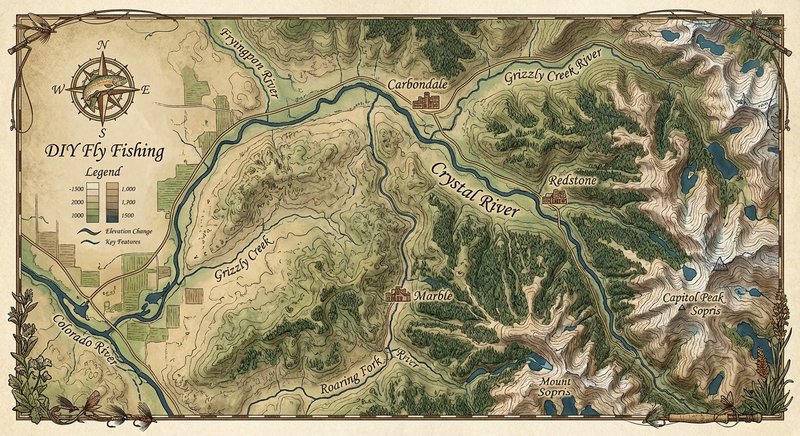
The Crystal River is one of Colorado’s hidden gems—a "wild" river in the truest sense. Flowing from the high peaks of the Elk Mountains near Marble down to its confluence with the Roaring Fork in Carbondale, the Crystal is one of the last major undammed rivers in the state.
As your guide, I’m excited to break down how to fish this spectacular, high-gradient freestone river.
🎣 Location Overview
The Crystal River is characterized by its dramatic scenery and crystal-clear (true to its name) water. Because it is undammed, it retains a natural hydrograph—meaning it experiences a massive spring runoff and very low, technical flows in the late fall.
The river transitions from a high-alpine stream near Marble to a classic "pocket water" canyon near Redstone, eventually widening as it approaches Carbondale. Anglers love it because it offers a more "rugged" experience compared to the nearby gold-medal waters of the Fryingpan or Roaring Fork. You won’t find many crowds here, but you will find eager, wild fish in a stunning red-rock canyon setting.
🐟 Target Species & Behavior
The Crystal is primarily a Rainbow and Brown Trout fishery, with the occasional Mountain Whitefish and Brook Trout in the upper reaches.
- Rainbow Trout: Found mostly in the faster water, current seams, and at the heads of riffles. They are opportunistic feeders and will often smash a well-presented dry fly.
- Brown Trout: These are the kings of the undercut banks and the deep, dark "buckets" behind large boulders. In the fall, they become more aggressive and territorial as they prepare to spawn.
- Behavior: Because the river is nutrient-poor compared to tailwaters, these fish aren't usually "PhD trout." They are fast strikers. If a meal passes by in the quick current, they have a split second to decide to eat.
📅 Best Times to Fish
While the Crystal can be fished year-round, your specified window of Summer and Fall is the absolute prime time.
- Summer (July – August): This is the post-runoff window. Once the river drops and clears (usually by early July), the fishing is electric. Expect heavy caddis hatches and excellent dry-fly action.
- Fall (September – October): My personal favorite time. The water is low and clear, the Cottonwoods are turning gold, and the Brown Trout are aggressive. The "Blue Winged Olive" (BWO) hatches on overcast days can be world-class.
- Time of Day: In the heat of summer, focus on the "t-shirt windows" (9:00 AM – 11:00 AM and 5:00 PM – dusk). In the fall, wait for the water to warm up slightly; 11:00 AM to 4:00 PM is the sweet spot.
🪰 Recommended Flies & Techniques
The Crystal is a "Dry-Dropper" paradise. Because of the rocky bottom, traditional deep nymphing can lead to a lot of snags.
Top Fly Patterns
- Dries:
- Chubby Chernobyl (Size 10-14) in gold, olive, or purple.
- Elk Hair Caddis (Size 14-18) in tan or peacock.
- Parachute Adams (Size 16-20) for technical sips.
- Amy’s Ant (Size 12) – a great attractor/terrestrial.
- Nymphs:
- Prince Nymph (Size 12-16) – The Crystal is famous for stoneflies.
- Frenchie or Pheasant Tail (Size 16-20) as a dropper.
- Pats Rubber Legs (Size 8-12) in coffee/black for high water.
- Streamers:
- Gold Beadheaded Woolly Bugger (Olive or Black).
- Near Nuff Sculpin.
Techniques
- The Dry-Dropper: Use a buoyant foam dry fly (like a Chubby) and hang a weighted nymph 18–30 inches below it. This allows you to fish the "pockets" without a heavy indicator spooking fish.
- Pocket Picking: Don't spend 30 minutes in one hole. Give a pocket 5–10 good drifts and move on. The active fish will show themselves quickly.
- The "Leisenring Lift": Near the end of your drift, let your nymphs swing up to the surface. This mimics an emerging insect and often triggers a violent strike.
💡 Pro Tips & Local Knowledge
- Watch the Redstone Reach: The stretch of river near the Redstone Castle is quintessential pocket water. Focus on the soft water behind "refrigerator-sized" boulders.
- The "Penny Hot Springs" Factor: There are natural hot springs right on the riverbank. In colder months, the water immediately downstream stays slightly warmer, which can keep fish active when the rest of the river is sluggish.
- The Stealth Approach: Because the water is so clear, especially in the fall, wear earthy tones (greens/browns) and avoid "lining" the fish (casting your fly line directly over their heads). Approach a hole from downstream and cast up.
- Look for "Ledges": The geology of the Crystal creates natural rock ledges. Fish will often sit right on the lip of these ledges waiting for food to drop over.
⚠️ Important Information
- Access: Much of the Crystal River flows through private land, especially between Redstone and Carbondale. Look for US Forest Service access points and "Public Fishing" signs. Use an app like onX Fish to stay legal.
- Regulations: Standard Colorado fishing regulations apply (8 fish limit, though we strongly encourage Catch and Release to preserve this wild fishery). Always check the current CPW (Colorado Parks and Wildlife) brochure for seasonal updates.
- Safety: The Crystal is steep and the rocks are notoriously slippery (round "bowling ball" rocks). I highly recommend felt-soled wading boots or studs, and a wading staff is a life-saver here.
- Be Bear Aware: This is deep canyon country. It is common to see Black Bears, especially in the fall when they are foraging near the bushes. Carry bear spray and keep your eyes peeled.
Tight lines on the Crystal! It’s a river that demands respect but rewards the adventurous angler with some of the prettiest trout in the Rockies.
Bug Hatches & Matching Flies
| Hatch | Type | Peak months | Time of day | Hook sizes | Matching flies |
|---|---|---|---|---|---|
| Midges Chironomidae | midge | January, February, March, December | Late Morning/Afternoon | #18-24 | Zebra Midge #18-22, Griffith's Gnat #20-22, Top Secret Midge #20-24 |
| Blue-Winged Olive (BWO) Baetis | mayfly | April, May, September, October | Late Morning/Afternoon | #18-22 | RS2 #18-22, Parachute Adams #18-22, Pheasant Tail #18-20 |
| Mother's Day Caddis Brachycentrus | caddis | May | All Day | #14-16 | Peeping Caddy #14-16, Elk Hair Caddis (Dark) #14-16, LaFontaine's Deep Sparkle Pupa #14-16 |
| Green Drake Drunella doddsii | mayfly | July, August | Afternoon/Evening | #10-12 | Colorado Green Drake #10-12, 28-Incher #10-12, Quigley's Drake Hackle Stacker #10-12 |
| Pale Morning Dun (PMD) Ephemerella | mayfly | June, July, August | Morning/Early Afternoon | #16-18 | CDC PMD Sparkle Dun #16-18, Split Case PMD #16-18, Barr's PMD Emerger #16-18 |
| Golden Stonefly Hesperoperla pacifica | stonefly | June, July | All Day | #8-12 | Pat's Rubber Legs #8-12, Chubby Chernobyl #8-12, Cat Puke #10-12 |
| Yellow Sally Isoperla | stonefly | July, August | Afternoon/Evening | #14-16 | Yellow Stimulator #14-16, Iron Cherry #14-16, Little Yellow Sloan #14-16 |
| Red Quill Cinygmula | mayfly | August, September | Afternoon | #12-14 | Red Quill Dry #12-14, Hare's Ear (Dark) #12-14, Mercer's Missing Link #14 |