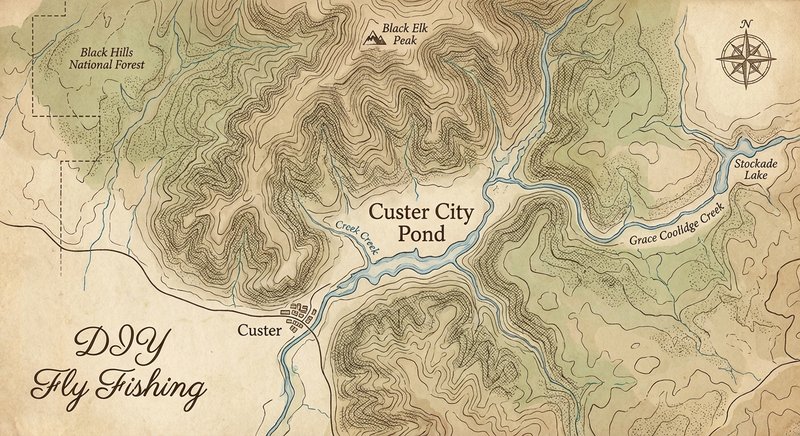
Custer City Pond
Fly fishing in South Dakota · beginner · Best seasons: spring, fall
Target Species
Rainbow Trout
About This Water
Town pond with stocked trout. Convenient access in Custer.
Fishing Recommendations
As an expert guide familiar with the Black Hills region of South Dakota, I can tell you that Custer City Pond (often referred to locally as the Custer City Park Pond) is one of the most accessible and rewarding "community" fisheries in the state. While it’s located right in the heart of town, it offers surprisingly high-quality angling for those who know how to approach it.
Here is your comprehensive guide to fly fishing Custer City Pond.
🎣 Location Overview
Custer City Pond is a small, spring-fed impoundment located within the Custer City Park. What makes this water special is its accessibility and consistent stocking program managed by the South Dakota Game, Fish and Parks (GFP). Unlike the rugged, brush-heavy creeks of the Black Hills, the pond offers wide-open casting lanes, making it an ideal spot for beginners to practice their loop or for veterans to enjoy a relaxing evening.
The water is generally clear but can develop weed growth in the warmer months. It features a manicured shoreline, a fishing pier, and easy walking paths. It is a "Gateway Water," meant to provide high success rates, but the larger "holdover" rainbows can become quite wary and selective, offering a legitimate challenge.
🐟 Target Species & Behavior
While you may find the occasional panfish, the star of the show is the Rainbow Trout.
- Behavior: These fish are a mix of recent stockies and "holdovers" that have survived several seasons. The recent stockables are aggressive and will chase flashy attractors. The holdovers, however, behave more like wild fish—they cruise the weed edges and the deeper center channel looking for midge hatches and scuds.
- Holding Zones: Look for fish cruising the perimeter about 10–15 feet from the bank. They often hang near the inflow area (where oxygen is higher) and around the submerged vegetation where aquatic insects live.
- Diet: Their primary diet consists of midges (year-round), scuds (freshwater shrimp), small leeches, and the occasional terrestrial (ants/beetles) that falls from the park trees.
📅 Best Times to Fish
- Optimal Seasons:
- Spring (April - June): This is prime time. As the ice melts and the water warms into the 50s, the trout become highly active. This coincides with heavy stocking schedules.
- Fall (September - November): As temperatures drop, the trout move from the deeper center of the pond back to the shorelines. The colors of the Black Hills are stunning during this window.
- Best Times of Day:
- Early Morning: From dawn until about 9:00 AM is the "Golden Hour" for dry fly activity.
- Evening: The hour before sunset often sees a prolific midge hatch, leading to consistent surface rising.
- Prime Conditions: Overcast, slightly breezy days are excellent. A light ripple on the water hides your leader and makes the trout less "spooky" in the clear water.
🪰 Recommended Flies & Techniques
Top Fly Patterns
- Nymphs/Larvae:
- Zebra Midge (Size 18-22) in black, red, or olive. This is the #1 producer here.
- Gold-Ribbed Hare’s Ear (Size 14-16) for general bugginess.
- Ray Charles or Scud patterns (Size 16) in pink or orange.
- Dry Flies:
- Griffith’s Gnat (Size 18-22) to imitate clusters of midges.
- Parachute Adams (Size 16-20) for general hatches.
- Streamers/Attractors:
- Woolly Bugger (Size 10-12) in Olive or Black.
- Balanced Leech (Size 12) under an indicator.
Effective Techniques
- The "Hanging" Nymph: Use a small strike indicator. Suspend a Zebra Midge or Scud about 3–5 feet below the surface. Give the indicator a tiny twitch every 30 seconds to provide a "lifelike" movement.
- The Slow Strip: Cast a Woolly Bugger toward the center, let it sink for 5 seconds, and use very slow, 2-inch strips. This imitates the leeches that are common in the pond’s silty bottom.
- Dry-Dropper: In the spring, a size 16 Parachute Adams with a tiny midge trailer 18 inches below is deadly for covering both surface and subsurface feeders.
💡 Pro Tips & Local Knowledge
- The "Inflow" Secret: On the north end where the small spring/drainage enters the pond, the water is more oxygenated. This is a magnet for fish during the warmer days of late spring.
- Lighten Your Tippet: Because the water is clear and the pond gets a fair amount of pressure, fish can be "leader shy." Drop down to 5X or 6X fluorocarbon tippet to increase your hook-up rate significantly.
- Move Frequently: If you don't see rises or get a hit in 15 minutes, walk 30 yards down the bank. These trout cruise in "pods." If you find the pod, you'll have a banner day.
- Stealth Matters: Even though it’s a city park, don’t stomp on the bank. Vibrations travel through the water. Stay back a few feet from the edge when casting.
⚠️ Important Information
- Access: Very easy. Located in Custer City Park off Grendane Ave. Ample parking, restrooms, and picnic tables are available.
- Regulations: A valid South Dakota Fishing License is required for anyone 16 and older.
- Limits: Check current SD GFP regulations for daily trout limits, as they can change seasonally. Custer City Pond is generally under statewide general regulations.
- Lead-Free: While not strictly mandated in all SD ponds, using non-lead weights is a "best practice" in community parks to protect local waterfowl like ducks and geese that frequent the area.
- Catch and Release: If you plan to release your fish, use barbless hooks and try to keep the fish in the water, as stocked rainbows can be fragile.
Guide’s Final Take: Custer City Pond is the perfect "warm-up" spot before heading into the deeper backcountry of the Black Hills. It’s a great place to dial in your midge game and enjoy a classic South Dakota afternoon.
Bug Hatches & Matching Flies
| Hatch | Type | Peak months | Time of day | Hook sizes | Matching flies |
|---|---|---|---|---|---|
| Chironomids (Midges) Family Chironomidae | midge | April, May, September, October | All Day | #18-24 | Zebra Midge #18-22, Griffith's Gnat #20-24, Ice Cream Cone #16-20 |
| Callibaetis (Speckled Duns) Callibaetis ferrugineus | mayfly | June, July, August | Late Morning | #14-16 | Callibaetis Spinner #14-16, Hare's Ear Nymph #14-16, Parachute Adams #14-18 |
| Damselfly Enallagma spp. | terrestrial | June, July | Midday | #10-14 | Marabou Damsel Nymph #10-12, Adult Damsel #12-14 |
| Cinnamon Sedge Family Leptoceridae | caddis | July, August | Evening | #14-18 | Elk Hair Caddis (Tan) #14-18, LaFontaine's Emerger #16-18 |
| Grasshoppers Family Acrididae | terrestrial | August, September | Afternoon | #8-12 | Dave's Hopper #10-12, Parachute Hopper #10-14 |
| Black Carpenter Ants Camponotus pennsylvanicus | terrestrial | May, June, July | Afternoon | #14-18 | Black Foam Ant #14-18, Chernobyl Ant #12-14 |
| Water Boatmen Family Corixidae | terrestrial | September, October | Afternoon | #14-18 | Water Boatman #14-16, Prince Nymph #14-18 |
| Scuds (Freshwater Shrimp) Order Amphipoda | terrestrial | March, April, May | All Day | #12-18 | Ray Charles #14-18, Orange Scud #12-16 |