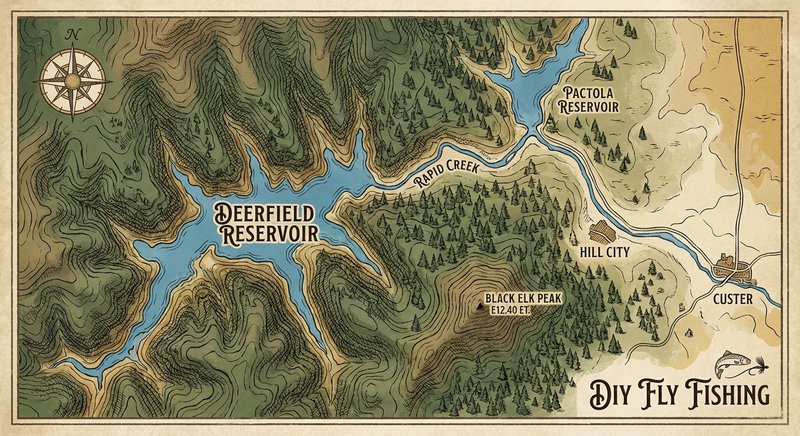
Deerfield Reservoir
Fly fishing in South Dakota · intermediate · Best seasons: spring, summer, fall
Target Species
Rainbow Trout, Brown Trout, Brook Trout
About This Water
High elevation Black Hills lake with trout. Scenic mountain setting.
Fishing Recommendations
Welcome to the high country of the Black Hills. As your guide, I can tell you that Deerfield Reservoir is widely considered the crown jewel of stillwater fly fishing in South Dakota. Situated at approximately 5,900 feet in elevation, it offers a distinct "alpine" feel that sets it apart from the lower-elevation lakes in the region.
Here is your comprehensive guide to fly fishing Deerfield Reservoir.
🎣 Location Overview
Deerfield Reservoir is a 435-acre impoundment located about 20 miles west of Hill City. What makes it special is its water quality and temperature. Because of its high elevation, Deerfield stays significantly cooler than other Black Hills lakes, allowing trout to remain active and near the surface even during the heat of summer.
The shoreline is a mix of ponderosa pine forests, rocky outcrops, and grassy flats. The water is remarkably clear, which presents a "sight-fishing" opportunity that is rare in the Midwest. Anglers love it because it offers a true "big water" experience where you can find genuine size and variety in a stunning mountain setting.
🐟 Target Species & Behavior
- Rainbow Trout: These are the most abundant. The state stocks "catchable" rainbows, but Deerfield is famous for its "holdovers"—fish that have survived several seasons and grown to 18–22 inches. They cruise the shorelines and weed edges.
- Brown Trout: The "ghosts" of the reservoir. Browns here can get quite large (20"+). They are more structure-oriented, often found near submerged timber or the rocky faces of the dam. They become highly aggressive in the fall.
- Brook Trout: Often found near the inlets (Castle Creek). They are smaller but exceptionally vibrant. They tend to hang in the colder, moving water where the creek enters the lake.
- Behavior: During the morning and evening, fish cruise the "shelf"—the transition zone where the shallow flats drop off into deep water. In the midday sun, they retreat to the 15–20 foot depths.
📅 Best Times to Fish
- Spring (May - June): This is prime time. As the ice melts (Ice-out is usually late April), fish are hungry and move into the shallows to warm up. The Chironomid hatches are massive in June.
- Summer (July - August): While other lakes slow down, Deerfield shines. Focus on early mornings (sunrise to 10:00 AM) and late evenings. Terrestrial fishing (hoppers) peaks in August.
- Fall (September - October): My personal favorite. Brown trout move toward the shorelines and inlets to spawn. The Brookies are in full color. The crowds disappear, and the fish are aggressive, bulking up for winter.
- Prime Window: The first two hours of daylight are critical for dry fly action.
🪰 Recommended Flies & Techniques
Top Fly Patterns
- Nymphs: Zebra Midges (size 18-22) in red or black, Ice Cream Cones, and Hare’s Ears.
- Dries: Parachute Adams (16-20), Callibaetis patterns, and Fat Alberts or Foam Beetles for summer terrestrials.
- Streamers: Pine Squirrel Leeches (black or olive), Woolly Buggers (size 8-12), and the Balanced Leech (highly effective under an indicator).
Effective Techniques
- Indicator Nymphing: This is the most productive method. Suspend a Balanced Leech or a Zebra Midge 4–8 feet below a slip-indicator. The wave action provides the movement.
- The "Slow Strip": Using an intermediate (slow-sink) line, cast a Woolly Bugger or a damsel fly nymph and retrieve with very short, 2-inch erratic strips.
- Dry-Dropper: During the summer, use a large Hopper as your "bobber" and hang a small pheasant tail nymph 3 feet below it.
💡 Pro Tips & Local Knowledge
- The Inlets are Key: Focus your energy where Castle Creek enters the reservoir on the west end. The moving water brings in oxygen and a steady stream of food. It is a magnet for Brookies and large Browns.
- The "Deerfield Wind": The wind almost always picks up by noon. Don't fight it—use it. Fish the "windward" shore where the waves are crashing. The turbulence stirs up insects and disorients baitfish, creating a feeding frenzy for larger trout.
- Float Tubes & Kayaks: While you can fish from the shore, a float tube or kayak is a game-changer here. It allows you to stay 30 feet off the weed line and cast back toward the shore, which is where the cruisers are.
- Sight Fishing: On calm mornings, walk the high banks on the north side. You can often spot 20-inch Rainbows cruising the flats. Lead them by 5 feet with a subtle midge presentation.
⚠️ Important Information
- Access: There are three main areas: Complex (near the dam), Custer Gulch, and Gold Run. All have good parking. The Deerfield Lake Loop Trail (10 miles) circles the entire lake, providing unparalleled foot access to remote spots.
- Regulations:
- A South Dakota fishing license is required.
- Check current GFP (Game, Fish & Parks) regulations, as there are specific creel limits for trout (typically 5 per day, but only 1 can be over 14").
- Boating: No-wake zones apply. This makes it very friendly for fly anglers in small watercraft.
- Weather: At 6,000 feet, weather changes fast. Even in July, bring a rain shell and a fleece. Lightning is a serious concern in the afternoons—if you hear thunder, get off the water immediately.
Tight lines, and enjoy the "High Country" of the Hills!
Bug Hatches & Matching Flies
| Hatch | Type | Peak months | Time of day | Hook sizes | Matching flies |
|---|---|---|---|---|---|
| Callibaetis (Speckled Duns) Callibaetis ferrugineus | mayfly | June, July, August | Late Morning/Afternoon | #12-16 | Parachute Callibaetis #14-16, Callibaetis Nymph #14-16, Callibaetis Cripple #14-16 |
| Chironomids (Midges) Chironomidae | midge | April, May, September, October | All Day | #16-24 | Zebra Midge #18-22, Ice Midge #18-20, Griffith's Gnat #20-24 |
| Trico Tricorythodes | mayfly | July, August, September | Early Morning | #20-24 | Trico Spinner #20-22, Trico Dun #20-22 |
| Pale Morning Dun Ephemerella excrucians | mayfly | June, July | Morning/Early Afternoon | #14-18 | PMD Sparkle Dun #16-18, Pheasant Tail Nymph #14-18 |
| Spotted Sedge Hydropsyche | caddis | July, August | Evening | #14-16 | Elk Hair Caddis #14-16, LaFontaine's Deep Sparkle Pupa #14-16 |
| Grasshoppers Acrididae | terrestrial | August, September | Afternoon | #8-12 | Joe's Hopper #10-12, Dave's Hopper #8-12, Morrish Hopper #10-12 |
| Flying Ants Formicidae | terrestrial | August, September | Afternoon | #16-20 | Black Flying Ant #16-18, Cinnamon Ant #16-20 |
| Blue Winged Olive Baetis | mayfly | May, September, October | Midday/Afternoon | #18-22 | BWO Parachute #18-22, RS2 #20-22 |